Saturday, April 14, 2012

It's All in the Name

Ardvreck, Ochil, Spittal of Glenshee, Tulloch, Brechin, Amulree, Glamis.  All are Scottish names of some of the most interesting places we’ve visited in the past 19 trips to the land of haggis, bagpipes, castles, and heather.  But what do the names mean?  Is there significance to the name of the Highland cascades called the Falls of Dochart?  This post is really a chance for me to highlight a new set of photos and photo technique in the guise of explaining the background of place names.  I’ll start my photo journey of Scotland in our home base of Crieff, Perthshire, central Scotland between Edinburgh and Glasgow.
The name Crieff comes from Old Scottish Craobh Cnoc meaning “Hill of Trees.”  The town originated as a trysting place (October cattle sale) which attracted drovers from all over Scotland.  It grew from the High Street up the knock (cnoc) or hill where the present Hydro Hotel and one of town’s golf courses resides.  The second largest town in Perthshire is now a perfect example of an historic Scottish village.  Just seven miles west of Crieff is another picturesque village, Comrie.
Right on the Highland Line, the division between the Highlands and the Lowlands and designating both the geographical and a social division of Scotland, Comrie is also known as Earthquake Central for its seismic activity.  In the 1830s, for example, local siesmologists recorded 7300 tremors “sometimes accompanied by a loud report and sulphureous smells.”   In fact, one of our favorite restaurants in the area is named Deil’s Cauldron (The Devil’s Cauldron).  The name Comrie comes from Scottish Gaelic comer meaning "river confluence"--at Comrie the Water of Ruchill, the River Lednook, and the River Earn all meet. A few miles up the road from Comrie is the Highland village of Killin (Cill Scottish Gaelic for “church” and fionn for “white”), home to one of the most scenic waterfalls in the country---the Falls of Dochart.  
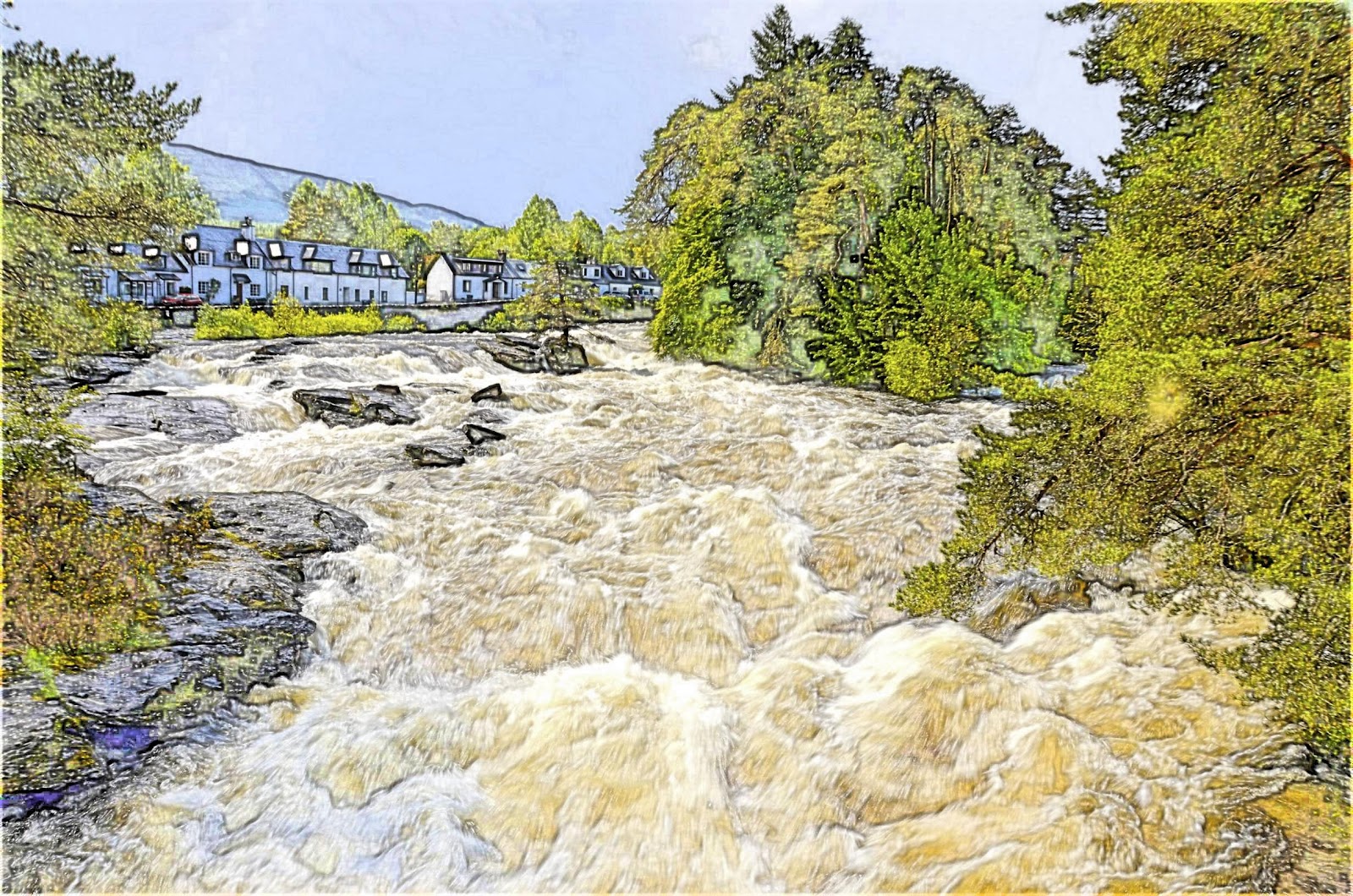
Especially in spate this Highland river cascade earns it name.  Dochart in Scottish Gaelic means “evil scourer,” and anyone seeing the river in full flow would know that anything in the water’s path would certainly be scoured.  Heading north from Crieff up through Sma’Glen (a tourist trade name for part of the Glen of Almond) will bring you to the hamlet of Amulree--a couple of houses, and old tearoom, a deteriorating hotel, and a church.
The Amulree Church and its spectacular setting is what takes us back to the spot originally called Ford of Maelruabha, a crossing point of the River Braan named for a 17th century missionary who became the area’s patron saint.   From Amulree we continue north to Aberfeldy (from aber meaning “river mouth” and feldy a reference to a 5th century missionary St Paldoc) then west past Loch Tay to Weem and Castle Menzies.
 Castle Menzies, ancestral home of Clan Menzies, is sited in the hamlet of Weems which in Scottish Gaelic means “cave.”  There are plenty of tales of Scottish cattle theives and reivers hiding in the local caves.  Traveling northeast from Crieff Glamis (glahmz) Castle is one of the major attractions.
Glamis Castle, the home of the Queen Mum and Queen Elizabeth’s childhood home, is a lovely castle named for its location.  Glamis in Scottish Gaelic means “wide gap,” which refers to the situation of the village in the center of a broad valley between Sidlaw Hills and the edge of the Highlands.   Two more sights with interesting names are half a country apart.  First is the village of Crail on the East Neuk of the Kingdom of Fife (the original and maybe official name for the county of Fife) about ten miles south of St Andrews.
Besides having its own challenging golf course, Crail is known for its picturesque small port.  In fact, the name Crail comes from Old Gaelic carr meaning “boulder.” The dangerous Carr Rocks lie three miles offshore in the Firth of Forth.  Last for this post we travel north and west to the other side of Scotland to visit one of the most photographed castles in the UK, Eilean Donan Castle on Donnan’s Isle.
Built on a small islet at the entrance to Loch Duich, this castle’s name comes from a simple combination of location and family names.  Eilean in Scottish Gaelic is “island” and Donan refers to the the Donnan family who were associated with the castle.  Whether from Old Gaelic, Scottish Gaelic, or family names, whether referring to places or saints, the names of Scotland’s sights add to and fuel our fascination with Scotland.
The next post on this blog will be from Scotland, where our friends in Crieff have been basking in wicked sunshine while we languish in waterlogged Oregon.  Wait to see if our first post talks about the rain we brought with us or the sun we snuck into.  Slainte!  (Scottish Gaelic for “Good Health.”)

Tuesday, March 27, 2012

Scottish Potpourri

Are You Here Again?
This spring’s trip to Scotland will be our twentieth since our first trip in September of 2000.  Friends, relatives, and even strangers ask why we go back to Scotland so often.  The answer is extremely simple and complex at the same time.  We love Scotland--the people and the land.  What makes that answer complex is when they ask, “Why do you love it; what is there about Scotland to love?”  The short answer to that question is that we love the history of the country and being able to visit that history whether it’s Stirling Castle, Bannockburn, Culloden, the Ring of Brodgar, or a local distillery.  Mostly though we love the people we met on our nineteen trips.
One special group is the people we’ve met on golf courses--over and over again.  At Tulliallan GC on Fife not far from Dunfermline we met George the first time we played the course.  He’s a prominent member of the course and we were introduced to him by the club secretary who was our host as we toured the course to write about it.  A year later we went back for a second visit and George caught up with us as we waited on the eighth tee for a slow group of blind golfers in front of us.  No joke, the golfers were all legally blind, though most had some sight.  They helped each other aim and then find their shots, and that’s why we ended up waiting a bit that day.  As we were standing on the eighth tee George came up and introduced himself and then said, “I remember, I met you last year.  You were writing about the course.”  We visited as George finished the round with us.  Fast forward two years.  Anne and I returned to Tulliallan to give them a copy of Hidden Gems II: Scotland and Wales.  As we were getting our gear together for a third round on the course, George came out of the clubhouse, spotted us, waved, and said, “You here again?”  What are the odds of seeing the same person (who doesn’t play the course every day) on the three days out of four years when we visit the course?  
                                  Tulliallan Golf Course

George isn’t the only repeat meeting we’ve had.  At St Fillans GC in Perthshire where we are members, we’ve run into the same English family (father, mother, handicapped adult daughter) five or six times over the years.  They visit the Perthshire area for a few days each year and we’ve managed to play golf with them (or in front or behind them) several times.  They’ve even become good customers, buying our books and promoting them to others.  
                                          St Fillans Golf Course

That’s a profitable repeat meeting. Several years ago we played Boat of Garten GC in the Highlands behind a group of four average golfers (not that we are that much better).  We waited quite a bit on that round.  The next day we were to play Fortrose and Rosemarkie GC on the Black Isle north of Inverness.  When we arrived we learned that we had been scheduled to play behind the same four chaps as the day before.  When they saw it was us going to follow them they kindly let us go first.  They said, “One day of slow play is enough.”   It was very nice of them, and we enjoyed our round and a bowl of soup in the clubhouse before they got finished.
In writing our three golf travel guides we’ve met more than two hundred secretaries, managers, professionals or captains of golf clubs.  It’s almost always a pleasure to meet these locally important people.  Several of them we’ve met more than once, and a few not in the same location.  One year we enjoyed a round and lunch in the company of Andrew Shinie, golf manager at Inchmarlo GC along the River Dee west of Aberdeen.  
                                  Andrew Shinie and Anne at Lunch, Inchmarlo GC

A year and a half later we were heading into the golf shop to check in for a round at Blairgowrie’s Lansdowne Course when we were hailed, “Bob and Anne.  Fancy seeing you here.”  It was Andrew who was no longer managing Inchmarlo, but was guiding golf tours of Scotland.  It seriously impressed us that after one meeting he would recognize us so quickly.  Bill Baird was managing Kingussie GC on the edge of the Highlands when we played the course.  A couple of years later we got a nice message from him about our first book which included Kingussie GC.  This past fall when we took a copy of our first book to Carrbridge GC in the Highlands the (volunteer) manager was the same Bill Baird who had retired from Kingussie GC.  He said, “I already have a copy of that book, but that was from a different course.”  At Gleneagles we had a special thrill when we were guided around the Queen’s Course by John Murray, the Gleneagles’ Head Teaching Professional.  A couple of years later we were surprised when we showed up to play Moray Old GC in the north of Scotland and the professional said, “I know you two.  We played together at the Queen’s.”  John had left Gleneagles to take the position of Head Professional at the Moray Golf Club.  We keep going back to Moray Old, one of our favorite courses, but keep missing John as he’s either off competing somewhere or on vacation.  We miss visiting with him, but we’re getting to know his able assistant pro, Andrew.
                                          Anne with John Murray at Gleneagles

Whether it’s the clerk in the local whisky shop in Crieff, the barber who trims my beard when we’re in Aviemore, or a golfer we’ve met before, we highly prize the Scots we meet more than once in our travels.
WHEN WE GO BACK IT’S NOT ALWAYS THE SAME
As I update our first Scotland travel guide, Scotland’s Hidden Gems: Golf Courses and Pubs, I am trying to check the accuracy of the information I put in the book.  We have replayed many of the courses to pick up any changes the course has made.  We’ve stayed again at several of the B&Bs so that we can be sure we note any differences.  When we can’t go to a place or talk with them we use the web to make sure the place is still open, or still owned by the same people, has the same menu, etc.  Even with all the checking we can still miss some.
 I have managed to discover some drastic changes  to make to the revised edition of the book.  For example, we are sorry to have to leave out the Taymouth Castle golf course in Kenmore at the edge of the Highlands.  I tried to book a round for this year’s spring trip, but found I couldn’t.  Ownership of the course has changed.  The new owners who also bought the castle (originally built for the Earl of Breadlebane in 1842) which has been abandoned for a couple of decades are refurbishing the castle into an upscale resort or condos.  They are also doing significant redesign work to the 1921 James Braid designed Taymouth Castle golf course.  The saddest part of all this is that the course will no longer be public, instead it will be for development owners and renters only.  They are now out of the book.  Another change we  have to make was discovered last autumn when we visited one of our favorite pubs, Kimberely’s Inn in Findhorn on the Morayshire coast in the north of Scotland.  We had played golf at Moray Golf Club, one of our favorites, and were looking forward to the great seafood chowder served at Kimberely’s.  The inn is still there but so were the flies.  The owner apologized and said something about their fly control system was waiting for the repairman.  He then wandered through the bar’s two rooms with a rolled newspaper swatting at and smashing on the tables the offending flies.  If that wasn’t unappealing enough, the chowder we got was watery, lacked flavor, and significantly lacked fish.  We left saying we would have to seriously rethink our recommendation.  We’ll give Kimberley one more chance, but our revised book tells readers to check with locals before planning to stop.  
                                             Storm Clouds over Findhorn Bay

Sometimes our checking isn’t enough.  We recommended Trevose B&B in Dornoch to our B&B family in Crieff when they were going north to play Royal Dornoch GC.  We had stayed several times and liked the B&B which has a lovely garden and is in perfect location next to the cathedral.  The report of our friends was disconcerting.  The bedrooms were shabby, cold, and not very clean.  The breakfast was average at best.  Everything about the place seemed tired, including the owner.  As we thought back to our last visit to Trevose a few years ago, we thought that everything was all right, but the owner had said she was thinking of retiring.  I guess she should have.  It too is now out of the book.  We try to check that our comments and recommendations are accurate, but with restaurants and B&Bs particularly things do change.  And in a few cases we couldn’t keep up with the changes.  
OPPS!  MISSED OPPORTUNITY.
On our first trip to the Isle of Arran, Scotland in Miniature between the Ayrshire coast and the Kintyre Peninsula, we took the tour of Isle of Arran Distillery in Lochranza in the northwest corner of the island.  We were early enough in our travels that we had taken tours at only two or three other distilleries--we’ve now taken tours at 31 distilleries in Scotland and Ireland.  The distillery tour was very interesting --Isle of Arran Distillery was quite new having opened in 1995--and we learned a great deal.  At one time there were more than 50 distilleries on the small island, most of them illegal, but now Isle of Arran is the only one.  As usual the distillery tour ended with a dram of the local product, in our case an eight year old Arran Single Malt.  We thought the whisky tasted a little young--most single malts are bottled after ten years more in oak casks--and decided not to buy a bottle.  We also passed up on a special offer to participate in a Cask Owner’s scheme: buy a cask (about 250 bottles when mature), and after ten or more years, sell the cask back to the distillery or bottle it for yourself.  The cost at that time was about $1200-1500, and even after paying excise duty and storage, after ten years there should be some profit, or so the sales pitch went.  We thought about it for a few moments, but decided we didn’t have that kind of money to throw away on a whim.
                                  Browsing the Whiskies

Fast forward ten years to 2012.  A cask of Arran Single Malt we could have bought for $1500 in 2002 would now bring about $15,000 when selling it back to the distillery.  That’s a thousand percent profit in ten years!  Where else could you find that kind of return on your investment?  The money may have sounded dear on that first visit, but the quality of the product and the reputation of the distillery would have turned a pretty profit.  Oh, if we had only.... 

Wednesday, February 15, 2012

Let's Eat

A “travel blog” is difficult to generate when I’m not traveling (and the two day visit to our timeshare on the Oregon coast doesn’t really count).  We have now, though, paid for our spring tickets to Scotland and reserved our main B&B.  I have a list of golf courses I want to visit and some new-to-us historic sites to visit.  [Would “new historic sites” be an oxymoron?]  With the planning for our spring trip already begun, I feel ready to tackle a couple of travel topics in this blog entry.  
Gastro Pubs
From one extreme (Anderson’s Restaurant in Boat of Garten, Scotland)

to the other (a roadside stand near Perth, Scotland)

and this entry is about those places in between (Kippin Inn near Stirling, Scotland).

The vision of the local tavern/bar as a dark, dank, smelly, smoke-filled, beer-splattered  drinking establishment frequented by society’s dregs and losers is a B-grade film noir scene even in America.  (Bar in Ballyferriter, Ireland.)

Oh, you can find those bars about in the inner cities, but local taverns have never really been like that, at least not in my 66 years.  In Scotland, though, local pubs have been a breed different from even the American local tavern.  When we began touring Scotland in 2000 we discovered that the village pub was closer to our cafe or greasy spoon than to any local tavern.  The pub was truly a public house--a place for people to meet, share a pint, a dram, or a coffee, read the tabloids, tell stories, and catch up on the local gossip.  The pub was also a place for a family to have a meal out--kids needed to be out of the pub by eight or ten in the evening (depending upon local laws).  That really brings me to the crux of this discussion: pub food in Scotland, England, and Wales.  (Dreel Tavern, Anstruther, Scotland.)

On all our trips to the UK we’ve eaten predominately in three types of places: tea rooms, restaurants, and pubs, with pubs being the majority of our main meals.  Especially during the first few years our lunches or dinners were in pubs, bars or taverns that in the main were drinking places.  Food was secondary.  “Pub grub” consisted of standard pre-packaged fare with dishes like fish and chips (greasy), shepherd’s pie, steak and ale pie (soggy), bangers and mash, lasagna (tasteless), and Sunday joint or roast on almost every menu.  Early in our travels, though, we began to notice an improvement in bar meals including more freshly made specials and the Gastropub concept (the idea of a pub as a restaurant) became more prevalent.  (Poacher’s Rest, Ellon, Aberdeenshire, Scotland.)

It’s getting far more difficult to distinguish between a pub which cares about its food (the gastropub) and a restaurant which cares for its drinkers (Should we call it an inbiberaunt?), but it has definitely made a difference in the meals we can order.  Fresh roasted chicken, curries in great variety, specialty steaks and chops, gourmet sandwiches, as well as better prepared versions of all the pub favorites.  Several of our favorite “pubs” have or are developing reputations for great food to go along with their real ales, specialty drinks, and atmosphere,  The oldest licensed public house in Scotland, The Clachan Inn [www.clachaninndrymen.co.uk/] in Drymen, was established in 1734 and today offers only the traditional pub menu until you look on the “Specials” board.  The range of specials of chicken and roasts effectively doubles the menu.  Craik is good with locals and tourists and the food is superb.  While The Clachan Inn interior is white, light and airy, the atmosphere at one of our other favorite pubs is dark and heavy, but the beers brewed on premises at the Moulin Inn [www.moulininn.co.uk/] just outside Pitlochry at the edge of the Highlands easily brighten the atmosphere.  The local golfer who suggested we visit the Moulin Inn said it was “the most English pub in Scotland.”  We never did quite figure out what that meant, but we will acknowledge that Moulin Inn (est. 1695) fits the stereotype of a real village pub.  With a peat or coal fire in the fireplace of the small bar area and dark wood booths the length of pub, Moulin is almost always crowded.  Plenty are there to drink the five Moulin ales, but most are visiting for the food.  The menu (a great souvenir) is anything but typical. Favorites include  Skye mussels, Scotsman’s Bunnet (batter pudding filled with Highland meat and veg stew) Game Casserole McDuff, Vrackie Grostel (sauted potatoes and bacon topped with a fried egg, an anytime breakfast), and a specials board reflecting seasonal offerings.  Have a brew while you wait for a table.  In southern Wales it was the golf pro at Pyle and Kenfig GC who put us onto the Prince of Wales Pub [www.kenfig.org.uk/history/prince-kenfig] nearby, named originally Ty Newydd Tavern (New House).  [You will find Prince of Wales pubs or restaurants throughout Wales, England, and Scotland.  As far as I know they aren’t connected; it just seems like a popular name.]  This supposedly very haunted 15th century hotel has a large pub room filled with heavy tables and chairs and flanked by smaller booths or snugs--picturesque comes to mind.  The pub is a drinker’s haven, but the food is not of the pre-packaged variety.  All the meat, produce, and dairy is local--including whatever was shot, trapped, or brought in that day.  A specialty is Braised Welsh Faggots (similar to Scottish haggis, but much richer, served with onion gravy and chips or mash).  The food and atmosphere is good enough to leave us saying, “I ain’t ‘fraid of no ghosts.”  (Black Boy, Caernarfon, Wales.)

Besides the afore mentioned gastropubs, we have others to recommend. In England we’d suggest The George Inn in Lacock near Bath (be sure to get a close look at the dog wheel spit turner), the Hest Bank Inn near Lancaster, the Hope and Anchor in Port of Carlisle, and the Kings Arms in Bowness-on-Solway.  In Wales try the Black Boy in Caernarfon, and King Arthur’s Hotel in Reynoldston in south Wales.  In Scotland our favorites include Poacher’s Rest just outside Ellon near Aberdeen, the Port Bar at the Lake of Menteith Hotel  in the Port of Menteith, Perthshire, The Kimberley Inn in Findhorn on the Morayshire coast, and The Dreel Tavern in Anstruther.
If you work hard you can still find typical fatty, poorly prepared pre-packaged “pub grub,” but whether called Gastropub or Inbiberaunt, the pub food in Scotland has definitely taken a turn for the better.   
Would You Like Music with Your Meal?
Restaurants make choices about the music (or lack of music) to go with the diner’s meal.  Too often they make poor choices.  Just outside of Tralee, Ireland, is the well known Oyster Tavern.  Highly rated in the tourist guide books, the Oyster Tavern is a lovely, high class bar and restaurant, all except their choice of music.  When we visited the ambience cried for light jazz or classical, instead of the Christmas tunes we got in late May.  Was this someone’s idea of a joke?  Seafood chowder and Jingle Bells don’t mix in May.  We’ve found this same lack of attention to the tunes playing in other restaurants.  Our B&B in Cirencester, England, recommended Jessie’s as the best meal in town.  We walked down to town early to book a table and returned at 7:00 for our reservation.  The dinner was superb (although slightly dainty and expensive for my taste) and the decor classy and comfortable.  (Jessie’s, Cirencester, England.)

The music, though, was abominable!  Again in a setting appropriate to light jazz, classical, or mellow ballads, the well-placed (right above our heads) speakers blared out rap and gangsta-rap.  Even the scallops on my plate were screaming to get back in their shells.  We cannot fathom the thinking of a restaurant owner who would spend a fortune to build a fine-dining establishment just to ruin it with bad music.    

Wednesday, December 14, 2011

A Season of Rituals and Traditions


Here we are in the midst of the Holiday Season.  Decorations have been put up in Macy’s since before Halloween.  We visited the Christmas Department in Jenners (Scotland’s Herrods) in Edinburgh on October 11.  
Magazines are brim full of new recipes to try for your Christmas feast.  Stores have taken down the pre-Christmas sale signs in order to be ready for the after-Christmas sale signs.

The news recently announced a new phenomenon: Pre-Christmas returns.  We, too, are getting into the spirit of the season--Anne has the house decorated inside, I’ve put up our small display of porch and patio lights, the Holiday tunes have been playing since we got back from Scotland in the middle of October (I do start playing my Holiday CDs early).  In all this decorating and frenzied buying or ordering (even in a weak economy) many of the original meanings of the seasonal celebrations get overlooked or have been forgotten altogether.  In this Holiday entry I plan to share some of the most ancient meanings, rituals, and traditions of our holiday celebrations.

Our most ancient celebrations center around the Winter Solstice, that time when because of the Earth’s tilt on its axis, our hemisphere receives the least direct light from the sun.  [Even though the sun is actually closer to the Earth at this time of year. Go figure.]  
(My photo of the 1979 solar eclipse in Oregon, published in Sky and Telescope Magazine.)

Solstice comes from the Latin sol stetit or literally “sun stands still” referring to the slow movement of the sun in the sky.  This year the solstice moment occurs on December 22 at 5:30 a.m. GMT.  That means that daylight in our hemisphere is the shortest and the sun has the lowest arc in the sky.  For us the Winter Solstice means that the sun is directly overhead at noon on the Tropic of Cancer (Sao Paulo, Brazil, southern Madagascar, and Brisbane, Australia), but it is only half way to the zenith at noon here in Oregon.  
One of the earliest recorded celebrations of the Winter Solstice, as reported in 4000 Years of Christmas, was by the  Mesopotamians who held a twelve day festival to help God Murduk tame the monsters of chaos for one more year.  The similarity to other Twelve Days of Christmas traditions should not be missed. Even older, but not confirmed, Neolithic tribes, the first farmers, ten-thousand years ago celebrated the solstice in order to overcome fear that the failing sunlight would not return.  In Ireland, in about 4000 BCE, the acre across tomb called New Grange in the Boyne Valley was built.
The original Irish Gaelic name meant “cave of the sun.”  For about a week before and a week after the Winter Solstice the light from the rising sun passes through a narrow slot in the tomb entrance and illuminates special spiral carvings on the wall eighty feet deep in the cairn.  
On Mainland (the main island), Orkney, off the north coast of Scotland, is a similar chambered cairn called Maeshowe.  It too is aligned so that the rising solstice sun shines into the tomb and lights up the main chamber.  
During this time of year many cities will have concerts or performances dedicated to the Return of the Light.  The Christmas Revels is a play performed each year in twelve cities which tells the Return of the Light story as seen in as diverse cultures as British, Celtic, Scandinavian, French, and American (more information at www.revels.org).  
      Several of our traditions of Christmas are rooted in very ancient rituals.  For instance, the tradition of the Christmas feast can be traced back to the ancient Chinese celebration Dong Zhi, the Arrival of Winter.  The Chinese celebrated the solstice with a day of feasting on the finest pork, chicken, beef, and mutton [Can mutton really be good?], but I don’t know if that came with egg rolls or not.  
(It's not a Christmas Feast, but this seafood feast was one order of the regular seafood platter at a hotel pub in Gairloch, Scotland.  No, I didn't eat the whole thing, but all the diners applauded when it was brought to my table.)

       In Russia one Winter Solstice ritual involved a young girl, two candles, and two mirrors.  The girl was placed in a dark room with only the two candles for light.  She was to seek the seventh reflection in the mirrors so that she could then see what the coming year would hold for the village.  Medieval Britain held a winter festival called “Apple Wassailing.”  It started with a blessing of the apple trees with song, dance, and decorations, and ended with the drinking of wassail, a combination of hot wine, spices and fruit shared out of a large bowl.  
Also in Medieval Britain was the Wiccan (witch) ritual of “Sunreturn,” which begins at Yule (the longest day) and ends when the sun return is noticeable on about the twelfth day.
The traditions we will celebrate this Christmas often can be traced back to ancient beginnings.  The Yule Log, such as we view on Oregon PBS broadcast from Timberline Lodge on Christmas Eve, is actually of Scandinavian origin.  From the Norse jol, Winter Solstice Festival, the log was supposed to burn from sundown to sunup on the longest night.  Today we use candles for the same purpose.  
Decorating with evergreens, especially holly, goes back to ancient beliefs that view evergreens as symbols of rebirth and life.  Holly was particularly treasured around doors, windows, and hearths because the prickliness was thought to ward off or snag evil spirits before they could enter the house.  
The ultimate evergreen ritual is the Christmas tree which adorns most homes and almost all our commercial establishments.  The oldest reference if from the Wiccan Sunreturn where they would decorated evergreen trees with edible goodies (apples, nuts, grain, roots, berries) for the wild creatures of the forest.  The earliest mention of indoor trees comes from the parlors of Strausbourgh, Germany in 1605. German tradition from the 17th century used candles on the trees glued with wax or pinned at the ends of branches.  Later they used candle holders with clips (introduced in 1890) and lanterns. Britain’s first tree was brought to Balmoral Castle in 1840 by Prince Albert for Queen Victoria.  
(Balmoral Castle, Scotland.)

The traditional Christmas tree came to the United States through German immigrants in the 1830s and 40s--in fact, the first tree in Virginia was set up in 1842.  The first advertisements for a Christmas tree and decorations appeared in 1843.  By 1880 the New York Tribune estimated there were 200,000 Christmas trees in New York City alone.  Twenty years later one-in-five families in the US had a tree.   Early decorated trees lighted with candles were responsible for many fires and much holiday tragedy. The first string of electric Christmas lights made up of 80 hand-blown globes was made in 1882 for an Edison Co. VP.  In 1895 President Grover Cleveland had electric lights on the White House tree.  The modern era was upon us.
It’s little recognized that Christmas trees were responsible for one of America’s great fortunes.  F.W. Woolworth bought some glass ornaments from an importer in 1889 and they sold out in two days.  In 1890 he went to Germany and ordered 1500 gross of glass ornaments, almost corning the market.
An old English tradition of giving small gifts or “gimcracks” (defined by The Modern American Christmas as “flimsy geegaws, tawdry and gaudy ephemeral, soon relegated to the limbo of the attic or ash heap; and characterized as low priced, poor quality, and of no useful purpose like the 12th set of cufflinks from Aunt Mary”) was changed in 1840 when a company started producing cards which could be exchanged instead of gimcracks. 
The idea caught on and one study in 1911 showed that more cards were sent than the small gifts.  After an aggressive campaign by the Greeting Card Association in America from 1917 to 1927 sales of Christmas cards increased five fold--from $10 million to $55 million.  Sales of Christmas cards actually increased during the Depression years.
        The newest wrinkle in Christmas cards has been the proliferation over the past twenty years of the Holiday Letter (which people either love or hate) and now the Holiday email (which the greeting card companies definitely hate).  In self-defense I make no mention of the Holiday Blog Entry--Opps, I mentioned it.
       This year as you sing of Santa Coming to Town Jingling Bells all the way in a Sleigh Ride strung with Silver Bells in a Winter Wonderland, remember the ancient beginnings of our Holiday Season celebrations, the rituals that came before ours, and the traditions we continue to celebrate.  On Thursday, December 22, the Winter Solstice, burn your Yule Log or light your candles to help bring back the Light.
Happy Holidays and Best Wishes for a Great New Year from Bob and Anne Jones

Sunday, December 4, 2011

A Dying Fascination, Part 3

In the two previous entries to A Dying Fascination I outlined some of the art found in graveyards mostly in Scotland (although some from England)--the interplay of light and vegetation upon the stones and carvings symbolizing mortality and immortality.  One final category of the carvers’ art includes the symbols we find on grave stones relating to trades or occupations.  Many stones have carved items that we would recognize as “tools of the trade.”  Because tradesmen took pride in their work, an attribute not often seen in today’s job market, it is natural for them to want symbols of their trade to have a prominent place on their monuments.  Once you understand what to look for, the images of trade are almost as common in the kirkyards as the images relating to mortality and immortality.  We’ve found symbols of several different trades:
The hammer may relate to either a Wright (woodworker) or a Cooper, but the other tools in this example in the Muthill Old Church identifies it as definitely relating to woodworking.
The Weaver or Waulkmiller’s symbols are very noticeable (the loom), such as this one in the graveyard of the Meigle Parish Church, Perthshire.
Shears and irons are the tools of the Tailor (also Meigle).  
Peels and scuffle, a long-handled tool with a cloth on the end to clean out the oven and the wheat bale, help to identify a Baker’s grave at the Church of the Holy Rude in Stirling.
Many stones identify the interred as a Farmer as in these examples from Muthill and St Madeos.

The Mason is easily identified by the compass and square, the recognizable symbol of the Freemasons, on this grave slab at St Peter’s Kirk near Duffus.
Merchants are often represented by items such as pen and book, compass, particular items that were their trade, and most commonly by a ‘4’ sign (sometimes in the reverse position). These examples are from Church of the Holy Rude in Stirling and Muthill Old Church.

Military (soldiers and sailors) are identified by special carvings, such as the carving of a ship for a sailor (Dull Church)
or the regalia of the soldier, as detailed in this carving in the St Andrews Cathedral cemetery. 
Though the carving may not be very artistic, the War Memorials often seen in villages or, in the case of Nethy Bridge on its golf course (Abernethy GC), are the ultimate symbol of departed’s occupation. 

Sometimes you can find very special Portrait Memorials recognizing a person’s trade.  Two such examples are the memorials to famous golfers Tom Morris (Young and Old) 

and the memorial of golfer and club-maker Allan Robertson, both found appropriately enough in the St Andrews Cathedral graveyard. 
By no means do these three blog entries exhaust the exploration of art to be found in Scottish and English church or kirk graveyards or cemeteries.  For example, there are some wonderfully carved examples of Heraldic Devices, such as this one example from the Orphir Round Church cemetery (Orkney). 
.
Next time you are traveling, whether in the UK, Europe or even in the States, take a look at the older cemeteries.  You might just find an interesting art exhibit.


One final image.  Fall in the graveyard (Mortlach Church).