Showing posts with label sled dogs. Show all posts

Friday, February 27, 2026

#235 PD, Story, Memorial, Photos


The Photos in this post are mostly just decoration—old photos found, new experiments, and eye candy. Please enjoy and comment.


The Continuing Saga of Bob’s Parkinson’s


I always tried to teach that to truly analyze an issue meant you had to examine all sides of the issue. Thus, my analysis of the good and the bad of Parkinson’s Disease. First, what causes PD? Fifteen percent of PD can be attributed to genetics—PD running in a family. That’s the bad news; you can’t do anything about it. But that means 85% of PD comes from environmental causes such as exposure to chemical factors (RoundUp, chemicals used on golf courses, etc.). And that is certainly good news because that means 85% of PD could be  preventable.


Next, PD is an eclectic disease where each individual’s symptoms or combination of symptoms and progression of the disease is different for each individual. That fact makes treatment much more difficult and stressful—it’s hard to prepare for what comes next in the disease when it could be any number of things. It takes a team effort to fight PD. The good news is you can find some really good people to put on your team. I’m lucky to have Anne as a care-giver and I worry about working her too hard. But I have also met two efficient neurologists and a great family practitioner, as well as several therapists (physical trainer, movement therapist, voice and swallowing therapist). I attend a group meeting of others fighting the condition and we all work at helping each other. I’ve met some wonderful people because of PD, and that’s a great thing.


Finally, there are good medicines and treatments for many of the symptoms of PD. It’s certainly good news when I find the right dosage of Carbidopa/Levodopa (Sinemet) that controls most of my tremors. The bad news comes when the disease progresses beyond what the meds can control or when the meds themselves cause problems. Constipation is one of the symptoms of PD and Sinemet often causes more constipation. 


Parkinson’s Disease is an ugly problem for all of us, patient and caregiver, and the good side of it becomes more and more a comparative good. But with the support of my team I’ll lumber on from one symptom to the next. Is it a good thing to look forward to the next new challenge or a bad thing? 


Amorak (son) and Myko (father) crashed out after pulling a four-wheeled cart 72 miles through beach and sand dunes in two days with rest of a 7-dog team. Good dogs!

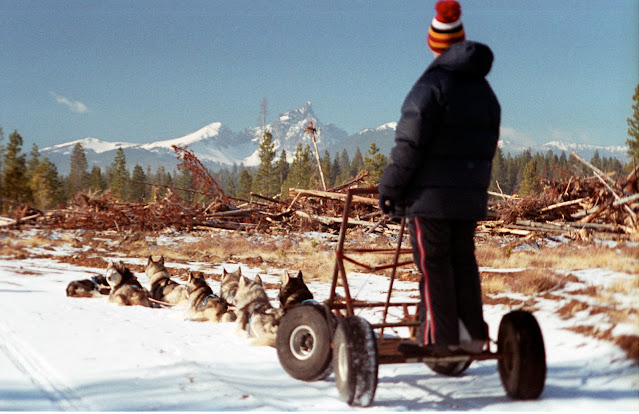
Anne and the team with little snow at Beaver Marsh and Mt Thielson in the background.

Anne driving a five dog team at a Dune Musher's beach race in the '70s.


The Tournament of the Bad Tooth


The fall 1964 University of Washington collegiate speech tournament was an unusual one for me. I was entered in three individual speaking events and debate, but that wasn’t what was unusual. It was the second day of the three day competition that I woke up with a swollen cheek and an extremely aching tooth. All Dr. Mahaffey or Craig Singletary, our speech coaches at Linfield College, could do was give aspirin and tell me to make my way over to the U of W School of Dentistry during the day to see if they could help.[Side note about our team: Linfield’s speech team had a small budget, so to extend our monies Hap had us stay in a downtown Seattle 4th Street hotel where the lower floors were rented out on an hourly basis while our cheap rooms were on upper floors. It was a good educational opportunity for small town debaters and we never had any problems. Back to my story.] With my full competitive schedule I could find only a little time during my lunch break—I had no interest in food anyway—to seek professional help. With my slurred speech, puffy cheek, and sore tooth they set me up to see one of the dental professors during a class session. He put me in a chair, took a look at my tooth, and called another professor over to take a look. Soon all the students were coming over and after seeing the tooth, muttered to each other about it. 

It seems that several years before, when I had had work done on the tooth by Dr. Toothacher in Los Angeles (and yes, that was his real name) he had done some unusual damage to the tooth which had now split right down the middle. The doctors said the tooth had to come out, but they couldn’t do it. They said I would have to take that up with my dentist in Salem when I got home. They did though pack the tooth and give me something stronger than aspirin for the pain.

So drugged up with more slurred speech I took my packed tooth back to finish the tournament. And finish the tournament I did. Mike and I placed 2nd in debate and I finaled and took a trophy in each of the three individual events in which I participated. Even drugged—swollen—and slurring it was one of the best performances of my college speech career. I wonder if I could have done any better if I’d been healthy. 


Osprey bringing home the fish dinner to the nest near Mt Angel.


George the Cat -- (?)1997 - March 20, 2013  (I know I've posted this before, but of all the animals we've shared our lives with he was our last and the one we can't forget.)


George, named by the neighbors, was a stray abandoned by the people who lived behind the neighbors across the street from us. The neighbors neutered George and fed him, but he was just one of several outside cats the neighbors fed. I started hand

feeding George Tender Vittles in the mornings before I went to work. He soon discovered that he liked coming into the house in the evenings, even if he had to share it with Muffy, Queen of the House. Muffy took all the best sleeping spots, but George decided that even the second best spots were better than living on the street. After talking with the neighbors and taking George to the vet for his jabs, he became our cat although weighing between twelve and fifteen pounds he freely claimed the neighborhood as his. 


George was a lovey cat with us, but fairly shy among other people. He tolerated us having groups over, but relished group dinners when he’d get his own chair at the table--he was content to sit at the table and watch us eat, knowing he’d eventually get some scraps when everyone was done. Almost any meat would attract his interest and ice cream was of course his favorite dessert.

In the twelve plus years we had George he got used to having sitters when we were away, first to debate camps and then to UK adventures. For a while we used live-in house/cat sitters, then we had neighbors who would watch over things while we were gone--letting George in and out on a regular basis. He didn’t like our traveling and started sulking as soon as saw the suitcases come up from the basement. He never knew whether the trip was to be for a weekend, a week, or six weeks--after all, as smart as he was he never learned to read the calendar or the itinerary we always left on the table. He was almost always happy to see us return. In fact, one time we had left our car at the airport for a friend who was coming back from a trip a couple of days after we left. When Scott pulled into our carport with our car George came anxiously running until he saw it wasn’t us. Scott said he looked so dejected when he left in his own car. George would punish us, though, for leaving him (even if he had been well cared for) by demanding to be let in and out at his whim for several days. Out of guilt (and fear, for George had claws which he kept very sharp) we always gave in to his demands. This was the pattern for years, until this last short trip to Eastern Oregon. When we got home George greeted us, wanted pets and a little lap time, but was far more interested in curling up in the bed we had for him in front of the heat vent. This now was the pattern for several days--George became harder and harder to wake up. He’d get up to eat his breakfast and dinner and wait beside us for our scraps, but then it was back to sleep in front of the heater without much lap time. In few days it was just sleep. I had a chat with George’s vet, made an appointment, and took him in for his final visit.

We hope George, good friend that he was, is now enjoying his long, permanent nap.


NEXT: Maybe some new photos...or maybe some old stories...or both.


Saturday, June 17, 2023

#204 Story, Photos, and News


       This post contains a story from our travels to Scotland, some favorite old photos (film that's been digitalized), and some other news. Hope you enjoy.


The World, It Is Exploding


Our first time using timeshare for lodging in Scotland was in the fall of 2003. We spent a week at Scandinavian Village in Aviemore in the central Scottish highlands. Our apartment had two bedrooms and a kitchen/dining/living room. What we missed by staying in self-catering (mostly the grand B&B breakfasts) was made up for by doing our cooking. With a stove, oven, and microwave we had plenty of cooking options.

Scandinavian Village unit in 2014


For breakfast on our first morning of cooking I planned to cook a microwave soft egg like I do at home. I had a correct size microwave proof bowl, but unlike home where I use Syran Wrap I had no plastic cling film to top the bowl. I just covered the bowl with a paper towel. I set the timer for 45 seconds on high heat (at home I use 55 seconds at 80%) and turned it on. Something made me turn and look at the microwave just in time (about 40 seconds) to hear a loud bang! The door of the microwave was blown open. Egg bits splattered everywhere and steam poured out of the open door.

Surveying the disaster scene I discovered nothing but particles of my egg were left in the oven, but that no real damage had been done in the room—the microwave was a mess, but still worked. As I cleaned up I mulled over the cause of the explosion. Were the eggs different enough in Scotland that they couldn’t be done in the microwave—after all, eggs in Scotland aren’t cleaned and are almost never refrigerated? Was the microwave too powerful at my settings? Did I really need cling wrap with holes poked in?

I never did find out the true cause of my eggsplosion, but in the more than 25 trips I took to Scotland after, I never tried to duplicate my experience.


Favorite Photos


    Astronomy: an interest of mine since Jr High days.


Telescopes on Mona Kea at over 13,000 feet. Grainy photo from 800 ASA film.

Solar eclipse from Biggs, OR, 1979--published by Sky & Telescope magazine.

Sled Dogs: Raised and raced Siberian huskies from 1970 to 1985.


Anne running at team at one of the Oregon beach races in mid-70s.

A winter run on a wheeled rig with limited snow at Beaver Marsh, view of Mt Thielson.

Forest Fire: in the early 80s we were on Mt Ashland when a major forest fire threatened a friend's home.


Backpacking with Dogs: we backpacked from the early 70s into the mid-90s.


Backpacking into Chambers Lakes basin for an article for Cascades East magazine.

Me and Myko in the Three Sisters Wilderness area.

Myko early morning in the Green Lakes area on South Sisters.


Other News


This next section of the post isn’t the fun stuff, that was all in the story and the photos. This section is a report about us. First, Anne is working hard at recovery from total shoulder replacement surgery on her left shoulder—no golf for her most of the summer. Her surgery was three weeks ago and she is doing fine, but the hardest part, physical training (otherwise called physical torture) is to begin in a week and a half. We know how hard it is going to be, she had the same surgery on the other shoulder about eleven years ago. It’s amazing how strong she is and how independent.


Anne has to wear her sling for at least 4 weeks, but rides along while I play.


Second, while I live with the spinal stenosis that makes walking difficult, I continue to learn about life with Parkinson’s. My symptoms are so far quite mild and mostly controllable with medication. I know that things will change, there is no cure, but one of my hardest challenges is accepting that I won’t know how PD will affect me until it happens. I’ve always relied on my old Boy Scout training and tried to be prepared. I find that it’s difficult to prepare; all I can do is adapt—it’s a new concept. I still play golf, although my balance is completely different than it used to be. All I can say is have one of the more unique swings out at my golf course.


I lose my balance when I swing the driver, but I haven't fallen...yet.


Although we can’t really do much travel planning currently, we are both thankful for all the support we’ve received from friends and family.


Sunday, January 23, 2022

We Change Plans...Again!

Sorry! In the last post I said this post would be about a real trip. Well, that one was cancelled and the next one as well. We’ve decided there are two ways people are tackling the pandemic: either they become risk takers and hope for the best or they are trying to avoid risks and hope for the best. We’ve decided we are the latter—we plan big and then cancel when we think better of it.  Anne’s sister makes big trips safely in her motor home, but we’re not set up for that. So, the gist is we are changing our travel planning to smaller trips we can do safely and not playing the plan-then-cancel game and being continually disappointed. How are you traveling in these tumultuous times?

Now to this post which has two stories and some black and white photos. The first story is from my sleddog days. The second story reminds me not to feel so bad about the way things are, they could be much worse. The idea of highlighting some black and white photos comes from a good friend, Nick, who is using his down time doing more black and white and street photography. The captioned photos come between the stories and after the second story—in no particular order.  


Pistol River Start


When we lived in Brookings, Oregon (1980-84), the local newspaper wanted to do a story about my sleddog team. We invited the editor/photographer Don Rogers to watch one of my training runs on the beach at Pistol River. We met Don at the Pistol River view point off Hwy 101 where we could hook the team to the back of the truck and take off over the dunes and down onto the beach where I could run the team for two miles north and turn back for another two miles.

At the hook up point we talked to Don for a while about racing, dogs, equipment, and more. We introduced him to our nine dogs—eight Siberian huskies and one Alaskan husky. He took pictures and asked questions about the dogs. Then it was time to harness the dogs and take a run. We harnessed all the dogs while they were hooked to the truck. We then tethered the training cart (a large go cart type rig with  four piper cub airplane wheels) to the truck via a large eyebolt. I next strung out the gangline and attached it to the cart. First, I hooked in the leader, Waveet, whose job it was to keep the gangline taut between himself and the cart. I next hooked up the swing dogs behind the leader, and then the next set, and the next. By this time all the dogs were excited to run. Finally, I put the first wheel dog on the line (Myko on the right) next to the cart. It was at this point things went wrong.

A normal start at Pistol River. (Photo by Don Rogers)


I went back to the truck to get the last dog, Amorak, the left wheel dog. I had just unhooked Amorak from the truck when I heard the loud snap. The team had bolted, straightening the heavy eyebolt and were off toward the beach. Amorak, now loose, was chasing the team. I was too. I hollered as loudly as I could, “Waveet, Whoa!” About 50 yards in front of me the whole team stopped and stayed while I caught up. I hooked Amorak into the team—he had run straight to his position and waited while I hooked him into the gangline. I said, “Good dogs,” then “Hike!” the go command. We were now off on our training run.

Back at the truck Don was quite surprised by what he had witnessed and asked Anne, “Does Bob always start that way?” Anne replied, “Only for special company.” 


The joys of pub life in Scotland.

The Birks of Aberfeldy

Pipe Major at Dornoch in the north of Scotland.

Stirling Castle

Callanais Standing Stones and Stone Circle, Isle of Lewis in Outer Hebrides.

Traffic in the Scottish Highlands

e
St Mangus Cathedral in Kirkwall, Orkney Islands

Molalla River and Mt Hood


Badbea Clearance Village 

Our tee time at Wick was one o’clock which gave Anne and I plenty of time to visit the clearance village of Badbea (BAD-bay) on Scotland’s east Caithness coast five miles north of Helmsdale. I’d seen the village listed on our map, but had no idea what we’d find there. In the lay-by on the A9 near Ousdale an informative sign told us a little about the history of the village and gave a few insights into the lives of the families brought here. 

The footpath is now more of a sheep trail; for about 100 yards we literally followed a sheep until she bolted off the path. We could be the only visitors this day or this week; the three-quarter mile trail was little used. As we approached the precipitous Berriedale cliffs above the North Sea, the monument, built in 1939 by David Sutherland in memory of his father and the people of Badbea, signaled we had reached the village site. 

At first the monument was all we noticed; that and the quiet. Even the gulls seemed to sense the sadness in this site as they slid by in respectful silence. Then we noticed a few drystone walls and the outlines of stone longhouses and byres of crofters from the straths of Ousdale, Langwell, Auchencraig, and Kildonan had built when they were evicted from their land and moved to the cliffside Badbea village. Sheep and politics had instigated the Highland Clearances and created places like Badbea, which started in 1792. Landowners like Sir John Sinclair of Ulbster evicted the crofters in preference to more profitable sheep. At its largest the village was home to 35 inhabitants, with the last leaving in 1911. 

As we wandered about the site under dramatically darkening skies, we could hear in the wind the stories of families forced onto these windswept cliffs as they were uprooted from ancestral lands--lands cleared and farmed by hand, lands which for generations had given a meager, but adequate life. Stories about men of the land forced to seek livelihood on the herring or salmon boats. Stories of many, who not knowing the ways of the ocean, did not return from the sea. Stories of children and livestock having to be tethered to rocks or posts so they would not be swept over the cliffs to the sea below by the fierce winds. Stories of a people who for more than a hundred years adapted, lived, and at times even flourished, under horrendous conditions. It didn’t take long before we too were hushed like the gulls by the stories that hung heavy on the wind. 

It was a quiet walk back to the car and drive on to the Wick golf course. As we played that afternoon on the lovely Wick links, every breeze brought back the stark scene and stories of the Highland Clearance village of Badbea. 

Prickly Hands on Hips

Eilean Donan Castle, western Highlands

Fountains Abbey, northern England

Hereto Head Beach, Oregon

The Road to Neist Point, Isle of Skye, Scotland

St Andrews Cathedral, Kingdom of Fife, Scotland

Bomamargy Cemetery, Northern Ireland near Bushmills

She Who Must Often Walk alone when I'm Taking Pictures
Kirkwall, Orkney Islands


NEXT: No promises and I think that's a promise I can keep.


Friday, December 3, 2021

Going to the Dogs

This post comes in two parts, but both parts come from rummaging through old files and finding old slides not converted to digital. Both also refer to our Dog Time, the 14 years of the 70s and early 80s when we owned a kennel of Siberian huskies. First, an article I wrote which was published in the late 80s.


Elke: The Lessons of a Beach Dog

Oregon Coast Magazine, January, 1988


Without the slight breeze blowing in off the ocean the day would have been uncomfortably hot. The sun had finally burned away the accumulation of gray that is the usual morning on the Oregon Coast. Kids were splashing in the incoming tide and parents were enjoying the sand and surf of Neskowin as much as their children. Frisbees were as thick as sea gulls and almost as graceful as they floated, dipped, and dived on the breezes and currents.

Anne and I were enjoying this beautiful day from a blanket about halfway between the tideline and the beach grass. We had owned a kennel of Siberian huskies for several years, and found it an interesting diversion from our books and the sand fleas to watch the beach dogs interact with one another. Rituals of tail-sniffing were performed with medieval aplomb. Dogs would approach each other, circle, sniff, and then trot about their business. This pattern held for all manner of dogs—from the pampered poodle getting sand in her ribbon and still smelling of foo-foo to the Heinz 57 mutt whose last bath was a dip in the creek. 

One dog, however, didn’t fit this pattern. A small female elkhound made her way up the beach avoiding other dogs as much as possible. While the other dogs seemed to lack purpose in their meanderings, little Elke showed marked determination. Her beach wanderings were punctuated by stops at all human beach-toweled encampments. As she approached our enclave, she got a whiff of our tuna sandwiches. Instead of circling us at a distance and then moving on, she circled once and then lay down looking directly at us. With head up and ears erect, she watched us eat our lunch. After a couple of minutes she moved to our left and lay down not more than twenty feet from us. She watched us as we discussed the obvious ploy she was making to join our picnic. She continued to move closer until Anne could have stretched out and petted her.

Elke was a pretty thing. She had no collar and lacked the fat look of many pampered pet elkhounds I’ve seen. At the same time she didn’t look particularly hungry. She seemed healthy, bright-eyed, bouncy. When she realized we weren’t going to be taken in by her act, as cute as it was, she headed off to find some easier mark. Before she abandoned us completely, she gave it one last shot. Elke stopped about twenty feet away with her ears pointed back as far as she could get them. She was giving us a final chance to call her back to join in some potato chip munching. When her last effort failed to elicit the desired effect, she trotted off, checking each beach blanket picnic in turn.

I spent a delightful hour enjoying the creative, purposeful antics of Elke. If she belonged to someone, she had certainly found an effective method of supplementing her meals—not everyone could have been as hardhearted as we were. If she were a stray, her physical condition gave a good account of the effectiveness of her begging behavior.

Elke also helped me realize something about my own pets. She pointed out the manipulative behavior of which most of our pets are capable. I thought of our oldest husky, Myko, who knows the surest way to get all the petting he wants is to jump up, lick my face, and bounce down to be chased. No matter how hurried I am, Myko knows that this routine will turn me into putty in his paws. Our 14-year old cat knows that lifting a paw that was once hurt will get some extra snack—or at least a sympathy pet. And if the “hurt paw” doesn’t get our attention, he puts it down and lifts the other one.

Much that has been written about human psychology probably applies to pets as well. Elke had a purpose to her manipulative behavior—she wanted food. Our pets have purpose in their behaviors. By being aware of these purposes we can better care for the emotional health of our dogs and cats. 

I may have resisted Elke’s advances the first time we met, but after I realized what she had shown me about my own animals, you can bet that the next time I’ll invite her to join our picnic as an honored guest.


 Dog Days


The second find was a large set of slides from our sled dog running days. Now converted to digital, the pictures are of our dogs, pictures I took of other racing teams, and some extra doggy photos. Most of these photos were slides taken by a fairly ancient Petri fixed-lens rangefinder camera or my first Ricoh interchangeable lens 35mm camera. Captions will help fill in the details. Hope you enjoy.


The Dogs

Our second husky, Gromyko of Kolyma Creek, a great wheel dog and companion.

Myko, a good backpacker dog, carried as much as 15 pounds (about a third of his weight). He's resting at our camp spot at Green Lakes.


We'd take the team out for runs near Hoodoo Ski Bowl.  Mt Washington in the background.

When we lived in Brookings (1980-84), we'd often take the team out for run at Pistol River and stop for coffee break. We had eight dogs much of the time and as many as 14 with puppies. 


Racing


Lee Muller, Albany, racing at Sisters with his team of Siberian and Alaskan huskies.

Anne raced a few times. Her best race was this one at Beaver Marsh.

I raced in 3-dog, 5-dog and 7-dog classes (3, 5, and 7 miles). This was at Sisters. I don't remember the photographer.

Art Christensen, Turner, always had a fast team of Chilkoot hounds, his own mixed breed. They were fast and strong, but got cold quickly.

Me with a five-dog team at a Sisters race. In a normal year we'd attend 7 or 8 races in Oregon, Washington, Idaho, and California. Photo by Mally Hilands, Canby.

Not all our races were on snow. This is a photo of Darell Stewart, Canby, at a cart races at the Painted Hills in Mitchell, OR. Most of us would train our teams on gravel roads with wheeled carts. In racing season I'd try to get two days of training during the week and go to the snow on weekends to race or train.


I was much younger then and had hair.

Anne, seated on the left, was head timer for most of the Oregon races.


Running the Dunes


The Oregon Dunes Mail Run was a non-competitive event that I ran in from 1978-1983. The run was 72 miles in 2 days over and through the Oregon Dunes National Recreation Area from North Bend to Florence. This is Phil Armstrong of Eastacada negotiating one of the tall dunes.

This photo of Linda Robertson, Bandon, has won numerous awards in photo competitions.

The first year of the Mail Run we booted up to run into Lakeside at noon on the first day. The boots were to protect the dog's feet from the rough pavement. Most teams lost their boots in the first couple of hundred yards, littering the roadway. Anne had had to handmake all our boots. We found that the dog's feet were tougher than we thought. My team front to back, left to right: Waveet in lead, Malenski  and Attica in point, Tamarmick and Laca in swing, and Myko and Amorak in wheel.


It was difficult and expensive to own and work the kennel of Siberians, but it was worth every penny and ounce of effort. Some of the best years we ever had. And yes, the dogs absolutely loved to run.


We tried Tigger in lead, but he was too independent.


NEXT: Happy holidays