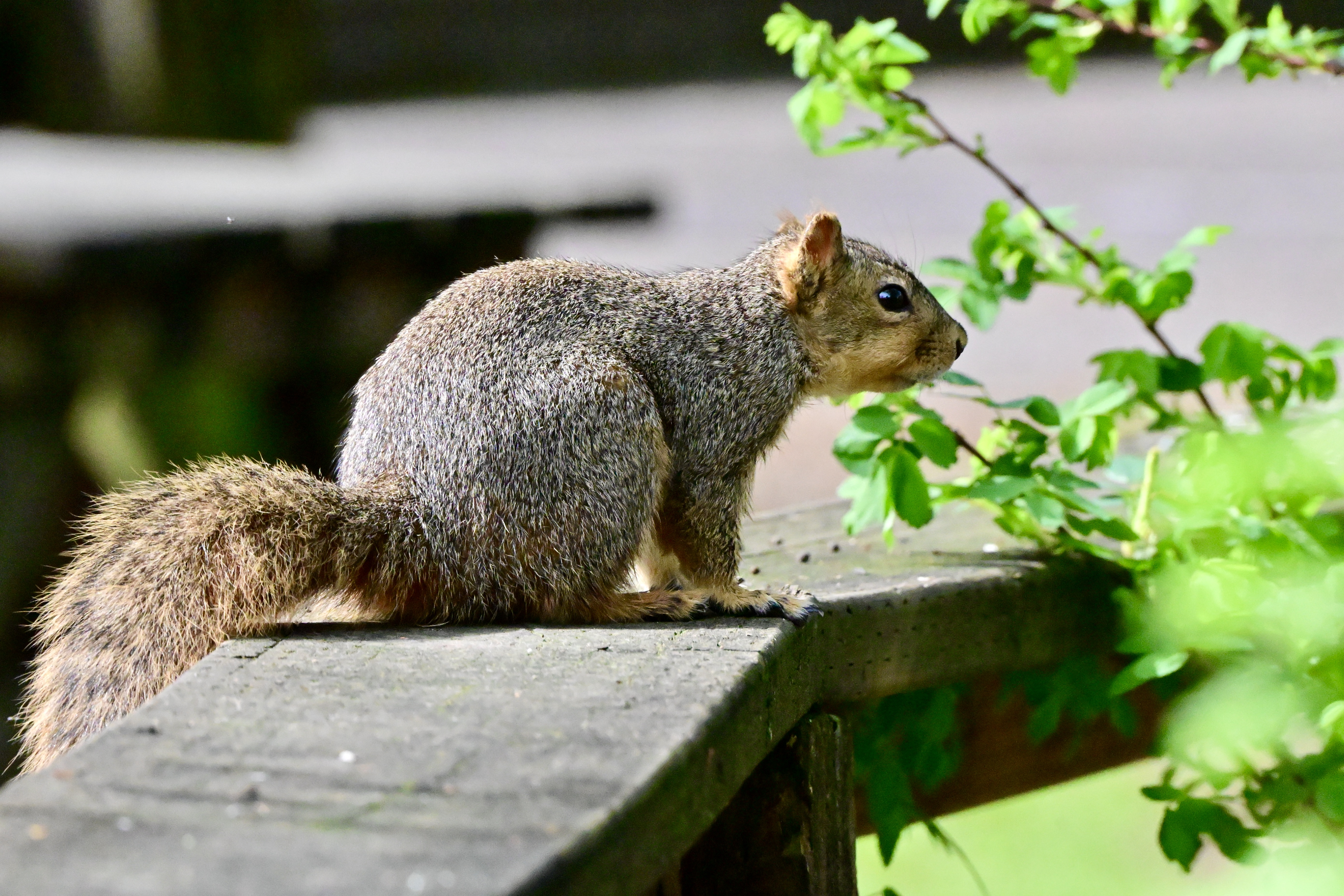
Showing posts with label squirrels. Show all posts

Friday, March 27, 2026

#236 Parkinson's Hallucinations and Some New Photos


Our front yard frosted with hail.


#236 Perception and Pictures


Crocus in our front garden.


The pictures in this post were actually taken this past month by me. They are real photographs taken on Lumix ZS100 or Nikon Z50ii cameras. It’s the first time in quite a while that I’ve felt good enough to get out and shoot some new photos, even if they are just ordinary—most were taken at the Canby Community Pond which is always full of friendly fowl and rodents.


Hallucinations and Delusions


John, Anne’s cousin, responded to the last blog post [Thank you, John!] with a story about his cat called Ghost. Ghost was a found gray cat like my George and got his name from his ability to seemingly disappear on walks and reappear later in the walk. John’s story made me consider telling about the fact that George The Cat seems to be haunting me even now. Every so often when I’m in bed the covers (usually just a sheet) will fall in on me like it would when George would curl up on the bed at night. I know there’s no cat that just got on the bed, but it’s hard to ignore the motion of the covers is like George is right there. Either the ghost of George has just crawled onto bed to settle in for the night or it’s a Parkinson’s disease hallucination.


A bullhead or common goldeneye?

A pair of ???

A newly rebuilt garden path.


That brings me to this post’s information about living with PD. As many as 50% of Parkinson’s sufferers over the course of their time with the disease will be affected by hallucinations and/or delusions. These affects will be in the form of seeing things that aren’t really there (people living or deceased, animals living or deceased, objects), hearing sounds that aren’t real (extraneous sounds, music, voices), other sensory manifestations, paranoia (believing people are watching you or talking about you), and false beliefs (fears of loved ones stealing from you, putting you in harm’s way, or being unfaithful). The causes of these hallucinations and delusions are varied, but most can be attributed to the natural progression of the disease (changes in the brain) or the side effects of dopamine therapy where the increase of dopamine in the brain may cause the effects. If natural progression is the suspected cause then certain drugs may give help. If drugs are the cause then a change of dosage as well as a change of treatment drugs may be the solution.


Alas poor Yorick...


With Parkinson’s related hallucinations visual images are the most common type. The hallucinations may be minor called passage images (like shadows) or major called presence. Most of PD patients who experience hallucinations say that while startling at first, they actually get fairly used to them. Most patients know the hallucinations aren’t real, but still find them unsettling. One of the members of my support group said that her hallucination came in the form of a cat—she knew it wasn’t real because it was polka dotted and wearing a yellow bow tie. If I have to include hallucinations in my PD symptoms I hope that they aren’t the paranoid delusional type, but rather the mild kind, like George’s ghost. Although, I don’t think I would mind meeting the polka dot cat as long as he was still wearing the yellow bow tie.  


Wood Duck

Wood duck circles and reflections.

He'll see what he can do.


Next: I like the idea of new photos. I'll see what I can do.

Spring Sunset in Canby


Thursday, May 1, 2025

#225 Some History and Travel Stories


This is not the post that I expected to put up this month, but trouble loading older photos from external hard drives has commanded that I punt that plan. The new plan (this post) consists of a memorial I have wanted to present for years and a couple of stories from my travel book (16 Years of Travel in Scotland, Ireland, England, and Wales which is still available on Amazon) intermixed with photos taken recently around the Canby Community Park. I hope you like plan B.


R.S.Baker


The pictures of R.S. were taken in 1978.


My introduction to Robert S. Baker, professor of English at Oregon College of Education, was the summer I went from Linfield to OCE in Monmouth. After four years at Linfield I didn’t graduate because of not having a second year of foreign language even though I tried them all. Instead, I transferred into a fifth year program to get my teaching credentials. That summer session I took a massive load of classes, many were lower division to get me up to speed with the education requirements and meet OCE’s requirements for a degree in English. My Linfield major was speech with a minor in English. I needed several writing classes as well some more extensive Lit classes. Thus I met R. S. Baker.

Baker taught a graduate level composition class needed for a fifth year program. I had made my way through Linfield’s English requirements by writing essays—I even ghosted essays for frat brothers for extra income. This one class would be a snap. The summer class was made up of many working teachers getting needed hours or degree requirements and a few undergrads with me somewhere between the two. After some basic class info, professor Baker gave us an in-class writing assignment. The topic was a personal essay about something easy to write on. We turned our essays in and I thought, "Easy peasy."


The next day we all showed up and Balker chose a paper to read to the class—he chose my paper. What a great thrill! He read the one page paper aloud, then looked at me and said, “Mr. Jones, this is a f***ing piece of shit!” He outlined all that was wrong with my writing  and tore the paper in half and threw it in the bin. He read a couple more papers, not as bad as mine, but still weak. He assigned us the next essay and I walked out crushed!

I did better on the next paper. Half the working teachers did not show up for the third session. Those of us who stuck it out worked really hard. I know I never worked so hard for a “B” in my life, but I learned. 

Over that year at OCE I had R.S. for every class I could. When I went for my Masters at OCE (now Western Oregon University) I took more classes from Baker. I was one of numerous R.S. Baker disciples and he became a friend. We’d talk in his office crowded with books and go to jazz concerts together, Not only was Robert S. Baker an outstanding teacher who helped us get the best out of ourselves, I consider him one of the major influences in my life.


Bio

Born Robert Samuel Baker in 1926 in Weed, California. His elementary schooling was in Salem and he graduated from Vancouver HS, WA, in 1944. R.S. spent time as a Merchant Marine and with the Army Signal Corps where he was stationed near New York City where he developed his love for jazz. After his stint with the Army, he went to Pacific University in Forest Grove, graduating with a degree in literature in 1953. He earned his Master’s Degree in English at the University of Chicago in 1956. Baker started his teaching career at OCE where he taught for 31 years. While teaching he published numerous articles in publications such as The Nation and Commentary. He remained a jazz devotee with special affinity for female vocalists. He died on June 26, 2004, and will always be remember for his influence on so many teachers.  


Attack of the Ducks


While touring the far northwest corner of Scotland, from

Durness east towards Tongue, we had one of our most unusual

animal encounters. We were attacked by a flock, herd, bevy, covey,

gaggle, crowd, or what ever you call a gang of crazed ducks. I had

gotten out of the car at an ocean overlook to photograph the view

and was soon accosted by a group of local ducks, at least they all

quacked with a northern Scottish brogue. They kept up their

begging behavior as I walked across the road, but left me when

I headed down toward the beach.


After about ten minutes of picture taking, I walked back to 

the car. Anne had rolled down her window and was shouting 

at me to come feed the ducks who had been pecking the car 

door under her window demanding a ransom of cracker crumbs 

for her release. I found some Carr’s Cheese Melts (our  favorite 

cracker) and lured away the mob who I discovered would fight 

each other to eat right out of my hand. We were several miles 

from even a small village in the remote far northwest corner of 

Scotland, yet the ducks were able to eek out an existence by 

gang attacking tourists. Clever birds!


Attack of Ice Cream Crazed Gulls


In Llandudno (clan-DID-nu), Wales, we hit an absolutely

gorgeous stretch of weather--clear skies, 80 degrees, almost no

wind--in mid April. After golf one afternoon we walked from our B&B

down to the waterfront and then out the Llandudno pier. It was too

early in the season for most of the pier shops and attractions to be

open, but the ice cream shop was doing a brisk business in the fine

weather. We each bought a cone and continued to walk out toward

the end of the pier making jokes about a long walk on a short pier.

Without warning, a gull swooped down and hit Anne’s cone holding

hand, knocking the ice cream and cone to the ground. A couple of

gulls pounced on the dropped cone with relish. 


After seeing what happened to Anne, I guarded my cone 

much more closely. I saw a gull dive at me and turned to the side,

but the gull hit me with a wing and knocked my glasses off. It might

have been the same gull who hit Anne or a different one, I didn’t get

a chance to ask for identification. In trying to keep my glasses from

a watery grave off the pier, I dropped my ice cream cone to the

great delight of another couple of gulls.


Without ice cream cones we walked back to the beginning of

the pier and noticed locals standing next to protective buildings

enjoying their sweet treat. When we told our B&B hosts about the

vicious attacks, they apologized for not telling us that the local birds

were a “tad aggressive.” Tad aggressive! Our military needs these birds!


NEXT: Your guess is as good as mine.


Saturday, February 1, 2025

#222 The Beasties


In the last post we visited with the birds and the bugs, and now it’s time we saw the beasts, which is about as wild as I ever get. The stories come from my travel book, Sixteen Years of Travel in Scotland, Ireland, England, and Wales (available at Amazon), and the photos come from travels in the UK, the American Southwest, Canada, and locally. As always comments and questions about the stories or photos are appreciated.


Red Squirrel, Scotland


The Golf Wildlife 

One year at the Gearheart Golf Links on the Oregon coast we came upon some real wildlife. A party of businessmen had brought with them some girls in business and they were driving around the course in all manner of undress. We haven’t seen that kind of wildlife on courses in the British Isles, but we have observed other wildlife. 

Arizona

Valley of Fire, NV

Grumpy Guy, Santa Fe golf course


Twice we’ve encountered hedgehogs in Scotland, once at Crieff and once at Tulliallan. We learned though that as cute as the hedgehog is it is probably just as full of fleas and other small critters and better left alone. Jamie Montgomery introduced us to black grouse which inhabit the Montgomery and Bruce courses he owns in Kinross. At Boat of Garten while looking for my wayward ball I flushed a covey of ptarmigan, and I was so startled that I just pointed (Good dog, Bob!). On a recent visit to Panmure GC on Scotland’s east coast I was lucky enough to get a decent picture of a harrier hawk as it fluttered above its prey. 

Pallas's Cat, Wildlife Refuge, Scotland

We definitely know that a coyote does shit in the woods around Lake Tahoe.


I was hoping for some special photos when I spotted a large bird at Blairgowrie’s Landsdowne course in the fairway ahead of us. I took several shots and moved closer for more. I thought perhaps I’d have special photos of the rare Capricallie (a large colorful wild grouse) until I got close enough to see that it was just a colorful rooster. The pro at the shop said the bird had appeared about five weeks before and was getting quite good at dodging golf balls. 

The wild deer are friendly in Scotland, St Fillans GC.

Mule deer, Painted Hills, Oregon


There are no serpents in Ireland; St Patrick cast them out. On Isle Arran’s Corrie GC we saw a sign which said, “Beware of Snakes.” It was at Pwllheli Golf Course in northern Wales that we finally heard that indeed there were snakes in the British Isles, and not just the harmless garden variety. Our golfing hosts told us that there were reports of black adders (relative to the cobra) in the area. At Milford Haven GC in southern Wales I hit a tee shot over a stone fence into an old croft orchard next to the course. Our playing companion told me to just play one from outside the stone fence. I asked if the area was Out of Bounds? He said, “No, but nobody goes in there.” After my quizzical look he emphatically added, “Black adders live there!” I took my penalty and dropped a new ball well away from what the locals call “The Snake Pit.” 

Elk, Banff National Park, Canada


One of our most unusual encounters was one we only heard, but never saw. As we played the St Fillans course in central Scotland on October 5 (the last round of our 2009 trip), we heard strange noises as we came up the 7th fairway. It sounded like a cow was in distress in the hills north of the club. We asked a local playing through if he’d heard anything strange, but he said he hadn’t. On our second time around we could still hear the noises coming from the hills. As we stood listening the player we’d talked to earlier came over from an adjoining fairway and asked if that was the sound we’d heard before. We said it was. He then explained that it was the bellowing of red deer stags at the beginning of the rutting season. He added, though, that it was the earliest he’d ever heard their calls, which explained why we’d never heard them before since this was the time we always would end our fall trip. Anne and I played the last three holes badly because we kept looking into the hills trying to glimpse the deer. 

Dartmoor Wild Pony

Exmoor Wild Horses


We’ve had two run-ins with fox on golf courses. One was quite fleeting as a large coyote-sized red fox ran across the path in front of us just before the twelfth tee at St Andrews Duke’s course. The other meeting was more interesting. At the East Clare Golf Club golf shop in Ireland the pro told us to be on the lookout for a red fox around the ninth or tenth hole. The fox was still wild but was becoming quite adept at begging for, of all things, chocolate. On the eleventh fairway the fox came trotting up towards Anne, who offered a carrot instead of chocolate (which isn’t supposed to be good for canines). That offering was rejected. He came within about five feet of me (great for photos) before realizing I had nothing for him and moseying on. 

We really found these kind of fox more fitting with the golf environment than the foxes we saw at Gearheart--although, they were an interesting distraction, too. 

Big Horn Sheep, Rio Grande Gorge, NM


Mt Goat and Kidd, Banff, Alberta, Canada


Midgies--the Scourge of Scotland 

We’d heard stories, had warnings, but had never had a personal introduction to Culicoides impunctatus. Most of our travel has been off-season, April-May and September-October. We’d never been in the Highlands in the peak season of early June through late August. According to one book, “During the Second World War Scottish soldiers training in the Highlands branded her worse than Hitler.” The “she” referred to is none other than The Midge. 

Of the 34 different species of biting flies in Scotland, only five are attracted to people and 85% of the attacks are by Culicoides impunctatus. Midges or midgies are small biting flies that appear in mid to late summer, especially in the Highlands and around water. In the Northwest we would call them “No See ‘Ems” or gnats, but ours don’t bite. 

Pronghorn Antelope, near Moab, Utah

Cool Dude (coyote), Rio Grande Gorge, NM


September 2007 was our tenth trip to Scotland, and it was the first time for us to come face-to-face (or rather mouth-to-arm) with the midges. When we played Ullapool GC in the northwest of the Scottish Highlands it was a wind free, overcast with light showers day. We thought we were prepared with insect repellant, but I was in for a surprise. By the time we’d reached the tee at the second we knew we needed protection. We sprayed our necks and heads with Off! and played on. The repellant worked fairly well, except that I didn’t think about the fact that I was wearing short sleeves while Anne had on long. Even though I hadn’t felt a single bite, by the end of the round there were a few welts on my arms that were beginning to itch. By that evening I was putting on the only anti-itch medicine we had by the gobs. The next morning I could count more than forty bites per arm and nothing was stopping the itch. Midge bites are not like mosquito bites which sting, swell up, itch for a couple of days, and are forgotten. Midge bites itch for a month! I tried every remedy available from every chemist (pharmacy) at which we stopped. Some worked a little or for a while, some didn’t work at all. We’ve since learned a lot more about the midges. As far as repellents go, the Off! worked fairly well, but we’ve since heard that Avon’s Skin So Soft is the preferred repellent by locals. One description I heard said that you slathered it on good and thick, and then any midges who do land on you drown in the lotion. 

Reindeer have been reintroduced into Scotland.

Very different look, but from the same herd.


Midges like the twilight and the females, who do the biting, are most voracious at dawn and dusk. Sun and wind are actually the enemies of the midge. They will never bite in the midday sun and can’t fly in breezes more than seven miles per hour. If the weather is dull and overcast, as our day at Ullapool, they can bite anytime. Businesses have refused to locate in the Highlands because of the midges. Scotland loses millions of pounds in lost work-time a year at Highland outdoor employment because of the “wee beasties.” 

Harbour seals lounge off the southern tip of the Kintyre Peninsula, Scotland.

The same picture could be taken at every village harbour in Scotland.


As I say, it took us ten visits to Scotland to become personally acquainted with the Scourge of Scotland. When we next travel in the Highlands in Midge Season we will be better prepared with a good repellant, protective clothing, and as much anti-itch lotion as we can carry. 

Black bear near Canmore, Alberta, Canada.

Moose in high mountain lake, near Canmore, Canada.


NEXT: Some more old pictures--I've got plenty to choose from.