Showing posts with label standing stones. Show all posts

Sunday, June 5, 2022

#195 Favorite Small Golf Courses in Scotland


Let me tell you a little about the small golf courses of Scotland, Ireland, and Wales. All golfers know about the big famous courses—the Old Course at St Andrews, Carnoustie, Troon, Lahinch, Ballybunion, Porthcawl. But almost every village and town has its own local golf track and many are 9-h0les or small courses. I find many of these small courses are more interesting and more fun than the long, tough, famous tracks.

This brings me to the next set of blog posts. Since I can’t now travel back to these fun courses, let me share them with you via my descriptions in my published golf guides. This post will highlight two of my favorite short courses written about in my first book Golf in Scotland: The Hidden Gems (published in 2005 and last revised in 2020). Note that I include Anne’s section, “From the Forward Tees,” which to our knowledge is still the only woman’s review of these courses. The first course is a course in central Scotland where Anne and I have been members since 2007. 


Raising the American and European Union flags for the Ryder Cup matches in 2014.


ST FILLANS GOLF COURSE 

South Loch Earn Road, St Fillans, Perthshire PH6 2NJ 

www.st-fillans-golf.com 01764-685312
Parkland, 5520 yards, par 70, £15/round, £20/day 


AMENITIES: Voted Best 9-Hole Course in Scotland for 2019 by the Scottish Tourist Board. Great clubhouse tearoom with outstanding food. In season does weekend special meals for which you have to have reservations. A few golf essentials available in clubhouse. 

Green at the 2nd

Tee shot from the elevated 3rd Tee.


COURSE COMMENTS: St Fillans GC is the perfect nine-hole course. It can be easy, it can be difficult, but it will always be fun and friendly. The 1903 Willie Auchterlonie design is mostly flat, but the one hill on the course gives a great elevated tee for one hole and adds challenge on three others. Although there are a few bunkers, the main difficulties are the hill and the heavy rough off the fairways. St Fillans is beautifully sited between steep hills and next to lush pastures. Bring you camera! 

The club website lists the first as the toughest hole on the course, and although it can be difficult if you misshit left. I think that the 2nd and the 7th are more difficult all the time. The 2nd, Earnside, is a 415-yard par 4 which starts with a long carry over heather to an angled fairway. Even a good drive then leaves a long second shot to a small green protected by a wee burn in front and heavy rough all around. For me a par feels like a birdie at this hole. Earnside is followed by St Fillans, the 279-yard par 4. Tee off from the top of the only hill on the course. Anything misshit short is probably lost in the ferns and bracken. Second shot should be a short wedge to a green protected by two fronting bunkers. With wind behind I have actually driven the green, but I’ve also found my share of trees and rough on the right. Definitely a fun hole! The 5th is the favorite hole of most club members. The Bothy is named for the small croft just off the fairway left and is a challenging 265-yard par 4. The tee shot is over a corner of the hill you tee off of on the 3rd and played around on the 4th. After the blind drive, the second is to an elevated green--short rolls back down or into a bunker, long rolls off into mean nasty rough. Never give a putt on this green. I really like the 7th, at 455 yards it is the longest par 4 in Perthshire. The hole is good, straight forward classic golf with OB on the left, trees and rough on the right, and several fairway bunkers before you reach the large green. Here again, par is like a birdie to me. 

I may gush a little about St Fillans GC, but we are members. It’s a course you can have fun on the first time, but it will still be a challenge the hundredth time you play. We absolutely love the interesting shots, the magnificent mountain views, the food in the clubhouse tearoom, and the friendly people we meet on the course. 

The green at the 4th is a delight with bluebells around.

Looking back down the fairway on the 5th with the iconic bothy on the left of the fairway.


COMMENTS FROM THE FORWARD TEES: I love a round on this course. It feels and looks like it will be easy but don’t be fooled. There are trees, heather, a small burn, and the hill to get in your way. The greens can be a challenge because they are different depending on the weather and ground conditions. I love this course and the setting, in a small valley surrounded by rocky hills, makes this one of the loveliest courses in Scotland. 
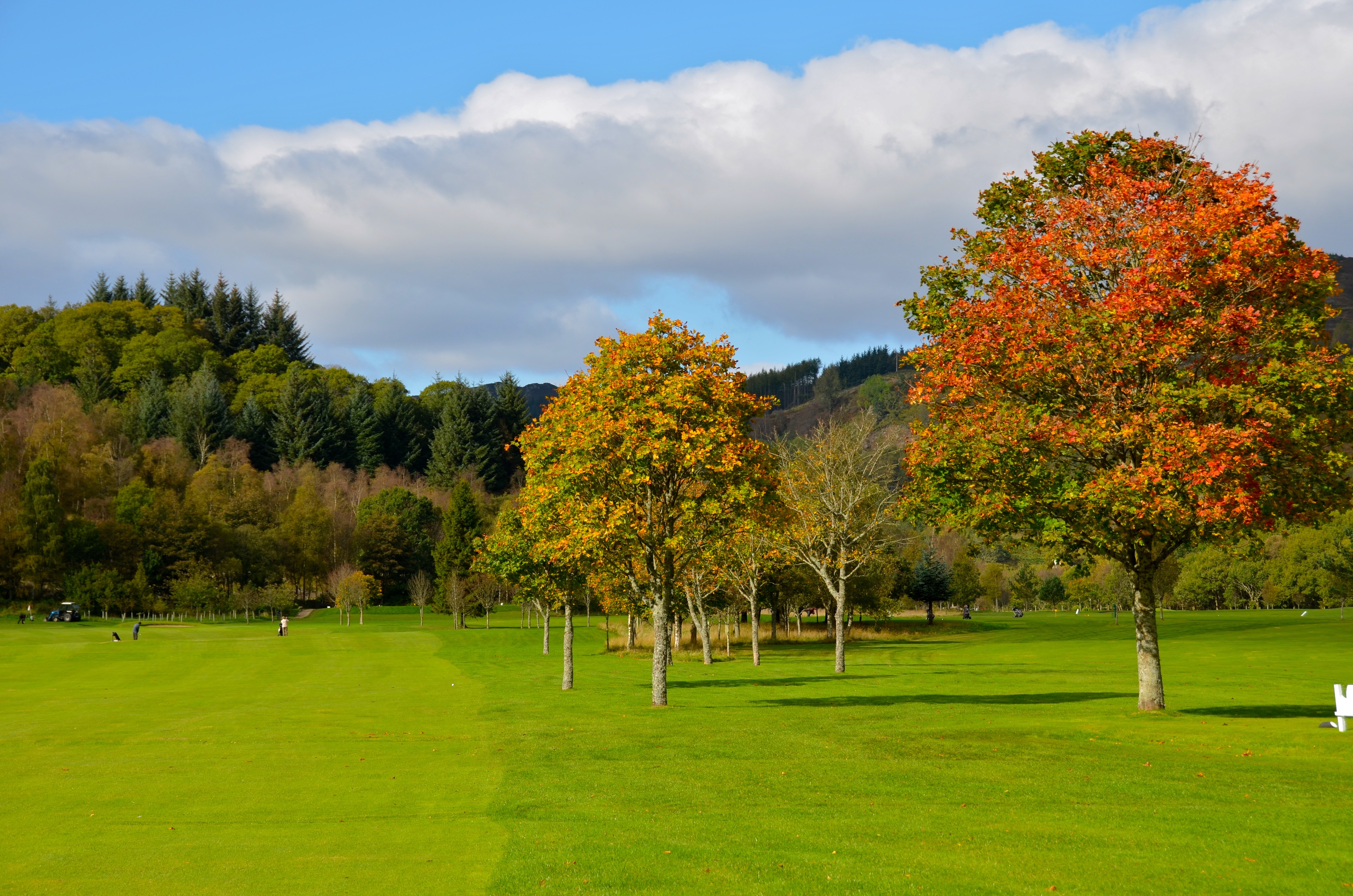
The long 7th is lovely in fall colours.

In the Area: For after golf or on non-golfing days we suggest visiting Famous Grouse Distillery in Crieff about 12 miles from the course or a visit to what we think is the premier tourist castle in Scotland, Stirling Castle about 45 minutes from the course.


For the next course we travel to Isle Arran off the west Ayshire coast.


SHISKINE GOLF AND TENNIS CLUB 

Shore Road, Blackwaterfoot, Isle of Arran KA27 8HA 

www.shiskinegolf.com 01770-860226
Links, 2996 (12 holes), par 42, £30 round, £43 day (2 rounds) 

The view down the 1st at Shiskine.


AMENITIES: New clubhouse, Felicity’s at the Clubhouse opened in March of 2010 and food service is even better than before. Whenever we’d eaten at the old tearoom we had been pleased with the food, quality and variety, but everything is even better now. The old starter’s office has been turned into a small, but well-stocked golf shop under the direction of PGA professional Douglas Bell. 

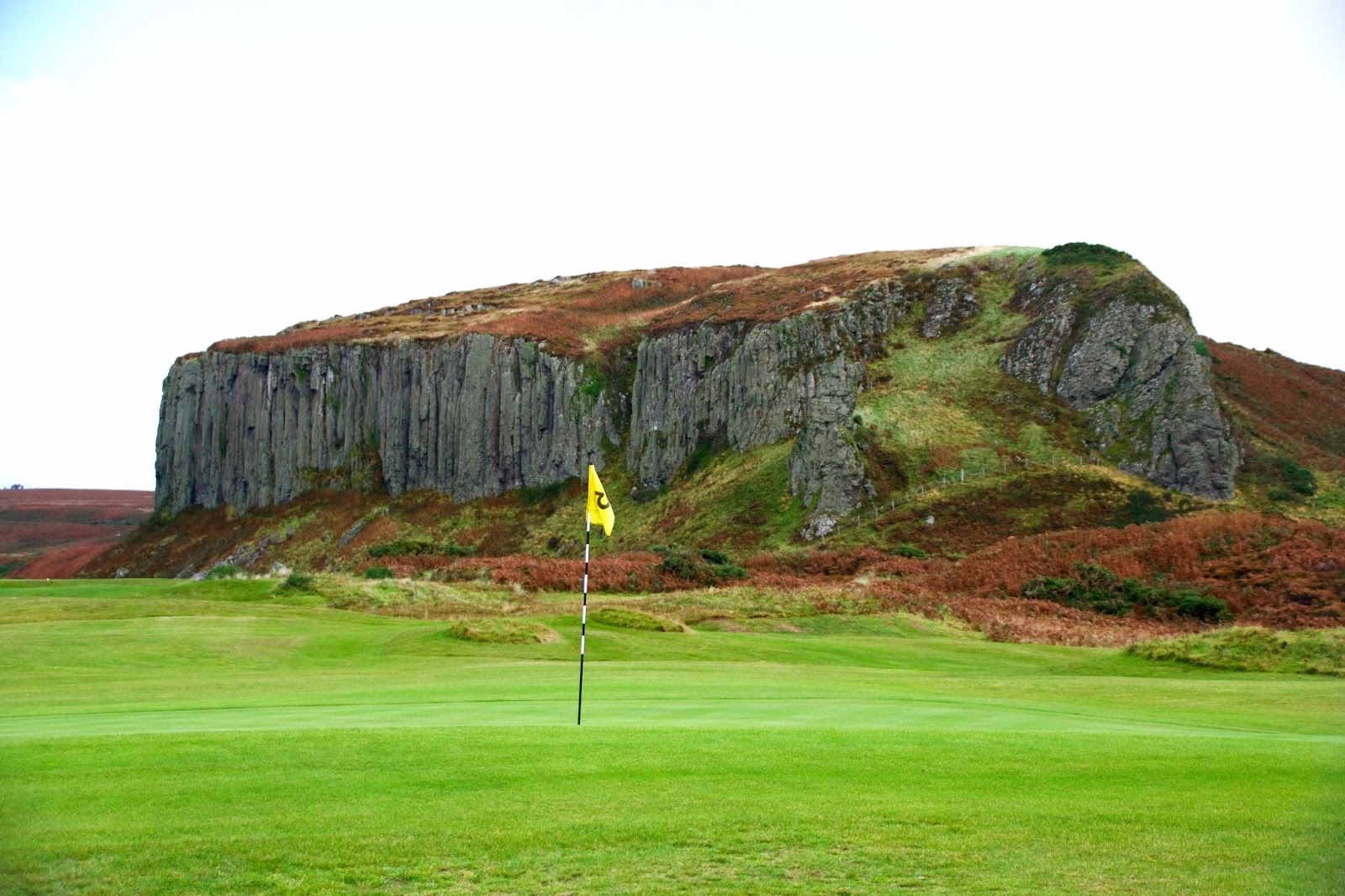
The 4th green with Drumadoon Head and Kilbrannan Sound in the background.

View from 3rd tee to the green with the Kintyre Peninsula past the Sound.


COURSE COMMENTS: Shiskine is our favorite course in the world. In good weather or in bad, the course will always challenge and delight. Shiskine is a 12-hole links course which plays along the shore of the Kilbrannan Sound and beside Drumadoon Head. The original 9-hole course was designed by Willie Fernie of Troon in 1896. In 1912 it was decided to expand the course to 18-holes. Willie Park Jnr was commissioned to build the new course. The Fernie course was scrapped, except for the 5th and the 9th, and new holes were built including six which played up on the side of Drumadoon Head. During World War I, 1914-1919, the hill holes were left to revert to grass and bracken because of a lack of work force to maintain them. After the war the club decided that besides being difficult to maintain, the hill holes didn’t meet the standard of the rest of the course. Thus was born the world’s first planned 12-hole course. It’s a number that visitors find just about right. If you want to go around twice in a day (the most the club will allow), 24 holes is also a very doable number. 

The course is a stunner with grand vistas of the Kilbrannan Sound, Drumadoon Head, rocks filled with seabirds, pleasant farmland, and the Kintyre Peninsula across the water. One of the most enjoyable features of Shiskine is that every hole is absolutely unique from every other hole-- wonderful variety. While mostly flat, there are some hills and raised tees and greens which add interest. Blind tee shots on seven of the 12 holes demand confident shot-making (or blind luck). Bunkers aren’t a problem at Shiskine; the few there are on the course are not penal. Gorse and fescue rough is a different matter. The biggest problem on the course is the wind and weather. If you hit a day without wind or rain, as we have a time or two, you may just want to play forever. If the wind is up and the rain is coming in sideways it’s a different course, but still one worth a go. 

I’m tempted to describe in detail every hole on this great course, but it’s probably best to let you discover much of it for yourself. Be sure to pick up a stroke saver in the golf shop before you go out; with all the blind shots it is almost a necessity the first time you play. Holes three and four are a fantastic combination. The 3rd, Crow’s Nest, is a 128-yarder seemingly straight up hill. A unique signal lets you know when the group ahead has cleared the green. Take an extra club, aim at the aiming post, and hope you can hold the green surrounded by heavy rough. For those who can’t reach all the way to the top there is a shelf about half way up so you can make two pitches. Once at the top you next play back down to the 4th green and the sea. The Shelf is a 146-yard one-shotter which plays down to a large flat green. If there’s no wind take about two clubs less. If the wind is up, into you, behind, or quartering, good luck--make your best guess and have a go. Hades, the drivable 222-yard par 4 eighth, is an opportunity for eagle or birdie with a good drive, or a high number if you find the gorse left and behind. Next is the 9th, Drumadoon, at 506 yards it’s the only par five on the course. The drive here is fairly open, but a deep burn makes the approach to the elevated green tough. Drumadoon is the most difficult hole on the back six (remember, it’s a 12-hole course). Everyone who plays at Shiskine recognizes its quality, so even if it is fairly isolated it will be busy most of the time. Be sure to call ahead, but be aware that the club only takes tee times 24 hours in advance in the summer. 

5th green with Drumadoon Point.

Teeing off over the hill on the blind 7th.


COMMENTS FROM THE FORWARD TEES: This continues to be one of my favorite courses in Scotland. It is unique because it has only twelve holes. What makes it really special is that it truly has twelve very different holes. Each hole is a test of skill and planning. Weather here can be unbelievably beautiful, sunny and calm or windy, cold, and wet. A burn runs through the course and the seashore is in play on four holes. The course is not long but don’t be fooled by the shorter yardage, you will be too busy planning your shots. The holes that require the most planning for me are the holes with dunes, hill, and hummocks to hit around and over. The 3rd is the first real thought provoking hole. It is a short 118-yard par 3 but to reach the green one must hit up to the green which is 60 feet above you. The green also slopes right to left and sits on a small shelf. The next is also a par 3 back down to the green and I find it easier to play than it looks especially if the wind is not in your face. The 5th has a small dune covered in grass right in the middle of the fairway where my first shot likes to land. Then comes the 7th which is a 164- yard par 3 with a 50-foot hummock to clear. You must not be too long or a burn gets your ball. There are more challenges on the rest of this course. Take the time to visit this wonderful course. I just love it. 

The small 12th green at Shiskine.

In the Area: On the small island of Arran there is much to see. We suggest a visit to Brodick Castle is worth your time as well as a visit one or more of the numerous ancient sites, such as the standing stones on Machrie Moor.


Golf in Scotland: The Hidden Gems is available at amazon.com.

Next: Small courses from my second Scotland book. 


Friday, March 11, 2022

It's About Me


It’s about Me


This post is about me. First is a story about my senior year at South Salem HS. Second will be 21 photos (some of my favorites) that I’ve never shared or displayed or sold as prints. I feel good about sharing both of these.


My Senior Speech Year at South Salem HS


My third year on the South Salem speech team was quite special and yet nobody really noticed. Throughout the entire year in debate, individual events, and special speeches I won awards in every event I entered—most of the time third place and never first. Besides debate, the individual events I participated in was quite a variety: extemporaneous speaking, impromptu, oratory, dramatic interp, salesmanship (Linfield College), public address (Linfienld), and student congress. In every one of these events in six different competitions (high school and college tournaments) I won awards. I also entered two scholarship competitions and won awards in each (Odd Fellows United Nations competition and American Legion Oratorical).  

Highlights for the year included winning five Superior or Excellent awards at Portland State in five different events—I competed in 3 events one hour and two events the next hour—I was awarded Outstanding Speaker in the tournament by Coach Dr. Ben Padrow. At the Linfield College tournament I placed in the three individual events I entered and with my partner, Mike Harrell, won 2nd in Sr. Debate. I did receive a speech scholarship to Linfield from Dr. Hap Mahaffey. At the state tournament at Oregon State University Mike and I along with Catrhy Stone placed third in team debate, and at the NW Regional National Qualifying Tournament at Evergreen College in Washington I won 3rd  in Men’s Extemp (top two got to go to Nationals).

With approximately forty trophies (all seconds or thirds) won in my senior year of high school, it was encouraging that my partner at Linfield, Paul Butcher, and I took first place (undefeated) in our first college tournament.


Some Favorite Photos


There’s no significant order to these photos, They are just images I like or that bring back good memories, yet I’ve never before shared them. I thought it was time they were seen and shared. Let me know which ones you like (or don't like).


Health and Safety doesn't like this picture.

Crown Point Vista House, Early Morning

Ancient standing stone and small castle in Central Scotland.

This really is a selfie taken on a Scottish ferry trip.

Grafitti Wall in Santa Fe

Anne enjoys a scone in a stationary rail car tearoom in Dufftopwn, Scotland.

An ancient stone circle in a cow field near Killin, Scotland.

Abandoned crofts on an island we passed on a ferry from the mainland to Kirkwall in the Orkney Islands, Scotland.

Dramatic clouds framed the dunes along Balnakeil Beach in the far Northwest corner of Scotland.

Anne crossing a clapper bridge (large flat stone bridge) in Datmoor National Park, England.

.
  

A small croft in the Scottish highlands near Braemar.

Gathering Pollen in Scotland

Tillamook Rock Lighthouse on a rare summer day.

Abiquiu Lake, New Mexico, near the home and studio of artist Georgia O'Keeffe

Forest bridge on the trail to the Burn O'Vat near Ballatter, Scotland.

Sunset in Arches National Park, Moab, Utah.

I have absolutely no idea what this creature is, but I know I wouldn't want to meet it in a dark alley. Photo taken near Sisters, OR.

Old Friends (Elgin, Scotland)

Anne on the trail in the far northwest of Scotland, near Durness.

Credit the photographer, Anne, for catching me at work in an ancient cairn in Ireland.

Store window and street reflection in Scotland. Is Anne inside or out?


Tuesday, October 4, 2016

Scotland Fall 2016: Glasgow, Fireworks, and Stone Circles

Welcome to the new readers from the OEA conference workshop.  Hope you enjoy the journey.

Picturesque Shiskine Golf Club

This is the road that circumnavigates the Isle of Arran.


An Afternoon in Glasgow
Glasgow Building Reflections

Jacky, our Scottish adopted sister, drove, so I got to look at the scenery as Anne, Jacky, and I went into Glasgow (an hour drive) to spend the afternoon with our adopted niece Ailsa, a second year Uni student majoring in Business. We parked at Ailsa’s dorm/apartment and walked the 20 minutes to Glasgow’s vibrant main shopping street Sauchiehall. Starbucks was our first stop—the first Pumpkin Spice latte of the season. 

Ailsa and Jacky on the down escalator.

Then it was across the Sauchiehall (a pedestrian mall) to the Apple store crowded with hundreds of Glaswegians struggling to get their hands on a new iPhone 7.  Is there enough difference to justify the expensive upgrade?  It seems there certainly is to many.
Street People

Street Art
Leaving the throngs to ogle the sparkling 7s, we walked down Sauchiehall to Buchanan Street (still a ped mall) where the ladies shopped at Primark, a clothing discounter.  For forty minutes I wandered outside the shop watching a steady stream of customers file empty-handed in and come out with bags of treasure. 

At one point, huddled against a display window under a small overhang, I pressed against the glass to avoid being drenched by a quick moving downpour. Anne, Jacky, and Ailsa eventually found their way out after the rain had ended; they were tightly clutching their Primark bargains.
I wasn’t as interested in shopping as I was in eating—it was 5:00 and we hadn’t had but a bite of cheese for lunch.  Ailsa promised us good food and great prices at a restaurant in the Italian section of Glasgow only a few blocks away.  

She made good on her promise; Amore offered a two-course dinner for £9.95 and my bruschetta and spaghetti with meatballs were quite tasty. 
A Glasgow Selfie.

Even the parking garages are well decorated in Glasgow.
It was a mile walk back to see Ailsa’s apartment and an hour back to Crieff.  Glasgow will be on our agenda in future trips—for the shopping, the food, and the people watching.  

Pladda Island off the southern coast of Isle Arran.

The mountains of Isle arran from the cross-island String Road.

Be Careful What You Say…

We were having a cuppa at the Corrie GC tearoom on the Isle of Arran and doing some writing. The tearoom manager was friendly and chatty with those of us in the room.  She commented about a group of young people who had just left saying, “They startled me. I hadn’t heard them come in and when I came from the kitchen they were there quietly fiddling with their mobile devices not saying a word. Just think, they’re the ones who will be in charge of us when we’re all in those special homes.” 

      She notice me writing and asked what I was doing.  When I told her that I was working on my notes for the golf guides we write she said, “Oh, I’ve got to watch what I say when I don’t know who’s in the room.” She laughed and went into the kitchen.
The village of Corrie.

A couple of minutes later she came out and told us a story of another time she should have held her tongue.  She and one of her regulars were talking about fireworks for Hogmanay, the Scottish New Year’s celebration.  The customer was bemoaning the fact that you couldn’t bring fireworks over to the island on the Caledonian MacBryne ferries from the mainland.  The tearoom manager said loudly enough for the whole room to hear, “I just go over to Ardrossan, buy about £400 of fireworks, cover them with a blanket in the back of my car, and drive right on the ferry—to hell with CalMac rules.”  One visitor said sort of quietly to her, “Young lady, you ought to be careful what you say in front of strangers.”
She gasped and said, “Oh my god, you work for Calmac ferries don’t you!”
“Yes, I’m a ship’s Captain.”
She said he wrote down her car registration (license plate number) and that her car now gets regularly checked.
Island post box or island art? Or both?

I found a tiny graveyard off the main road around Arran.  When I hiked to the graveyard I found stones commemorating members of Clan MacAlister, which is my clan. Notice the dates -- 1961 and 1783.


The Stones of Isle Arran

It wasn’t a long drive from our B&B in Lamlash on the Isle of Arran to Brodick and then over the String Road to the small parking lot on the west coast of Arran about three miles north-northeast of Blackwaterfoot.  At one end of the ten car lot was a gate with a sign pointing inland to Machrie Moor.  Through the gate, Anne and I started the one and a half mile hike that would take us back four or five thousand years.  


The view back down the path to Machrie Moor.
We started our hike along a well-worn cart track through fields of sheep who weren’t very interested in us, unless we got too close.  We passed several small groups of people hiking back to their cars and by the time we reached the first ancient site along the trail, we were alone with the stones.
The first ancient monument on the way to Machrie Moor is probably a cairn with kerb stones around it.

Most impressive of all the archeological sites on Arran are Moss Farm Road circle and Machrie Moor which has been called “the best group of architecturally varied circles in western Europe.”  The path is a dirt and gravel cart track which climbs gently through pastures to the Moss Farm Road stone circle (labeled “Circle X”).  The “circle” is a type of burial cairn which is surrounded by a series of upright stones.  Ancient people passing the cairn would have been impressed by the family’s importance shown by building such a fine monument to their dead.  
Moss Farm Circle

Old Moss Farm

Continuing past a couple of significant standing stones we came to the ruins of Moss Farm.  Here was the first of six stone circles in the care of Historic Scotland which make up the Machrie Moor stones.
Machrie Moor is an area of approximately five square miles of flat fertile soil called low blanket bog.  The name machair means an area of flat sandy land.  This had been an important area of human habitation far before the 1800 to 1600 BC date of the stone circles we see today.  
The main stone of Circle No. 2.


The wide moor hosts numerous prehistoric monuments, tombs, and hut circles besides the six main megalithic stone circles.  The moor was abandoned at the end of the Bronze Age (about 2600 years ago) because of climate change and poor farming practices.  
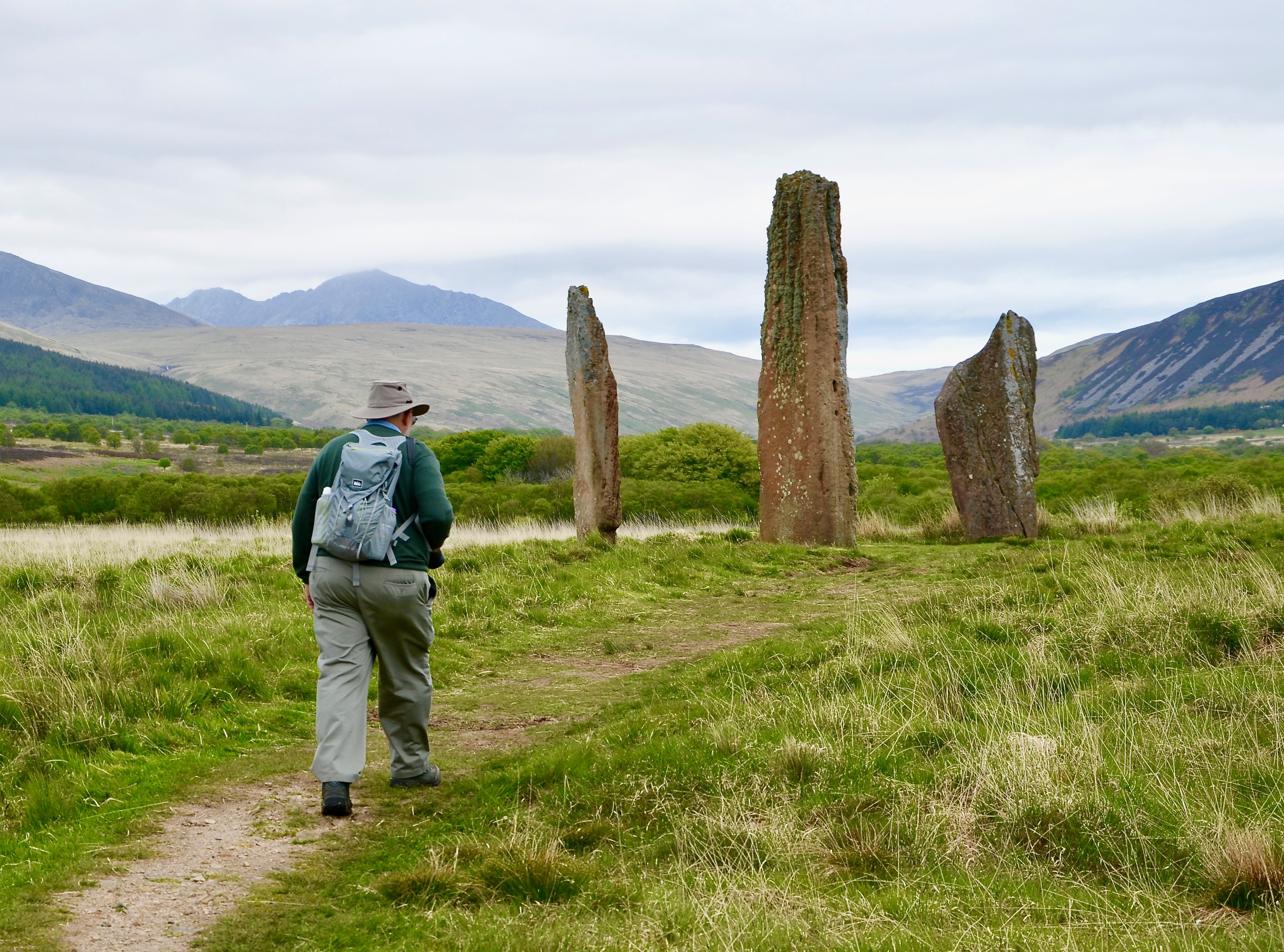
Three stones of another circle on Machrie Moor.


Of the six circles Circle II contains the largest stones reaching almost 18 feet in height.  Circle V, a concentric ring about 60 feet in diameter, is known as Suidhe Choir Fhionn or Fingal’s cauldron seat.  Legend says that Fingal, the mythological Scottish giant, tied his dog Bran to a stone in the outer circle while he ate a meal in the inner circle.  Circle XI is the most recently excavated being uncovered in 1985-86.  

Diggings at the various circles have unearthed a smattering of human remains, arrowheads, a bronze awl, a food container, a beaker, and several flint flakes. The stones may have served a variety of ceremonial and/or astronomical purposes. Archeologist John Barnatt suggested in 1978 that the circles aligned with a notch of the Machrie glen skyline and that the notch is split by the rising sun on Midsummer’s Morn.  
The view back at the parking lot for Machrie Moor.

Anne and I noticed an interesting juxtaposition on the moor—the contrast of viewing the crumbling ruin of Moss Farm, probably only 200 to 300 years old, and the permanence of the stones placed there by primitive people more than 4000 years ago.  As we walked back to our car we again passed small groups, this time heading up to view the stones.  It was nice to have had the moor to ourselves at least for a little while. 


The Birks (birches) of Aberfeldy

A fitting good-bye to Scotland from our home course at St Fillans.