The New Year is here and as always it presents to us opportunities for new beginnings. I am busy planning travel for the coming year--Las Vegas, Death Valley, the Washington coast, Phoenix and Flagstaff, Utah and Colorado, the Canadian Rockies, Scotland. Until I've actually done some traveling, I have a couple of interesting items for the first blog of the year. The first is an article from my first travel book (now out of print, although Amazon still has some copies of Ten Years of Travel in Scotland, Ireland, England, and Wales available) and the second is some thoughts about how Anne and I travel, using timeshare.
The Mark of the Mason:
An Exploration into the History and Meaning behind the Marks on Stones Found in Scotland
Anne, and I pulled up to Balmerino Abbey on Fife about five miles west of Newport on Tay on a blustery September day in 2000. Having come off the links at St Andrews we were sightseeing our way back to our B&B in Crieff. To us the abbey was just a dot on the map which looked to have an interesting location along the edge of the hills with vistas out to the Firth of Tay, Dundee, and the Carse of Gowrie across the firth. The abbey ruins looked intriguing and the National Trust of Scotland sign indicated we would learn something on our visit.
Nobody seemed to be about, so we entered the unlocked gate and started to wander the grounds taking pictures of the remains of the 13th century abbey and abbot's house. We turned a corner to get a look at the chapter house and were startled to see a man bent over cleaning stonework. He was as startled as we and told us that the abbey was closed for the day so that he could do some preservation work, but when he found out we were members of the Trust he offered to give us a tour of the abbey. Membership definitely has its benefits. Our guide, the abbey’s curator, told us about the work he was doing to preserve the abbey ruins, showed us the influence of Rome in the arches, and most interestingly pointed out the marks left on stone blocks by the 13th century masons who put the building together.
From that first visit to Balmerino Abbey, Anne and I have looked for the marks of the masons who cut the blocks used in abbeys, chapels, cathedrals, and castles throughout Scotland (and the rest of Europe). Mason marks, also called Banker’s Marks, have a fascinating history and serve several important functions. Also, hunting for them is an enjoyable activity for the tourist visiting Scotland’s historic sites.
 |
| Fraser Castle |
In the study of mason marks we must first understand what they are. The broadest definition says that mason marks are monograms, symbols, or arbitrary figures chiseled (cut) by a mason on the surface of the stone. Or as Alison Stones says in her article on Chartes Cathedral of Notre Dame, mason marks are “the inscribed signature symbols of masons on a building’s stones.” The Stonemason’s Dictionary (1999) points out that each stonemason or cutter had his own pattern for a mark. It was usually a simple design composed of straight cuts. These marks would be engraved on the blocks the mason cut as well as on his tools. These may have indeed been the world’s first “trademarks.” Most of the time these marks would have been covered by surface treatments such as frescoes or plaster, but time has left them exposed to the eyes of visitors.
The purpose of these marks is open to debate. Theories suggest the marks were used primarily to identify who cut the stone so they could get paid for their work, thus the moniker “Banker’s Marks.” It would have thus been possible to attribute any defects or excellence to the appropriate mason. This was an early form of quality control as the mark would identify a mason who inaccurately dressed a stone. Today, we can identify castle builders through their marks or “sign manuals” to their works, similar to an artist signing a painting or a sculpture. Often when we find the same mark in two or more places we presume the marks belong to the same person. When a mason migrated from one place to another he carried his skill and mark with him. For example, George Bel of Clan Bell was a builder of Midmar Castle in Aberdeenshire. Subsequently his sons Ian and David built five additional castles in the 14th and 15th centuries--Craigievar, Crathes, Drum, Fraser, and Fyvie. We know this from the marks they left in stone. Other theory suggests the marks could indicate the placement of the stone to facilitate construction. A third theory suggests that mason and carpenters (or wrights) mark specific stones with symbols of the sun or Virgin Mary as talismans to ward off evil demons who were thought to enter through windows or doorways. These marks were applied to architectual features in interior as well as exterior entry points. Craigievar Castle in Aberdeenshire has some excellent examples of this type of mark.
 |
| Huntingtower Castle |
Mason marks have a long and complex history going back as far as 2500 BCE. Two thousand “mark men” were employed by the builders of Solomon’s Temple whose duty it was to mark the stones to facilitate their assembly on the building site. The marks of this period were most probably mythical, symbolic, or historic (an allusion to specific events). These type of “operative marks” have been found in the stonework buildings of the Egyptians, Assyrians, Babylonians, and Greeks as far back as 1500 BCE. According to the International Trademark Association, quarry marks or stonecutter’s signs have been discovered on materials used in buildings in Egypt as early as 6000 years ago. Mason marks have also been found in ancient buildings in Italy, Israel, Syria, and Turkey. These are marks made by masons, but are not the “proprietary mason marks” we find in Scotland.
 |
| Tullibardine Chapel |
The modern (a relative term) marks we found at Balmerino Abbey are quite common in Scotland’s churches, abbeys, and castles, and are similar to marks found throughout Europe. The proprietary marks used to identify the man who shaped the stone can be traced back to the 10th century building of the Cathedral of St Mark in Venice. Since little of the population could read or write, when he became a qualified mason each collected his mark or design which became his mark for life. These marks were cut into stones so they could be seen after integration into the construct--by the builders, not necessarily by the public. Mason marks represent the name, character, integrity, and skill of the individual mason. Most important to the masons was to identify their work because the cutter would get paid by the piece. In both Germany and Scotland the marks of the masons were organized and recorded. Others areas may have done the same, but no proof has been found. The Scottish Schaw Statutes of 1598 show how a mason would register his mark and delineates who was entitled to register his work. Another law was set down in the St Ninian’s Masonic Lodge at Brechin which said that every mason should register his mark in a book, and he could not change that mark at pleasure. Besides masons other crafts made use of registered marks. We are familiar with the marks of silver and goldsmiths, but few know that according to the 1681 Statutes of Rheims (France) “order that every baker shall have his different mark in perpetuity to mark his bread.”
It was Mr. George Godwin who in 1841 was the first to write about the stones in old churches of England, France, and Germany which bore the marks of the builders. The marks that were registered and that visitors can find today fall into several categories or styles [see Figure 1].
One category of marks are those called Literal. These were patterned after initials of the mason. Geometric designs, much more common than literal marks, represent a second category. These marks are made up of angles, curves, circles, and mathematical figures. Finally, there is a category of Symbolic marks. These generally relate to specific meanings, often religious, and are quite recognizable today. The most prominent of these marks are the Pentalpha representing a talisman against evil or the five wounds of Christ; the Hebrew star or Seal of Solomon; the Swastika of Fylfot, the mystical cross of Buddhists; and the Vesica Pisces, the fish symbol of Jesus [see Figure 2].
Besides these major categories of marks there exists an almost infinite number of variations on the basic marks [see Figure 3].
Thirty different marks of all types were copied from the stones of the underground walls of Old Trinity Church, Edinburgh, before it was demolished.
Scotland has some good locations for starting your search for mason marks. Of course, Balmerino Abbey was for us an excellent beginning. Several other locations come to mind as good hunting grounds. Crossraguel Abbey, about two miles southwest of Maybole on A77 in Ayrshire, has several fine examples of both geometric and symbolic marks which are easy to find. At Tullibardine Chapel, between Crieff and Gleneagles Resort off A823 on a minor road (signposted), you only need to look up at the transept arches to find numerous examples of all three types of marks. Melrose Abbey in the heart of the Borders is rich with Scottish history and mason marks.
 |
| Melrose Abbey |
We’ve also found good examples at Edzell Castle in Angus north of Brechin, in Duone Castle near Stirling, as well as in Innerpeffray Chapel, Brechin Cathedral, St Giles Church in Edinburgh, Huntingtower Castle in Perth, and the well known Roslynn Chapel. We found a specialized mason mark in Iona Abbey. As the current floor of the abbey was laid, masons would cut a Christian cross in a stone which covered a former grave.
The phrase “to leave your mark on the world” has special meaning in regard to masons whose work in the 13th, 14th, and 15th centuries we now visit. Even today we talk about the “mark of a man.” If you have visited Scottish abbeys or castles and haven’t noticed the mason marks, don’t feel alone. George Godwin in 1869 wrote, “It is curious how long a thing may remain unseen until it has been pointed out.” In another example an old priest at one abbey, when a number of mason marks were pointed out to him, commented, “I have walked through this church four times a day, 28 times a week, and never noticed them. Now I cannot look anywhere but they flit into my eyes.” As a tourist visiting Scotland’s abbeys, cathedrals, and castles you should take the time to seek out the mason marks so long ago cut into the stones.
For Further Reading:
Guides Notes from Culross Palace, Lorraine Hasketh-Campbell, National Trust for Scotland
Grand Lodge of BC and the Yukon
“Chartes Cathedral of Notre-Dame,” Alison Stones
Timeshare
When Anne and I retired we decided to invest in Timeshare instead of a motor home or trailer. We’re happy with the decision we made most of the time, but timeshare is not for everyone. As I plan for our travels in 2018 I think about the advantages and disadvantages of timeshare ownership:
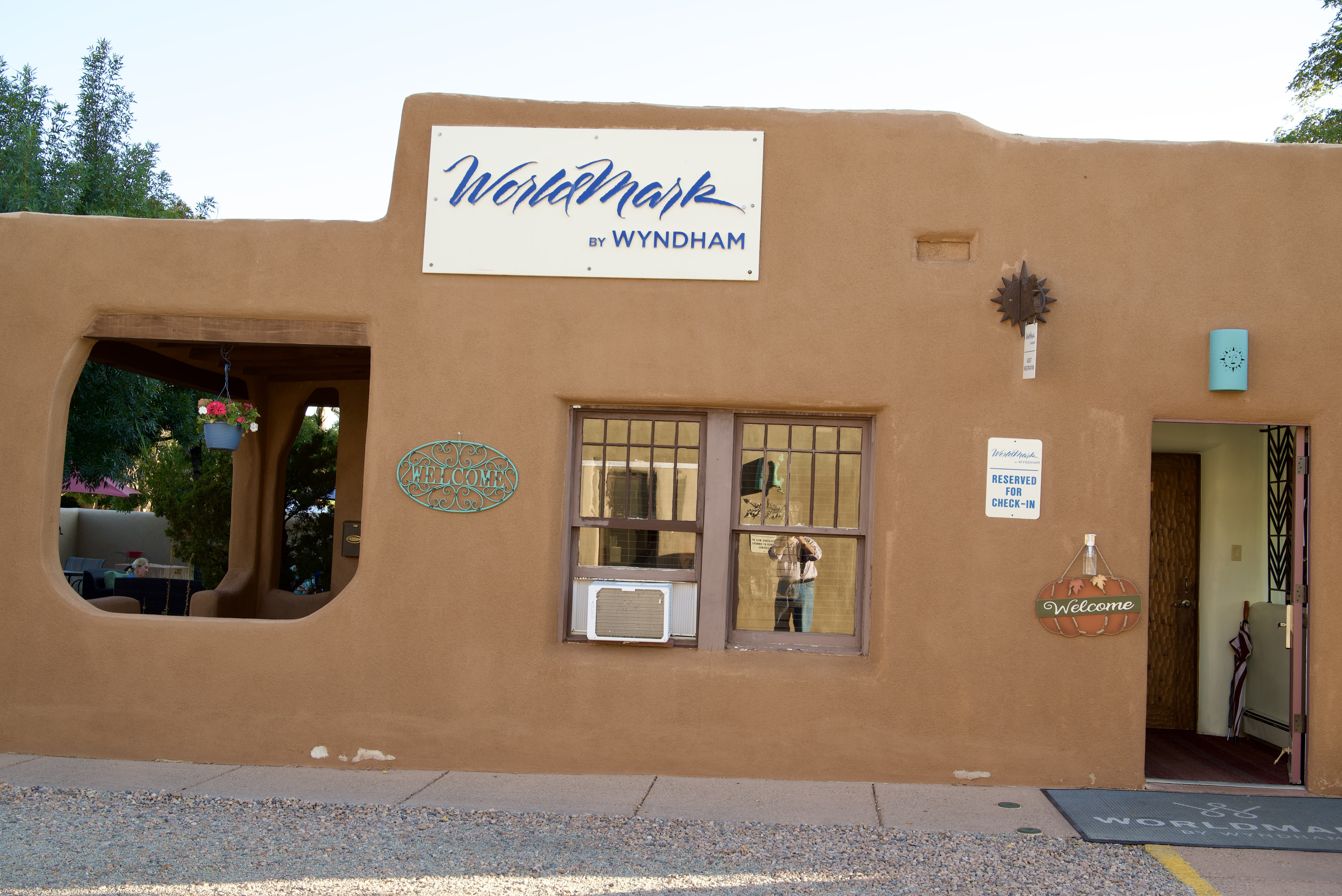
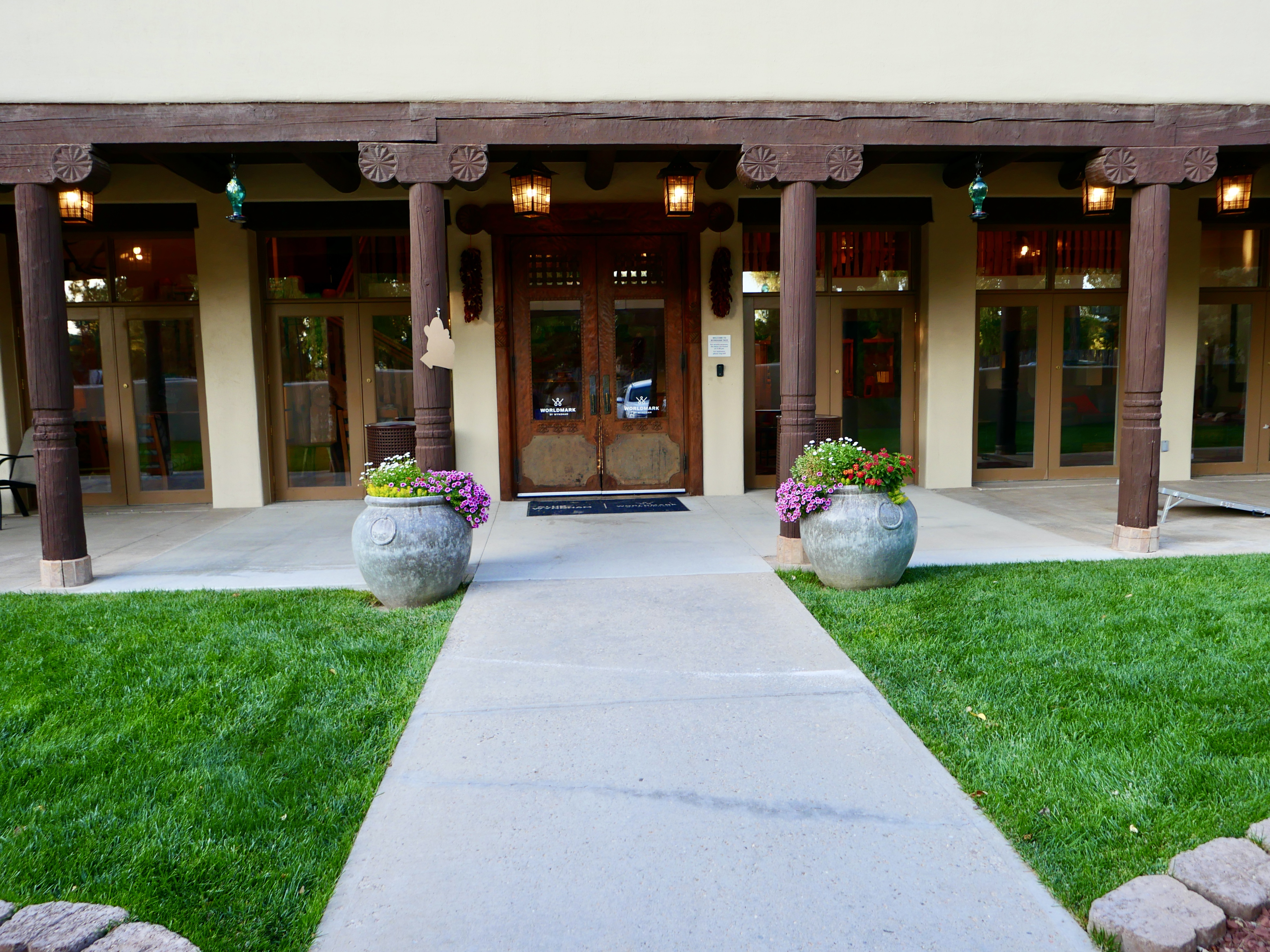
Advantage: The places we stay in through our Worldmark (by Wyndham) ownership are fantastic. Most of our accommodations are four and five star and in prime locations (Santa Fe, Taos, San Diego, Solvang, the Oregon and Washington coast, Seattle, Vancouver BC, Victoria, Whistler, San Fransisco, etc.).
Disadvantage: The cost of buying into timeshare can be quite an investment and the yearly fees are high as well.
 |
| Garden bedroom at Kilconquhar Castle |
 |
| The Castle |
Advantage: Once you pay for and use your timeshare (points or credits), you get them back the next year and can use them again, and again, and again.
Disadvantage: Many of the prime locations are difficult to book because everyone wants them (ie., Hawaii, the coast, etc.). It takes diligent planning to book those special places.
 |
| Santa Fe, New Mexico |
 |
| Our unit in Santa Fe |
Advantage: Many special features come with ownership—bonus time (last minute cheap bookings), exchange programs with other timeshare companies (this is how we book into timeshare in Scotland and Wales).
Disadvantage: The company is in constant sales pitch mode which is hard to avoid if you want to keep updated on program changes.
 |
| Hilton Craggendorrach in Ballater |
Advantage: Our program is an ownership which we can pass down to others.
Disadvantage: Younger family members may not want the obligation, thereby striking the previous advantage.
 |
| Las Vegas, a favorite place to stay |
Advantage: We don’t have to empty the water tanks or repair the motorhome.
Advantage: We get automatic discounts when we book into lodging aligned with our ownership (Wyndham owns several major motel/hotel chains).
 |
| Slainte! from Ballater |
As I said, timeshare is not for everyone and there are times when our sister and her husband take off in their motorhome and stop wherever they want, we are envious. But, in the long run, we love the investment we made and the travel it has encouraged and helped us do.