|
| Rio Grande Canyon |
Our Southwest trip now continued with Santa Fe, New Mexico, as our base. Santa Fe has changed greatly since I started summer teaching at the College of Santa Fe in the late 1980s. For one thing, the college has folded, reopened, and folded again. The city has grown, of course, but the feel of the “City Different” has basically stayed the same.
Our digs in Santa Fe were at the Santa Fe Worldmark (timeshare) where we had a pleasant one bedroom unit in the oldest part of the facility.
From there we looked forward to a week of adventures.
The first full day we stayed in town visited a few of the main attractions. First was the downtown Plaza with its art and souvenir shops.
 |
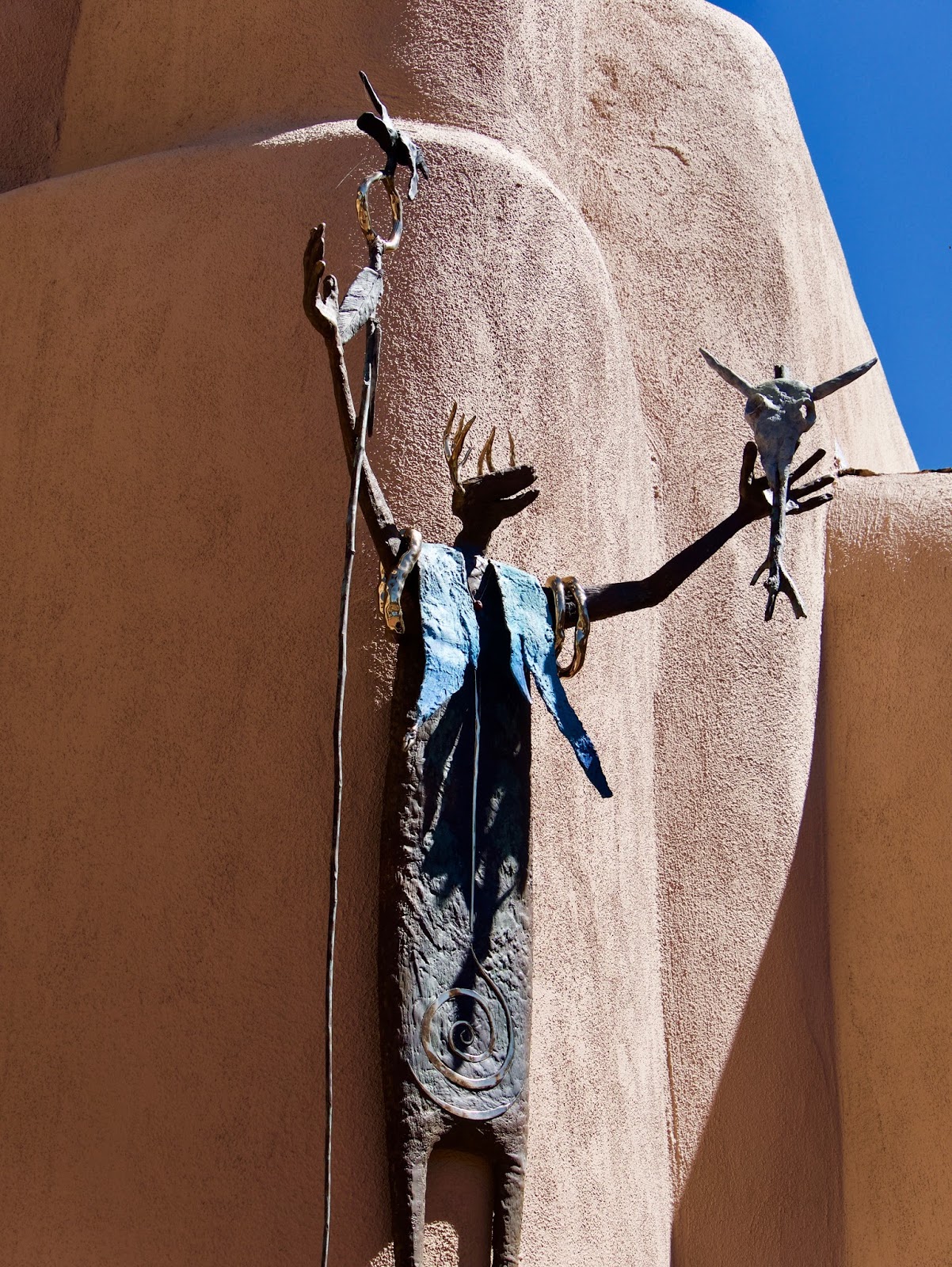
| Outside art in the Plaza area. |
The shop that got our serious attention was Starbucks—we’d been too long without our fix. Shopping was at the Governor’s Palace,
an area under cover set aside for native crafters to sell their wares—you’re guaranteed of handmade native goods there. Anne found a couple of sellers with earrings she liked
and I found a native couple who will make me a special bracelet.
It was a short walk from the Plaza to the Basilica Cathedral St Francis of Assisi.
Built in 1886 by Archbishop Jean Batiste Lamy, the church serves as the mother church for the Archdiocese of Santa Fe.
Lovely outside, the church has a beautiful interior highlighted by historic stained-glass windows. On the other side of the Plaza from the church we enjoyed the Georgia O’Keeffe Museum and the Andrew Smith photo Gallery next door. The Georgia O’Keeffe Museum, opened in 1997, celebrates the artistic legacy of one of America’s premier artist, called the Mother of American Modernism.
 |
| An iconic O'Keeffe image. |
The museum exhibits tell the story of O’Keeffe through videos, her art, and photographs by contemporaries such as Ansel Adams, Alfred Stieglitz, and others. Not cheap (but then very little in Santa Fe is), the tour of the museum is worth both the money and the time.
 |
| Photo of dog in photo shop. |
Next to the museum is a small photography gallery that used to be exceptional. Now, much of the lower floor is converted into an antique shop, but the upper floor still had some nice photography on display—and there’s no fee to visit.
Before golf on our second day we drove out to the La Cieneguilla Petroglyph site on the edge of town. We expected a short hike and lots of accessible rock art, at least that’s what various guidebooks said.
The hike to the base of the rock cliff with the art was 15 minutes and then we began the climb up a 200 yard boulder field. We were ill prepared for this type of trail. I managed to get up to the art, but Anne struggled more with the rocks and uneven footing. Talking to other visitors, I found out that the art extends along the cliff face for about a mile.
 |
| The Cieneguilla area is famous for Kokopelli images--Kokopelli is the humpbacked flute playing fertility god. |
I settled with what I could see at this first site and then helped Anne back down through the rocks. This will be a place to come back to with more time and better equipped with boots and hiking stick.
Saturday [End of the World Day] was our Taos Day. We took the High Road to Taos which is longer and more scenic than the freeway and would take that road again. We made several stops for photos at vistas and local historic churches, but our best stop was at El Sanctuario de Chimayo in that small village.
This early 19th century church has become a pilgrimage site attracting almost half a million visitors each year. The main adobe church with two bell towers is lovely both inside and out (no photos inside).
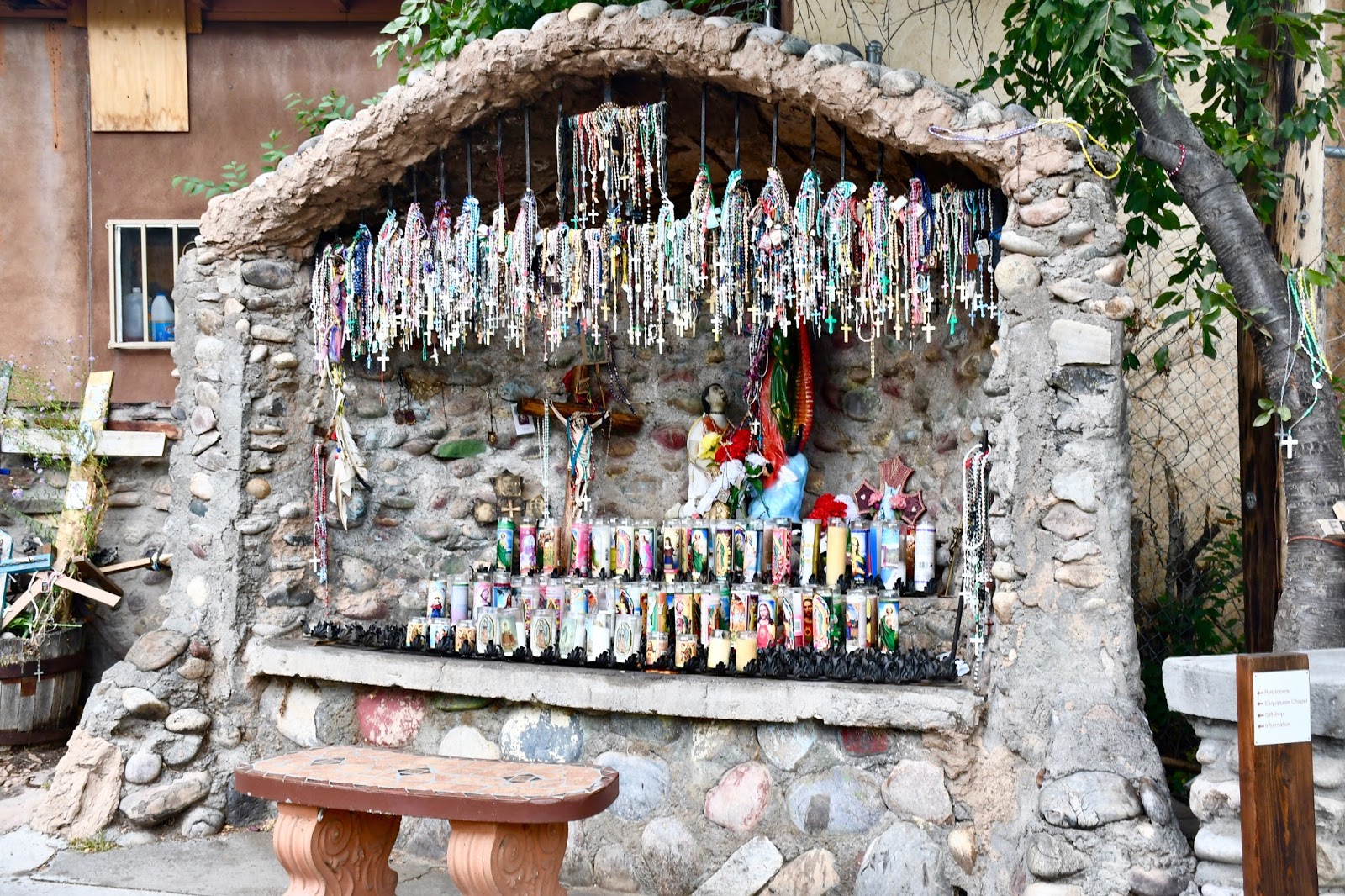
The whole sanctuary village is a photographers paradise with interesting shrines and architecture. In Taos we did a little spending at a local artists’ market and then wandered in the shops in the old town square.
 |
| Photo gallery in Taos |
 |
| Taos art Kokopelli. |
We ended our Taos trip paying homage to famous photographer Ansel Adams when we visited one of the spots he and Georgia O’Keeffe made famous, the San Francisco de Asis Church.
Completed in 1816, the adobe church is recognized as a fine example of Spanish colonial mission architecture. The church is a treasure inside and out and has been an inspiration for numerous artists.
I spent about an hour trying to get a good set of photos. This is one of my favorite places to visit in the world.
On Sunday, after wandering in the artist area of Santa Fe known as Canyon Road,
 |
| Canyon Road Art Shop |
 |
| An average house on Canyon road in Santa Fe. |
we met our adopted New Mexico niece, Jasmine, her husband, Zach, and their 10-month old girl, Zea, at Kakawa Chocolate Shop. Between hot chocolate and sweets at Kakawa and lunch at Cafe Pasqual’s, we had a wonderful visit.
Jas is the daughter of Bill and Cat Bennet whom I taught summer debate camp for; we watched Jas grow up and have managed to keep in touch. Look up Zach and Jas’s “natural farm” website at www.wildhoodfarm.com.
Our last touring day was spent at Bandelier National Monument about forty miles from Santa Fe. We arrived at White Rock Visitor Center, but had just missed the shuttle bus to Bandelier. During high season, to limit auto traffic at the monument, White Rock provides a free shuttle ride to the monument. The shuttle takes 25 minutes and runs every half hour. At Bandelier we hiked the main trail up to and past ancient cliff dwellings and petroglyphs.
There was even one set of pictographs (painted images instead of chipped)
—usually, pictoraphs are only seen in extremely inaccessible locations. Anne hiked the main trail back to the visitor center while I hiked an extra mile to Alcove House.
 |
| Alcove House--takes four ladders to get up to it. |
After spending two hours in the park, we boarded the shuttle back to White Rock.
Our flight home ended up being delayed by about five hours due to storm damage to the plane we were supposed to board in Albuquerque.
The delayed flight gave us plenty of time to reflect upon our great trip and start planning the next trip to the lovely Southwest.
NEXT: Greeting from Scotland as We Enjoy Our 30th Trip since 2000.