Showing posts with label Painted Hills. Show all posts

Saturday, July 25, 2026

#240 Parkinson's, My Greatest Golf Shot, and Photos


 #240 Parkinson’s, My Greatest Golf Shot, and Photos

Dramatic skies on our way to the coast.

The bridge at Florence, OR.

A latte and some work time at one of our favorite stops.

One of our favorite stops.


Photos in this post all come from an iPhoto album called Covid Year, May to December 2021, one of the files to which I’ve recently regained access. Any semblance of organization is purely coincidental.


Young Crow


Parkinson’s Information 


The Wearing of Masks

We agree with this sign at a Manzanita coffee shop.


Now that I am up from my latest fall I can continue my discussion by attempting to explain the complex progression of Parkinson’s Disease. Please note that the exact progression or rate of progression varies drastically from patient to patient. Sources for this information include The Parkinson’s Foundation and The Michael J Fox Foundation.

The broom has almost swallowed the asphalt path at South Beach in Florence.

We bought a new Subaru Forester.


Parkinson's disease progression is typically measured using the Hoehn and Yahr scale which categorize the disease into five stages based on motor symptoms and functional disability. 


  • Stage 1 (Early-Stage): Symptoms (such as tremors or stiffness) are mild and only affect one side of the body. They do not typically interfere with daily activities. 
  • Stage 2 (Mild): Symptoms start to affect both sides of the body. Posture and walking may change, but balance remains intact, and the individual remains independent. 
  • Stage 3 (Mid-Stage): Balance and movement become noticeably impaired, leading to a higher risk of falls. Daily tasks are slower and take more effort, but individuals can still function relatively independently. 
  • Stage 4 (Advanced): Severe symptoms require the use of assistive devices like a walker. Independent living becomes unsafe, as individuals need help with daily tasks. 
  • Stage 5 (End-Stage): The individual is confined to a bed or wheelchair and requires 24/7 care. Non-motor symptoms such as confusion or hallucinations may also be present. 
Painted Hills


For more information or to donate to help find a cure for Parkinson’s, check out these sources:


The Davis Phinney Foundation, www.davisphinneyfoundation.org


Michael J Fox Foundation, www.michaeljfox.org


Parkinson’s Foundation, www.parkinson.org


Parkinson’s Voice Project (SPEAK OUT), www.parkinsonvoiceproject.org 


Parkinson's Resources of Oregon, www.parkinsonsresources.org 


Near Sisters, OR

Mitchell, OR


YOUTUBE podcasts I’ve found useful:


Doing Life Today [Bryce Perry]

The Secret Life of Parkinson’s

Dr. Luis E Zayas, MD PT

        Parkinson's Disease Education 


My Greatest Golf Shot


Winter Golf


I’ve been playing golf since I was ten years old. I’ve played hundreds of courses in the US, more than 250 in Scotland, more than a hundred in Ireland, about 30 in Wales, and even a few in England and Canada. I’ve played enough golf to have written books about it that still sell on Amazon. I started out playing bad golf and I got better. I’ve scored three holes-in-one (witnessed) in my golfing career. My handicap got as low as 10 (official USGA) and I maintained a handicap below 15 for several years before Parkinson’s disease took away my balance and my golf game went with it. Why with all this history with golf would I call the recent drive I made on the ninth hole at Arrowhead GC (our club in Molalla) the greatest shot I’ve ever made?


Deer at Smith Rocks State Park


It was a couple of Sundays ago that I was playing in my usual Sunday foursome—Anne, Kris, Jackie, and I. I was recovering from my latest fall so I only chipped and putted on most of the first eight holes. But on the ninth I decided to try hitting a full shot. I didn’t have any of my clubs, except a nine=iron and putter, with me so I borrowed Anne’s driver for the shot. I teed the ball up and took one practice swing. When I stepped up to the ball I had to wait a few seconds for my tremors to calm. With my tremors silent I took a full backswing and with a smooth downswing sent the ball straight down the fairway about 180 yards—a distance I hadn’t seen in two years! I remember thinking I had taken a full slow swing, that I’d watched the clubhead strike the ball, that I’d kept my head down though the swing, and that I still had my balance after the swing—none of my usual extra steps to catch my balance and keep from falling. This was my greatest shot because it gave me hope that even with Parkinson’s I may still have some good shots left in me. My 375-yard drive over the eleventh green at the Struie Course at Royal Dornoch was longer and straighter and my swing when I was a 10 handicap was more consistent. But this shot gives me hope.


That's All, Folks!


NEXT: It depends upon what I find.


Thursday, November 18, 2021

Central Oregon -- Photos and Stories, Part Two

The fried ravioli we had at the Eagle Crest Resort cafe was a delicious small surprise.


Our Big Surprise


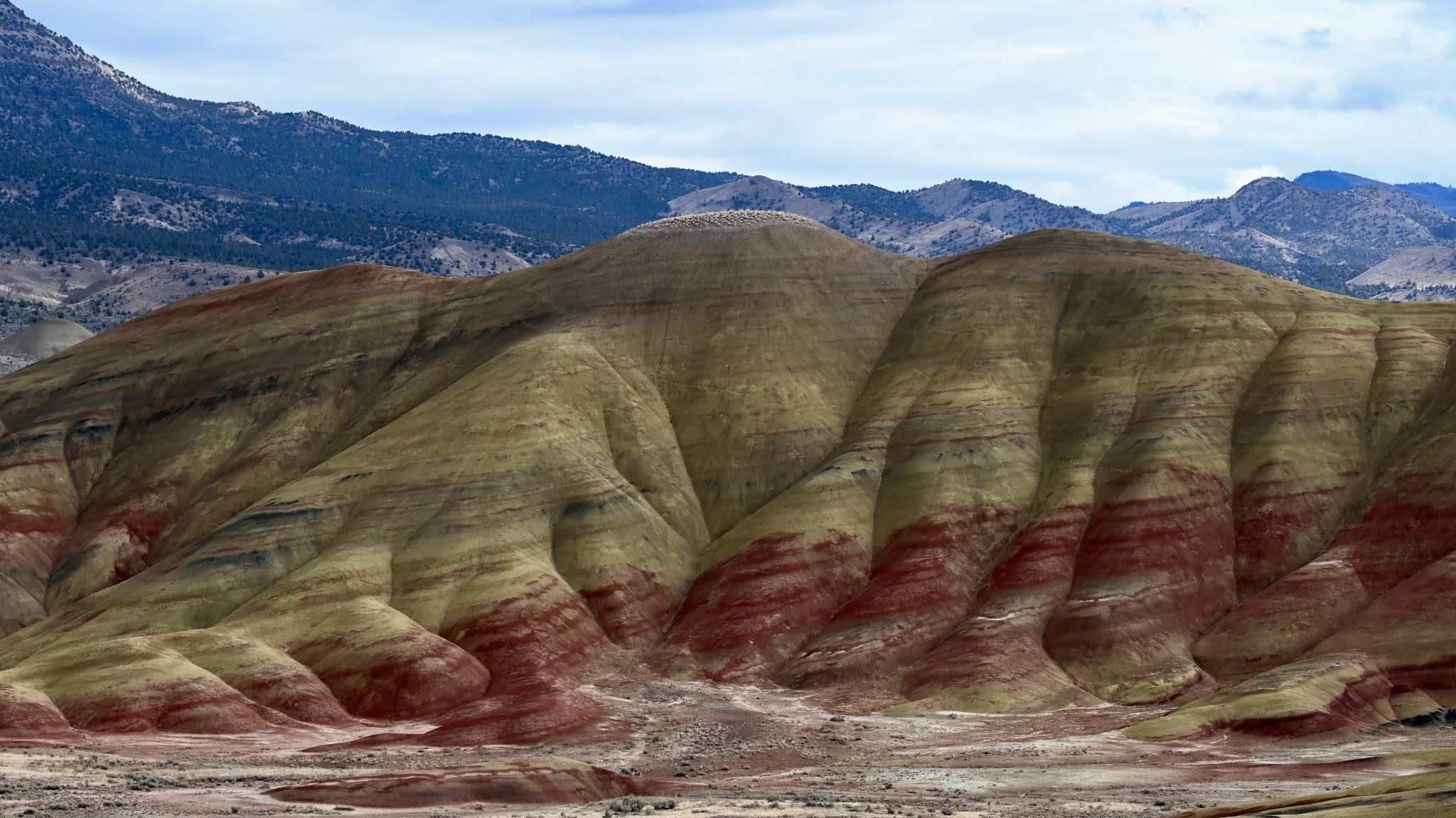
The last post highlighted the first days of our trip to Central Oregon. This post details some of the rest of the trip, including our biggest surprise. As we were getting close to Mitchell from Redmond and bemoaning the fact that the better photo opportunities were further on (where we weren’t going), we saw a sign which read, “Painted Hills 6 Miles,” pointing to the northwest off Hwy 126. 

Coming into the Painted Hills from Hwy 126.


I thought the Painted Hills were much closer to John Day and thus beyond this day’s drive. So, now I had my missing photo op.


The Painted Hills are the western most unit of the three part John Day Fossil Bed National Monument—Painted Hills, Sheep Rock, and Clamo units. Nine miles northwest of Mitchell, the hills are considered one of the Seven Wonders of Oregon,


along with Crater Lake, Smith Rock, the Columbia River Gorge, the Oregon Coast, the Wallowa mountains, and Mt Hood. The Painted Hills are definitely a geological wonder known for the colorful layered hills. 


The colors developed in the hills as early as 35 million years ago. The colors we see today correspond to both geological eras and chemical composition. The red represents a warm and humid climate and the predominance of iron in the soil. The yellow, in contrast, comes from a drier period and the presence of the building blocks of aluminum. Darker or black veins are from vegetative matter, while the gray is from sandstone or shale. The colors will change in intensity with the amount and intensity of light—the hills can look very different morning to night. I think the colors are better for photos in the muted light of cloudy weather, but I’d never pass up a sunny day in the hills.

This circular opening in the sandstone hill shows the layers beneath. Kind of freaky looking, almost like an alien eyeball peeking out of the hill.


The Painted Hills Unit has several different viewing areas. On this visit I photographed from the main vista point (and partially up the viewing trail) and from the short Painted Cove trail. 

The Painted Cove quarter mile trail is part boardwalk and part gravel. 


This is the view from the top of Painted Cove trail.


There are numerous trails in the unit, and you are strongly requested to stay only on official roads or maintained trails to protect the Hills from unnecessary erosion.

Being able to photograph the Painted Hills with almost no one else around was a grand surprise.


The view from the small visitor center parking area.

An Interesting Museum Visit


Just out of Bend, Oregon, about a half hour drive from our digs in Redmond, is the High Desert Museum. 


The museum was very Cove aware and responsible--masks in all areas, reserved seating in the Bird of Prey demonstration area.


Opened in 1982, funded by members, donors, visitors, and grants, the museum is affiliated with the Smithsonian Foundation. Open all year, the High Desert Museum presents the high desert landscape (flora and fauna) and its relationship to the people through both permanent and changing exhibits. 

There were snakes also, but Anne didn't want any pictures of those.


We were impressed with exhibits relating to indigenous peoples—my background includes a bit of Apache. And, although I’m not a fan of zoos, I enjoyed the presentations of native species—mostly creepy crawling things. 

Shy bald eagle.

Menacing golden eagle.

She could be at Hogwarts.


Outside the main building is a well done display of rescued birds of prey and inside was a fine flying exhibition of a small falcon. We could have spent much more than the two hours we did, but my legs sort of said, “Enough.” 


The High Desert Museum is well worth whatever time you can spend. More information is available at www.highdesertmusem.org.


Story of the New Ride


I know I mentioned a new car in the previous post, but this is the story of that new car. We sold our hot 2007 VW Fahrenheit GTI (#914 of 1200 made) to get a truck to pull our mini trailer. Then we bought a 2017 Ford F150 with very low mileage. The truck was fun to drive and great for pulling the trailer. We found, though, that we really weren’t cut out for the trailer life—our camping out is in a five star Worldmark timeshare resort. So we sold the trailer and kept the truck. During the early part of Covid times the truck mostly sat. When we did take it to the coast on a rare several day trip we had trouble parking and getting around where we wanted to go. That trip convinced us we didn’t really need a truck either. Since used trucks were in high demand, it seemed a good time to trade it in on something more useful. Thus, the new ride.


A Subaru Forester fit the bill for what we wanted. Wilsonville Subaru had one Forester Sport in the color I wanted and with a lot of extras I didn’t know I wanted. The car comes with standard Forester equipment including AWD, but it was also set up for off-road—raised suspension, larger aggressive tires, skid panels underneath, and more. I fell in love with the car immediately and Anne liked it well enough to indulge me.


On this trip the Forester handled the highway driving and the mountain roads just fine. It carried all our gear and had room for more. It’s comfortable to drive and is set up to handle winter conditions—besides AWD it has two other traction settings, called X-modes for dirt, mud, and snow. On the trip we got several appreciative comments and lots of looks. The Forester (named Lewis) is far more of a “rig” than we need, but like my beloved 2007 GTI, it’s just plain fun to drive. 


Fall colors at the High Desert Museum.


Next: Victoria, BC???