Showing posts with label cars. Show all posts

Wednesday, July 26, 2023

#205 My Favorite Cars

 Special Note: My website [www.penandprint.com] will soon be going to internet heaven. It’s been a good run, but it’s no longer needed for contact with Scottish, Welsh, and Irish golf courses. Be sure you bookmark this blog  www.penandprint.blogspot.com  so that you can easily connect to Have Pen and Camera, Will Travel when I write new posts. And thanks for your comments.


My Favorite Rides


On Facebook a few days ago there was a question asked—one of those share your experience posts. The question was, “What is the favorite car you’ve owned?” Good question, but why not share a more complete answer on my Blog. So, here it is, a discussion of the favorite autos (and trucks) that I’ve owned.


The first car I ever owned was a tank. A sick green 1950 Buick automatic with a dynaflow transmission (you stepped on the gas, waited three seconds, and then the tank started to move). Not a favorite, but a starting point for a list of favorites. Two vehicles need special mention here. 

Bookings HS Speech Team Van-boot Sale


The first was a 1974 VW bus (aka, a micro bus) which we used as a speech team carrier in Brookings where I started a team in 1980 and the district didn’t have transportation we could use. The blue van allowed me to take six students to a tournament. The 1600cc engine developed 67 horse power and got the fully loaded van up the coastal hills at 35mph. At the same time we had the second car of special mention, 


a 1976 yellow Dodge Colt coupe with 90 hp. Anne could carry three more students to tournaments. Both of these vehicles are remembered fondly as reliable friends who helped build my career as a speech coach.


We sold the blue bus our last year in Brookings (the school district finally had a minivan we could use) and bought our first VW GTI, a 1984 special edition Rabbit with 90 hp, suped-up suspension, special seats, and five speed stick transmission—

1984 GTI in Autocross in Medford


it was our first pocket rocket. The gray with red stripes racer led to a lifetime of small, hot cars raced in auto-crosses and hillclimbs throughout the northwest. Very often we had his and her’s VW Golf GTIs in our parking area in Canby. 

16 Valve GTI at Mary's Peak Hillclimb


We had new Golf GTIs in 1988 and 1994 and our only non-GTI when we bought a 2000 4-door. Our last VW GTI I’ll tell more about later in the post.


Many or most of you know we raised and raced Siberian Husky sled dogs for many years. That meant we had trucks, many of which were not our favorites. I particularly remember a Chevy LUV mini pick up that we jacked up and converted to 4-wheel drive. With the dog’s boxes full it was so underpowered that besides fearing it would tip over at the slightest corner, we were again stuck going 35 mph over every mountain pass. For a while we did have an old 1952 International pick up that I drove around town when I taught special education at the Oregon State Hospital in the 1970s. The film company for “One Flew Over the Cuckoo’s Nest” paid me $25 to park in my usual spot at the hospital so a period car would appear in the Supt’s window. We’ve never been able to find it in the movie (probably ended up on the cutting room floor), but Anne and I got a nice dinner out of it. Our favorite truck, though, was our last one.


In 2019 we bought a very low mileage Ford F150 to tow a small Little Guy Mini travel trailer. The truck was fun to drive and the combination of truck and trailer was great. 


We had to give the pair up because of my advancing Parkinson’s symptoms, but the truck still stands out from all the others we owned.


This brings me to our current favorite autos, Subarus. We bought our first Subaru Outback Special LL Bean edition in 2003 and fell in love with the cars. 

2012 Outback in Mitchell, OR


They are comfortable to drive, small and yet roomy, have plenty of power, and are very reliable. We are now on our fourth Outback (2003, 2012, 2016, and 2018). 

2016 Outback


We’ve bought new ones as equipment and features have changed, not because of wear or mechanical problems. Anne’s favorite is the 2018 Outback 3.6R.


Our fifth Subaru is my favorite. We traded in the 2017 F150 for a 2021 Forester Sport equipped for off road with special tires, suspension, and skid plates. 


It’s an easy and fun car to drive in town or longer trips. And while it’s the favorite I drive now, it is not the most favorite.


My favorite of all the vehicles we’ve owned is a 2007 VW Fahrenheit GTI #914/1200. The special Lamborghini Orange 2.0L 200 hp with six speed automated manual transmission and European tuned sports suspension was a special car. 


Fast, agile, head-turning, this GTI was a dream to drive, although we worked hard keeping the mileage low (having good Outbacks for long trips made that easier). I finally gave up the Fahrenheit GTI when we needed a truck to pull the trailer. It was a terribly hard decision, but the right one—trading one toy for another.


At this time in our lives I can’t see us needing another car, so my list probably won’t change. It’s now time for me to ask…


What is your favorite car? 


Friday, March 31, 2023

#202 Four Stories


Sqiddy, Our Resident Squirrel, taken yesterday


This post is a mixed bag of stories—one suggested by a good friend and former debater, Dave Carlson, two stories from early travels to Scotland and Ireland, and one unbelievable story that just occurred [actually, I do believe it because it happened to us]. The accompanying photos will be a mixed bag of whatever I can find that might be appropriate to share—sorry, I’ve not been getting out much recently (weather, a cold, and a bout of Covid).


The Fiats in My Life


We bought our first Fiat sports car in 1969, a new red Fiat 124 Sports Spyder, when we were newly married and teaching in SoCal. It was a fun and comfortable car to drive, classy and sporty. We loved that car and the love affair lasted until we moved back to Oregon in 1970. Oregon and the SoCal Fiat did not get along. We soon learned that FIAT really did stand for “Fix It Again Tomorrow.” Bye-bye Fiat 124.


Fast forward to about 1990. We were living in Canby where I was a speech teacher and high school speech coach. A sexy yellow 1981 Fiat X1.9 came on the market for a good price and my Fiat memories had mellowed—golfers always forget the bad shots and dwell on the good ones. Anne said I could get the car if I was sure it was okay. I had the car thoroughly checked by a local foreign car mechanic—at least I thought he was thorough—and he said it would be a short list of repairs to get it into top shape. So, we bought it. Then came the short list of repairs which got longer the more we broke it down. To make it road worthy I had spend half again what I bought the car for. Finally, with the repairs done, the car was ready to drive.

I loved driving the car to school, it was the coolest of teachers’ cars. Exciting to drive on the twisty back roads, the car commonly called the Poor Man’s Ferrari was loud, fast, low to the ground and soon proved that it really was a Fiat, “Fix It Again Tony.”

The first problem came when the gear shifter came away in my hand as I shifted into 2nd gear on the way home from school. Soon after the engine overheated when at high speed, then at slow speed, then upon start up. The brakes went bad. The wheels wouldn’t align. The targa roof panels wouldn’t fit right. My beautiful little car was spending more time in the repair shop (the same foreign car mechanic) than on the road. All the Triple AAA tow drivers knew both Anne and I by first name. Anne refused to drive the car because she didn’t know what was going fall off next.

The car sold quickly and for practically nothing. It had been an expensive second chance for Fiat. All this came flooding back to me when Dave sent me an email with an ad for a modified ’81 Fiat X1.9 for sale. It was a pretty car. He sarcastically asked if I was interested. I thanked him kindly and immediately started writing this post.


Ardvreck Castle, Northern Scottish Highlands


Petrol Strike in Scotland


On our first trip to Scotland in September of 2000, we had plans to see a lot of the small country driving our rental Vauxhall Wagon on the Other Side. After our third day in the country our plans were put in jeopardy by a nationwide petrol strike—petrol delivery drivers were refusing to deliver fuel because of high government taxes on petrol. We tax gas mostly for money for roads and transportation while in the UK petrol taxes are much higher and cover things such as education and health care as well as roads. At first there were reports of limited outages, but then we started hearing that 80-90 percent of stations had only reserves left for emergency vehicle. Poor us: foreigners not knowing the country, on our first trip, in a rental car, driving on the other side.


A Gathering of Lotus Super 7s in Crieff, central Scotland


We started making plans with the remains of our first tank of gas in mind. Local stations were closed. For a couple of days we would only drive a few miles to see sights or play golf, always keeping enough reserve to get back to Glasgow and the car rental company. One afternoon in a local pub we were accosted by a drunk trucker who blamed the Americans and Tony Blair for the troubles and what were we doing in his pub! [BTW, that was the only time in 34 trips to Scotland that we had trouble with anyone over anything—a real One Off.] We considered turning our car in at Glasgow and turning the trip into a train trip. In a couple of days the claims were getting wilder: all stations everywhere were closed, they were rioting in the streets of even small villages, even the potato crop was rotting in the fields because farmers had no fuel.


One of our many Scottish rental cars.


It was decision time because we were scheduled to move on. Our B&B host arranged to get us a small amount of petrol to make us more comfortable and said he didn’t believe what we were hearing. He said, “I’m sure you’ll be alright once you get the motorway (freeway).” He was correct. The stations on the motorway were operating fully and there was plenty of petrol. We’d had our welcome to the UK by British Press.


Typical local pub near Dingle, Ireland.


Finding Our Way in Ireland 


We found our way to Ireland on our first trip (May 2002) with no trouble—north from Portland, turn right at Vancouver, and head east for several hours. Finding our way to anything in Ireland was a different matter. First we discovered that highway signs didn’t contain important information, such as road numbers. In fact, when we were leaving our first B&B near Swords we asked our host how to get to highway R3200 and his reply was, “Our roads don’t have numbers. To get to where you want to end up just turn right at the third barn, go a mile and take the left fork with the big white house, and stay on that road for 2 miles.”


Merrick Round Tower, Ireland


We also found out that road signs would often name the furtherest large city or town on the route. So to use a map, the navigator had to find the destination and then look further to see what might be mentioned. For instance, you might want to go to Macroom from Cork to play golf, but there are no signs to Macroom. All the signs say Killarney, but don’t tell you Macroom is on the way to Killarney. It only takes a little work to figure it out, but it’s the Irish way. Another stumbling block is that some destinations have more than one name. We discovered this when looking for the route to Londonderry in Northern Ireland while we were in the Republic. We kept seeing signs for Derry, but no Londonderry. Duh! We were in Ireland where they wouldn’t say Londonderry. To the Irish it was Derry. When we crossed the border into Northern Ireland the speed limits changed from km/h to mph, road numbers changed from Ns and Rs to As and Bs, roads got wider, and signs said Londonderry.


Corcomroe Abbey near the Burren, Ireland


The last major problem with signs in Ireland is that often there aren’t any—or at least not enough. This is especially true when the destination is some tourist point. At one point we were looking for an abbey listed on our map. From the main highway we could actually see the ruin in distance and a sign told us where to turn off to head to the abbey. They forgot the four signs needed at four intersections to get to the abbey. We made our best guesses, looked for other clues on our map, backtracked several times, and finally found the abbey. There was a sign that said “Abbey” which was a ruin in a farmers cow field—even the road was so mucky I couldn’t get out of the car for a picture.


This Winkle seller was easy to find in the middle of Tuam, Ireland.


Don’t get me wrong, we loved our four, month-long Ireland trips. We love the country and the people. And though the craik and music is great in Ireland, the signage was not.  


Has this Happened to You


A little over a week ago Anne got a text on her phone that an Rx was ready at the local RiteAid pharmacy. The only thing unusual was that we quit going to RiteAid about two years ago and now use Fred Meyer pharmacy. Anne thought the prescription might be for an inhaler from her allergy doctor, a prescription that comes only every couple of years. Since I was going out I said I’d stop at RiteAid and check on the prescription. It was an inhaler so I pickled it up and brought it home.

Now it gets stranger. When I got the Rx home Anne said she’d never used that medicine before and couldn’t have because it contains sulphur which she is allergic to. Reading the label closely we discovered that although Anne’s name, address, and DOB were correct, the Rx was from a doctor she’d never heard of in Oakland, CA. How does a doctor she’s never seen or heard of prescribe her a medicine she didn’t order and can’t take?

We called RiteAid and they don’t know why or how it happened, but we can’t take it back and have already paid the $15 co-pay which we can’t get back. Our insurance company says medicine which can’t be returned will still be charged against our account. They did say they’d check into how it happened and get back to us in a day or two (that was 10 days ago). We’ve paid for medicine we didn’t order and can’t use or return. Thoughts anyone? 


Thursday, November 18, 2021

Central Oregon -- Photos and Stories, Part Two

The fried ravioli we had at the Eagle Crest Resort cafe was a delicious small surprise.


Our Big Surprise


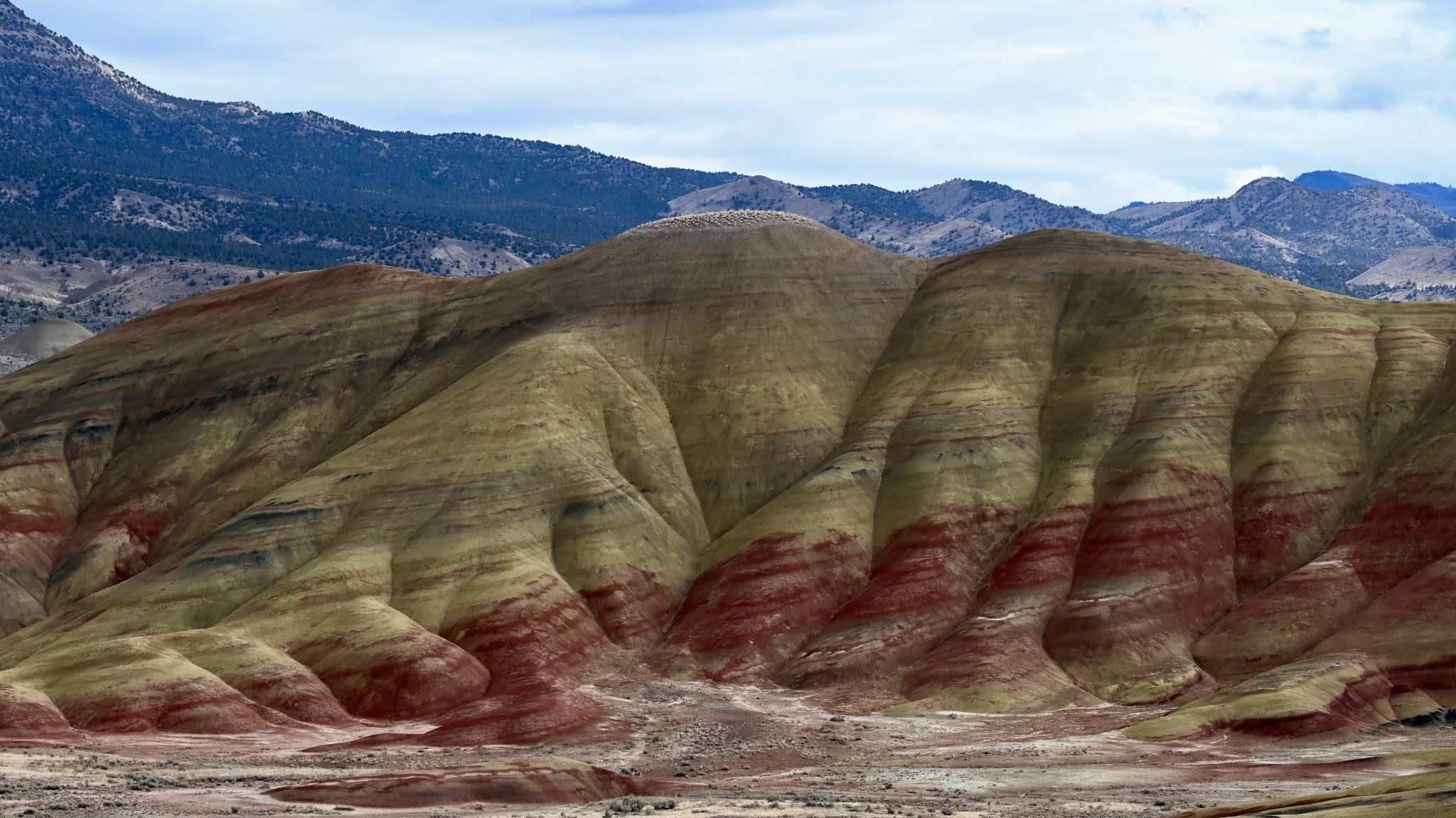
The last post highlighted the first days of our trip to Central Oregon. This post details some of the rest of the trip, including our biggest surprise. As we were getting close to Mitchell from Redmond and bemoaning the fact that the better photo opportunities were further on (where we weren’t going), we saw a sign which read, “Painted Hills 6 Miles,” pointing to the northwest off Hwy 126. 

Coming into the Painted Hills from Hwy 126.


I thought the Painted Hills were much closer to John Day and thus beyond this day’s drive. So, now I had my missing photo op.


The Painted Hills are the western most unit of the three part John Day Fossil Bed National Monument—Painted Hills, Sheep Rock, and Clamo units. Nine miles northwest of Mitchell, the hills are considered one of the Seven Wonders of Oregon,


along with Crater Lake, Smith Rock, the Columbia River Gorge, the Oregon Coast, the Wallowa mountains, and Mt Hood. The Painted Hills are definitely a geological wonder known for the colorful layered hills. 


The colors developed in the hills as early as 35 million years ago. The colors we see today correspond to both geological eras and chemical composition. The red represents a warm and humid climate and the predominance of iron in the soil. The yellow, in contrast, comes from a drier period and the presence of the building blocks of aluminum. Darker or black veins are from vegetative matter, while the gray is from sandstone or shale. The colors will change in intensity with the amount and intensity of light—the hills can look very different morning to night. I think the colors are better for photos in the muted light of cloudy weather, but I’d never pass up a sunny day in the hills.

This circular opening in the sandstone hill shows the layers beneath. Kind of freaky looking, almost like an alien eyeball peeking out of the hill.


The Painted Hills Unit has several different viewing areas. On this visit I photographed from the main vista point (and partially up the viewing trail) and from the short Painted Cove trail. 

The Painted Cove quarter mile trail is part boardwalk and part gravel. 


This is the view from the top of Painted Cove trail.


There are numerous trails in the unit, and you are strongly requested to stay only on official roads or maintained trails to protect the Hills from unnecessary erosion.

Being able to photograph the Painted Hills with almost no one else around was a grand surprise.


The view from the small visitor center parking area.

An Interesting Museum Visit


Just out of Bend, Oregon, about a half hour drive from our digs in Redmond, is the High Desert Museum. 


The museum was very Cove aware and responsible--masks in all areas, reserved seating in the Bird of Prey demonstration area.


Opened in 1982, funded by members, donors, visitors, and grants, the museum is affiliated with the Smithsonian Foundation. Open all year, the High Desert Museum presents the high desert landscape (flora and fauna) and its relationship to the people through both permanent and changing exhibits. 

There were snakes also, but Anne didn't want any pictures of those.


We were impressed with exhibits relating to indigenous peoples—my background includes a bit of Apache. And, although I’m not a fan of zoos, I enjoyed the presentations of native species—mostly creepy crawling things. 

Shy bald eagle.

Menacing golden eagle.

She could be at Hogwarts.


Outside the main building is a well done display of rescued birds of prey and inside was a fine flying exhibition of a small falcon. We could have spent much more than the two hours we did, but my legs sort of said, “Enough.” 


The High Desert Museum is well worth whatever time you can spend. More information is available at www.highdesertmusem.org.


Story of the New Ride


I know I mentioned a new car in the previous post, but this is the story of that new car. We sold our hot 2007 VW Fahrenheit GTI (#914 of 1200 made) to get a truck to pull our mini trailer. Then we bought a 2017 Ford F150 with very low mileage. The truck was fun to drive and great for pulling the trailer. We found, though, that we really weren’t cut out for the trailer life—our camping out is in a five star Worldmark timeshare resort. So we sold the trailer and kept the truck. During the early part of Covid times the truck mostly sat. When we did take it to the coast on a rare several day trip we had trouble parking and getting around where we wanted to go. That trip convinced us we didn’t really need a truck either. Since used trucks were in high demand, it seemed a good time to trade it in on something more useful. Thus, the new ride.


A Subaru Forester fit the bill for what we wanted. Wilsonville Subaru had one Forester Sport in the color I wanted and with a lot of extras I didn’t know I wanted. The car comes with standard Forester equipment including AWD, but it was also set up for off-road—raised suspension, larger aggressive tires, skid panels underneath, and more. I fell in love with the car immediately and Anne liked it well enough to indulge me.


On this trip the Forester handled the highway driving and the mountain roads just fine. It carried all our gear and had room for more. It’s comfortable to drive and is set up to handle winter conditions—besides AWD it has two other traction settings, called X-modes for dirt, mud, and snow. On the trip we got several appreciative comments and lots of looks. The Forester (named Lewis) is far more of a “rig” than we need, but like my beloved 2007 GTI, it’s just plain fun to drive. 


Fall colors at the High Desert Museum.


Next: Victoria, BC???