Showing posts with label Robert Burns. Show all posts

Saturday, October 21, 2017

Fall Scottish Trip, Part 1

Mt Rainier as we fly out of PDX.

A rainy greeting in Crieff, Scotland.

Crieff and About. Our first stop on each trip to Scotland is the village of Crieff in the county of Perthshire. Besides being the home of our adopted family, the Cliffords, Crieff is central to many interesting attractions. In this post I’ll present a photo essay of some of the attractions that draw us back—waterfalls, mountains, forests, ancient sites—and end with a more complete description of one of the more unique of Perthshire’s tourist sites.
The Highland Hills around Crieff

The Falls of Dochart, the River Dochart in Killin. The river flows into Loch Tay and ends up as the western extension of Scotland’s longest river, the River Tay. 
The River Dochart drains from the eastern side of Ben Lui and the north side of Ben More.

The village of Killin is on both sides of the Bridge of Dochart built in 1760 and rebuild after a major flood in 1831. All these photos we taken from the bridge.

The Clan McNab Burial Ground is on an island (Innes Bhuidhe) in the middle of the river; there are graves there of nine clan chiefs.


Ben Lawers. This mountain is the highest in the southern part of the Highlands. The name in Gaelic means “Claw Mountain,” and it’s a Munro at 1214m (3983 feet)—a Munro is a Scottish mountain over 3000 feet tall. 
Bronze Age remains have been found at various locations on the mountain.

Sheep freely roam the lower slopes of the mountain.

Ben Lawers is now a National Nature Reserve with many species of protected flora and fauna. Most of the south side of the mountain has been owned by the National Trust for Scotland since 1950.

The Birks of Aberfeldy. The Birks is a circular 1.5 mile nature walk along the Moness River in the Moness Glen. The birks were made famous by Scottish national poet Robert Burns’s poem of the same name:

Bonnie Lassie, will ye go,
Will ye go, will ye go, 
Bonnie Lassie, will ye go
to the birks of Aberfeldy!
The Birks is a site of Special Scientific Interest for botanic plant life. 

The circular trail is most scenic when walked clockwise.

The path leads to Moness Falls which drops in three tiers a total of 380m--difficult to photograph, but lovely.

Croft Moraig (Mary’s Croft) Stone Circle. On A827 between Aberfeldy and Kenmare is a compact grouping of stones which is actually a complex double stone circle dated to around 2000BC. 
The site was officially excavated in 1965.

Robert Burns mentioned visitors exploring the stone circle over 200 years ago.

A least one survey lists the circle as one of the 20 best prehistoric sites in Scotland.

Cultybraggan Camp. This place has a reputation for being haunted. People say they get strange feelings about the place, they see figures in the shadows, faces looking through the broken panes of glass, ghostly figures about. It’s not surprising that Cultybraggan Camp has that reputation if you know its history.

The camp was built in 1941 to house 4000 Category “A” POWs. Named Camp 21, it was  a “Black Camp” holding the most committed and fanatical Nazi POWs. It was the camp that held the ringleaders of the Devizes Plot—a scheme to break 250,000 POWs out of camps and attack Britain from within.

After the war the camp was opened in 1949 as a training camp for Regular Army. Later, several of the 100 original Nissen huts (quonset huts) were removed to make room for a firing range. Then in the 1960s, the camp was made into an ROC (Royal Observation Corps) monitoring post. An underground Regional Government HQ bunker—Cold War survival bunker designed to be used by the Scottish Secretary of State—was added in 1990.


Finally, in 2004 Cultybrqggan was sold to the Comrie (the closest village) Development Trust and is now used for local small businesses, agricultural uses, and sports fields. There are plans to renovate the camp into a 4 Star hotel complex, but the ghosts have yet to give their approval.
Two photos of the Amulree area about 17 miles from Crieff.


Also 17 miles from Crieff, in a different direction, is St Fillans GC where we are members.

NEXT: We hunt for fall colors.

Thursday, April 7, 2016

CULTURAL AFFINITY 101

CULTURAL AFFINITY 101
Glancoe and Rannoch Moor

Bridge of Balgie Village
On our first trip to Scotland in the fall of 2000, we stayed in Glasgow for one night and then ventured into the Scottish countryside, which we later learned was the Borders region.  After playing golf on a rustic nine-hole course more than a hundred years old, we stopped at a local pub in the small village of Innerleithen.  We were welcomed by the pub’s official greeter, a rather large blonde retriever.  We were sitting with our drinks after ordering what to us seemed like exotic meals (which were really just traditional pub food, simply not our tradition) when we met the pub’s unofficial greeter.  She, too, was blonde and about our age, but extremely drunk.  She sat at our table and asked us where we were from and what we were doing in Scotland.  We chatted for a few minutes and then she introduced us to the entire pub as her “American friends.”  We were soon everyone’s “American friends.”  A quick meal in a pub had turned into two and half hours of eating, drinking, and visiting.  It was indeed a good thing that our B&B was only seven miles up the road and there was no way to get lost.
Amulree Church, Perthshire

Interested locals at Amulree

Visiting in a pub
The next day we played our second round of Scottish golf at West Linton GC.  When we finished our round we asked the club’s pro to recommend a local pub for a bite and a brew.  He suggested The Gordon Arms Hotel bar on the outskirts of the small village of West Linton.  We were too late for lunch, but Anne could get a Guinness and I a coke (strict drinking and driving laws in Scotland, and after last night I didn’t want to press my luck) and we shared a bag of crisps (potato chips).  Two pub dogs, one retriever and one border collie, shared the bag of crisps with us.  There was some rough talk from truckers at the bar complaining about the government regulations and high petrol prices.  There was also an upright piano sitting quietly in a corner with a sign on it which read: “I like to be played.”  The bag of crisps done, the dogs wandered off to see if anyone else would share anything.  Anne looked at me and said, “I like this.  It feels right.  We should write about it—the golf, the pubs, the pub dogs.”  I completely agreed—we both felt at home in Scotland.
Harlech Castle, Wales

South Stack Lighthouse, Anglesey, Wales

Glen Lyon Road, Highlands
There have been other examples in our travels that felt natural.  In Caernarfon, northern Wales, we kept seeing large signs by a solicitor named Lloyd William Jones.  Than’s my fraternal grandfather’s name.  As a Jones I knew there was some Welsh in my background, but it was startling to see these big signs advertising my grandfather.  It was even more startling when wandering in the town of Conwy I did a double-take as my Grandpa Jones’s doppelganger passed us in a crowd of shoppers.   
Pittenweem Harbour, Fife

Loch Awe

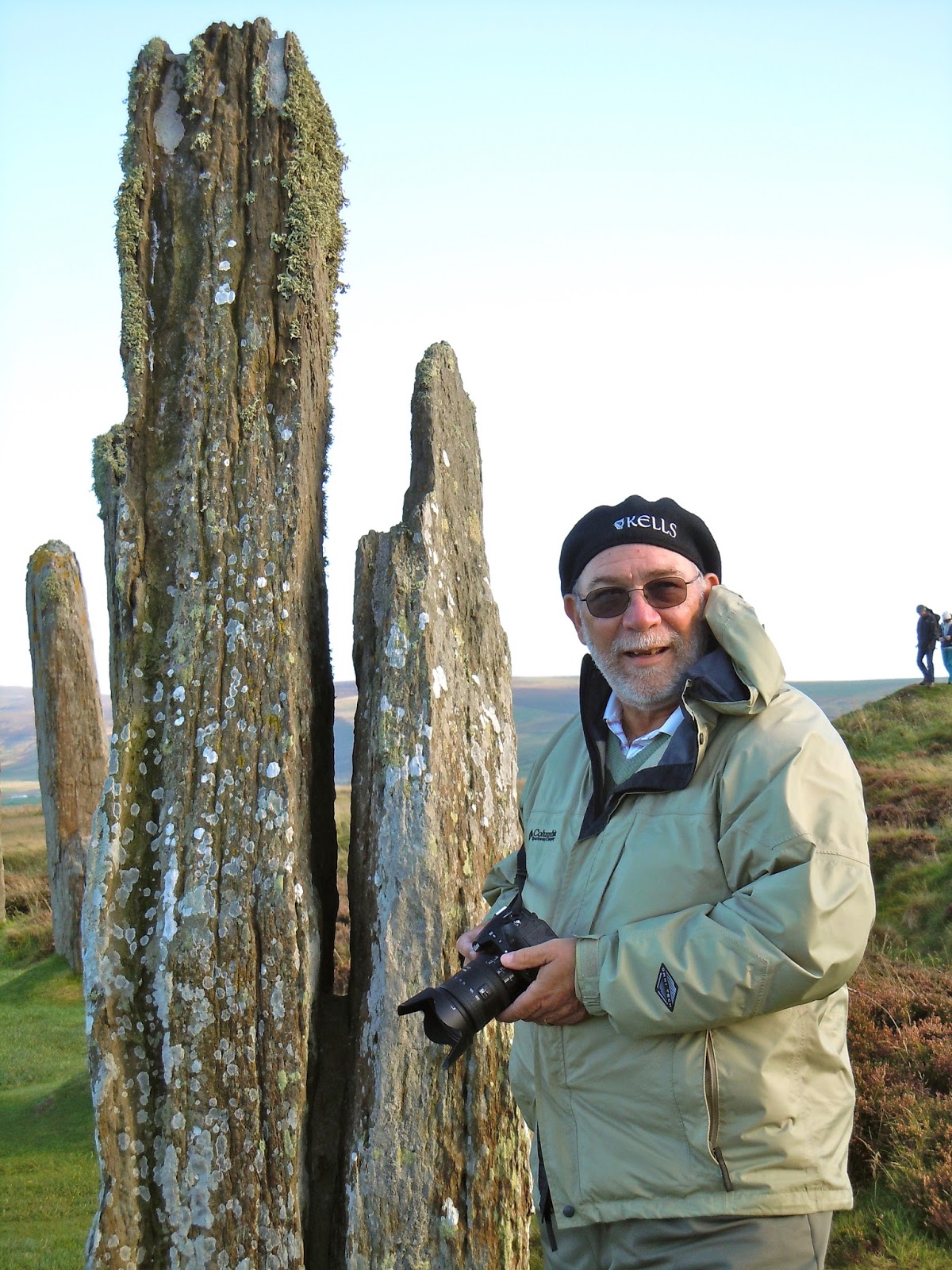
Ring of Brodgar, Orkney Islands

On our first few trips to the British Isles we didn’t really know much about our family backgrounds or what connections we might have to the area, but both Anne and I felt “connected.”  For some reason I felt a cultural link to Scotland and Wales.  In my mind I termed it a “cultural affinity.”  Recently, I looked up the term and found that it was not just my made up phrase.  “Cultural affinity” is defined in several sources as a feeling, bond, or naturalness with a certain culture.  It seems that many people will see some of themselves in the culture’s speech (I do think Welsh is a beautiful, but complex language and love to hear it spoken), dress, history, and current values.  Research by J.S. Swift of Staffordshire University Business School shows that “a correlation exists between the level of affinity (or liking) executives feel for a foreign culture and the extent to which they feel psychologically close to that culture.”  So, cultural affinity is indeed real.
Whisky tasting, Famous Grouse, Crieff 

Buchanty Spout, Perthshire
To explain the feeling some (with better understanding than I) might invoke Jungian psychology or analytical psychology.  Swiss psychologist Carl Jung (1875-1961) believed in a collective unconscious—instincts and archetypes (universal symbols) shared by a group or groups of people.  I dimly remember reading about the collective unconscious eons ago in basic Psych 101 class, but it does sound like what we experience as cultural affinity.
Isle of Skye
As I taught summer debate camps in the American southwest for high school students, I felt an affinity for the area, the art, the music, and the people.  But I also knew that my maternal grandmother was from Durango, Colorado, and that her background was Native American and Hispanic.  It would be natural to be interested in and have feelings for the native lands in Arizona, Utah, New Mexico, and Colorado.  But that did not explain why I feel so connected in Scotland.  Even my Welsh background didn’t explain why the area around Crieff—Strathearn, Stirling, Perth, Sma’Glen—has such a draw for me.  Cultural affinity, though, seems to hold the answer.
Comrie

Crieff, Saturday Market

Robbie Burns and I in the Birks of Aberfeldy

A few months ago my nephew who enjoys doing genealogical research sent me information about my fraternal grandmother’s family tree which not too far back has a direct and confirmed link to Scotland.  
Crieff

My Scottish ancestor, George Alexander, was born in Stirlingshire in 1620, married in the United States in 1644, and died in America in 1680.  
Crieff Whisky Shop

But even more interesting are the areas of my ancestor’s family, the names and birth places: Alexander in Stirling and Clackmannanshire, Erskine in Menstrie (Stirling), Graham in Perth and Clackmannanshire, Douglas in Clackmannanshire, and Forbes in ?Scotland.  
Selling books and photos at the Portland Highland Games

Anne on the 7th hole at St Fillans GC

Why does Crieff have such a hold over me? Why have we chosen to spend almost three years of the last sixteen in Crieff (besides our wonderful adopted Scottish family, John and Jacky Clifford at Merlindale)?  
Merlindale B&B in Crieff; our Scottish home.

It’s because that’s where my Scottish roots are.  We did a book on Ireland golf.  We enjoy forays into southern England, the Cotswolds, the Lake District, and the Yorkshire Dales.  I love the people and the land of particularly northern Wales almost as much as Scotland.  But home is Crieff and I now understand why. 

Crieff

Monday, September 24, 2012

TOURING AND COLLECTING


After more than a week of nice golfing weather, jumper (sweater) weather, and nine golf rounds in the last twelve days (including three British Open Qualifying courses), the weather has turned to winter and I have a chance to get on line and send out this entry--  our usual evenings being spent writing up the day’s golf course and pub notes for the next book. Look for another entry in the next few days that will be our end of the trip summary and photo montage.  For now a little history and a wee tipple.

An Historic Chapel

As fascinating as Melrose Abbey (previous entry) is, other spots are equally intriguing.  For example, Sweetheart Abbey in the Dumfries and Galloway area has an interesting history being built (1275) to memorialize Lady Dervorgilla of Gallow’s husband John Boiliol. 

When Lady Devrogilla died she and the embalmed heart of her husband were interred on the abbey grounds--thus, Sweetheart Abbey.  The new National Trust Robert Burns’ Birthplace Museum in Alloway is filled with original Burns’ documents and memorabilia.

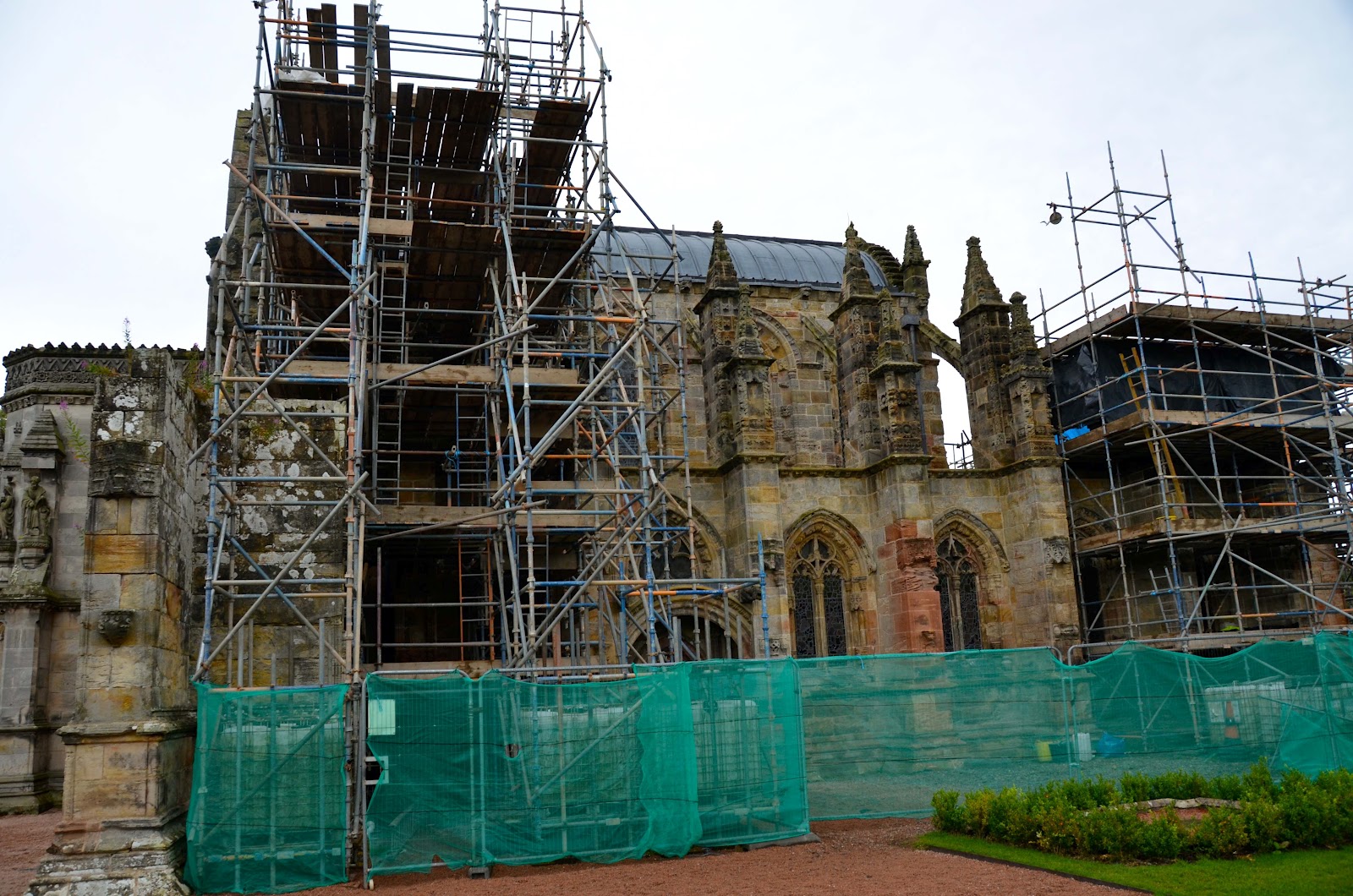
Even more fascinating is Rosslyn Chapel outside of Edinburgh, made even more famous by Dan Brown’s novel and then the movie The Da Vinci Code.  

We have a special affinity for the chapel having played golf with the current trustee of Rosslyn Chapel, Baron St Clair Bond.  The chapel, whose official name is the Collegiate Chapel of St Matthew, was built by William Sinclair, the First Earl of Caithness (the far north area of Scotland) in 1456.  Supported by 14 large pillars, the chapel is most famous for its interior sculptures and carvings, which are some of the best and most intricate in Europe.  After Brown’s 2003 book the crowds visiting the chapel got so large that the Rosslyn Chapel Trust banned interior photography--too many people taking pictures and getting in each other’s and everyone else’s way.  


It’s a shame, but it makes my pre-2003 interior photos that much more special.  The chapel boasts of more than a hundred Green Man carvings (sculptures combining a face with leaves or vines and symbolizing, among other things, rebirth) and carvings of Maize (corn), aloe, and trillium which were at the time the chapel was built (almost forty years before Columbus’s first voyage to the New World) supposedly unknown in Europe--lending credence to the stories of a Sinclair voyage to the New World in the 1300s.  Now Masonic and Knights Templar connections fuel even greater interest in Rosslyn Chapel.  

With all the interest in the chapel, the money from both trusts (such as Historic Scotland and the National Trust for Scotland) and visitors has been put to good use.  The chapel has a new state of the art Visitor’s Centre and has begun an extensive program of restoration and preservation of the exterior carvings. 

Rosslyn Chapel is one of the premier visitor destinations in Scotland, even if no interior photography is allowed.

Collecting a Taste of Scotland

Haggis and black pudding may not be our favorite dishes, but another taste of Scotland is not only worth having while in Scotland, it’s also worth taking home and collecting.  Uisge Beatha, The Water of Life, Scotch Whisky.  I had always like Scotch whisky, although in college it was whisky and 7 Up or whisky and soda--always the blended stuff (Johnnie Walker, Vat 69, Teachers).  It wasn’t until we started traveling to Scotland that I really discovered my taste for Single Malt Whisky.  In 2000 we brought a couple of bottles home, then went to the local liquor store and bought more.  Not that I’m a heavy drinker--a couple of fingers a night is my usual limit--but I do enjoy the collecting of various whiskies and having several bottles to choose from when I want a dram or offer a dram to guests.  
                      One of our favorite places to buy whisky, The Corn Exchange in Crieff.

Visiting the distilleries is always an entertaining enterprise and so far we’ve visited 29 in Scotland.  There have also been a few adventures in my whisky collecting experience, especially when trying to bring home whiskies I can’t get in my local store.  

Once, early in our travels, I was almost caught by US Customs in violation of our quota which is four and half bottles of spirit.  I was carrying five and listed “whisky” on our customs declaration without specifying the number of bottles.  The agent saw that I had declared whisky and asked, “How much?”  I lied, “Five bottles, but one is a half.”  She said, “Okay. This time.”  That was the last time we tried to bring more than four bottles back.  

There was once when I tried to bring back an unusually shaped bottle, sort of like a crock-style large flask (if that makes any sense) of special Caol Ila (Islay whisky).  It’s the only bottle we’ve ever had that leaked.  We lost about a quarter of the contents, but thankfully it was sealed up well in bubble wrap and plastic bags (Anne does a great job of packing) and no whisky got on anything else in the suitcase.  No, I didn’t lick the bubble wrap.

The biggest disaster we’ve had transporting booze has been the time we got stopped by TSA in Newark with a special bottle of rare Ardbeg (Islay) whisky.  From Edinburgh my carry-on had been sent as baggage under strict British security rules, but when we got delayed in Newark overnight, the backpack became carry-on again.  At five in the morning with only three hours of sleep the night before, my travel-addled brain didn’t register that I had whisky in the wrong place.  The TSA agent was very nice about it and gave me several options: (a) give it to someone (we knew nobody in Newark); (b) go back through the check-in line and ship it as checked baggage (we didn’t have time before our flight); (c) drink it (at that time in the morning even I couldn’t face the best whisky); or (d) throw it in the bin with all the other I-forgot -to-throw-them-away liquids.  I couldn’t do it, so I asked the agent if he would do the honors.  He placed the bottle ever so gently in the bin.  I do hope he recovered the whisky later and shared it around--it would be a shame to think it went to waste. 

On this trip we are bringing home just three bottles: a Pittyvaich (closed distillery) 18 Year Old by Rare Malts, a 20 Year Old Braes of Glenlivit whisky, and a special bottle I just bought this afternoon (that’s why it’s not in the photo) of Mackinlay’s Rare Old Highland Malt Whisky, a commemorative recreation of the whisky from the British Antarctica Expedition of 1907.  The Nimrod Expedition (named for his ship) was the first of three Antarctica expeditions lead by Ernest Shackleton.  The whisky was found almost a hundred years later buried under Shackleton’s McMurdo Sound cabin.  After 18 months of analysis the whisky is reported to be an exact match for the Shackleton whisky and “sheer heaven” to drink.  I hope so, but we’ll see.

A last note on whisky collecting.  While staying at the Neidpath Inn in Peebles we saw two display cases of old rare miniatures.  The owner didn’t name a value, but I’d estimate from the age and rarity of some of the wee bottles several thousands of pounds Sterling were mounted on the wall.  Anne won’t let my collection approach anything near that.  Damn!