CULTURAL AFFINITY 101
 |
| Glancoe and Rannoch Moor |
 |
| Bridge of Balgie Village |
On our first trip to Scotland in the fall of 2000, we stayed in Glasgow for one night and then ventured into the Scottish countryside, which we later learned was the Borders region. After playing golf on a rustic nine-hole course more than a hundred years old, we stopped at a local pub in the small village of Innerleithen. We were welcomed by the pub’s official greeter, a rather large blonde retriever. We were sitting with our drinks after ordering what to us seemed like exotic meals (which were really just traditional pub food, simply not our tradition) when we met the pub’s unofficial greeter. She, too, was blonde and about our age, but extremely drunk. She sat at our table and asked us where we were from and what we were doing in Scotland. We chatted for a few minutes and then she introduced us to the entire pub as her “American friends.” We were soon everyone’s “American friends.” A quick meal in a pub had turned into two and half hours of eating, drinking, and visiting. It was indeed a good thing that our B&B was only seven miles up the road and there was no way to get lost.
 |
| Amulree Church, Perthshire |
 |
| Interested locals at Amulree |
 |
| Visiting in a pub |
The next day we played our second round of Scottish golf at West Linton GC. When we finished our round we asked the club’s pro to recommend a local pub for a bite and a brew. He suggested The Gordon Arms Hotel bar on the outskirts of the small village of West Linton. We were too late for lunch, but Anne could get a Guinness and I a coke (strict drinking and driving laws in Scotland, and after last night I didn’t want to press my luck) and we shared a bag of crisps (potato chips). Two pub dogs, one retriever and one border collie, shared the bag of crisps with us. There was some rough talk from truckers at the bar complaining about the government regulations and high petrol prices. There was also an upright piano sitting quietly in a corner with a sign on it which read: “I like to be played.” The bag of crisps done, the dogs wandered off to see if anyone else would share anything. Anne looked at me and said, “I like this. It feels right. We should write about it—the golf, the pubs, the pub dogs.” I completely agreed—we both felt at home in Scotland.
 |
| Harlech Castle, Wales |
 |
| South Stack Lighthouse, Anglesey, Wales |
 |
| Glen Lyon Road, Highlands |
There have been other examples in our travels that felt natural. In Caernarfon, northern Wales, we kept seeing large signs by a solicitor named Lloyd William Jones. Than’s my fraternal grandfather’s name. As a Jones I knew there was some Welsh in my background, but it was startling to see these big signs advertising my grandfather. It was even more startling when wandering in the town of Conwy I did a double-take as my Grandpa Jones’s doppelganger passed us in a crowd of shoppers.
 |
| Pittenweem Harbour, Fife |
 |
| Loch Awe |
 |
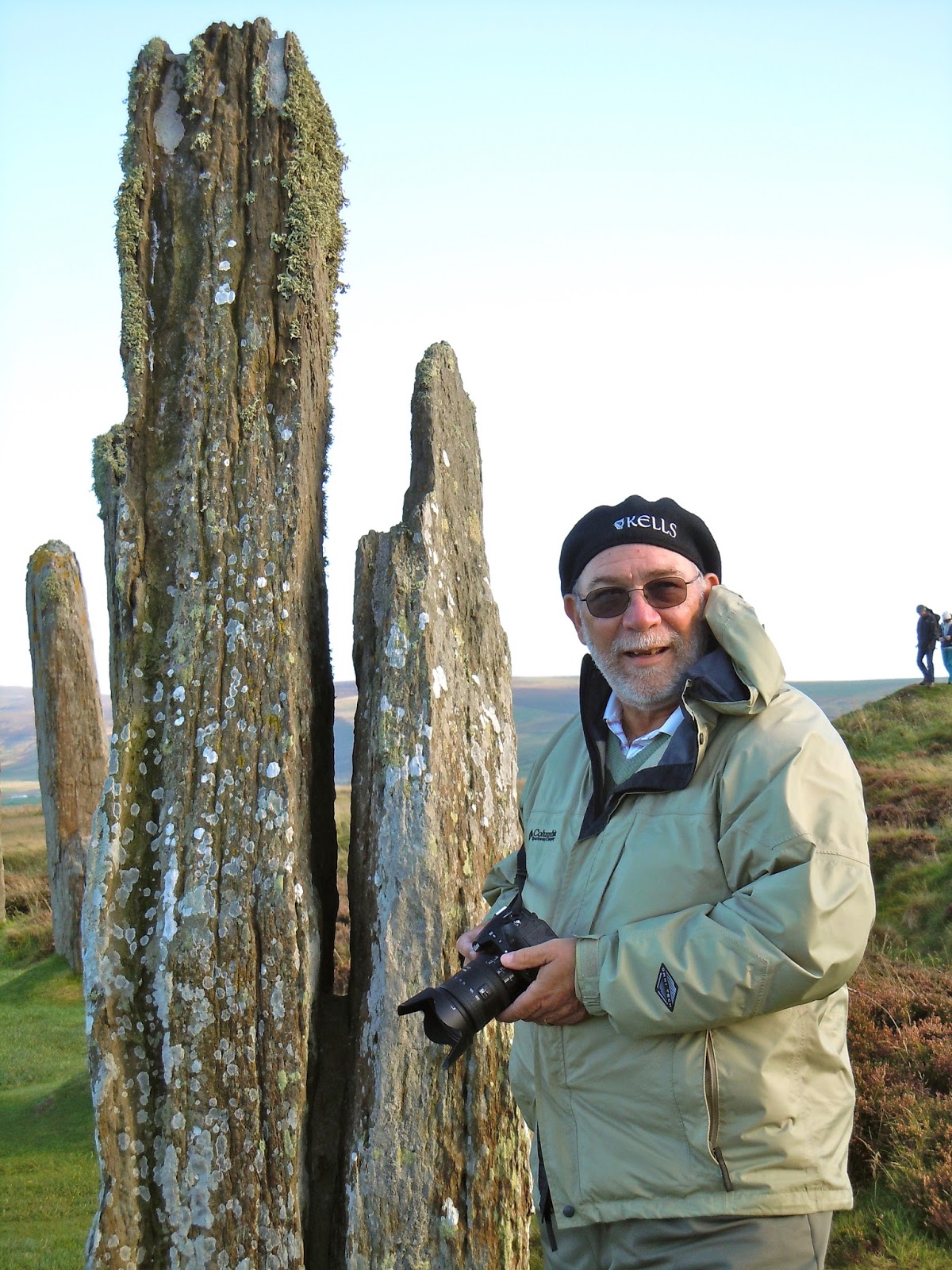
| Ring of Brodgar, Orkney Islands |
On our first few trips to the British Isles we didn’t really know much about our family backgrounds or what connections we might have to the area, but both Anne and I felt “connected.” For some reason I felt a cultural link to Scotland and Wales. In my mind I termed it a “cultural affinity.” Recently, I looked up the term and found that it was not just my made up phrase. “Cultural affinity” is defined in several sources as a feeling, bond, or naturalness with a certain culture. It seems that many people will see some of themselves in the culture’s speech (I do think Welsh is a beautiful, but complex language and love to hear it spoken), dress, history, and current values. Research by J.S. Swift of Staffordshire University Business School shows that “a correlation exists between the level of affinity (or liking) executives feel for a foreign culture and the extent to which they feel psychologically close to that culture.” So, cultural affinity is indeed real.
 |
| Whisky tasting, Famous Grouse, Crieff |
 |
| Buchanty Spout, Perthshire |
To explain the feeling some (with better understanding than I) might invoke Jungian psychology or analytical psychology. Swiss psychologist Carl Jung (1875-1961) believed in a collective unconscious—instincts and archetypes (universal symbols) shared by a group or groups of people. I dimly remember reading about the collective unconscious eons ago in basic Psych 101 class, but it does sound like what we experience as cultural affinity.
 |
| Isle of Skye |
As I taught summer debate camps in the American southwest for high school students, I felt an affinity for the area, the art, the music, and the people. But I also knew that my maternal grandmother was from Durango, Colorado, and that her background was Native American and Hispanic. It would be natural to be interested in and have feelings for the native lands in Arizona, Utah, New Mexico, and Colorado. But that did not explain why I feel so connected in Scotland. Even my Welsh background didn’t explain why the area around Crieff—Strathearn, Stirling, Perth, Sma’Glen—has such a draw for me. Cultural affinity, though, seems to hold the answer.
 |
| Comrie |
 |
| Crieff, Saturday Market |
 |
| Robbie Burns and I in the Birks of Aberfeldy |
A few months ago my nephew who enjoys doing genealogical research sent me information about my fraternal grandmother’s family tree which not too far back has a direct and confirmed link to Scotland.
 |
| Crieff |
My Scottish ancestor, George Alexander, was born in Stirlingshire in 1620, married in the United States in 1644, and died in America in 1680.
 |
| Crieff Whisky Shop |
But even more interesting are the areas of my ancestor’s family, the names and birth places: Alexander in Stirling and Clackmannanshire, Erskine in Menstrie (Stirling), Graham in Perth and Clackmannanshire, Douglas in Clackmannanshire, and Forbes in ?Scotland.
 |
| Selling books and photos at the Portland Highland Games |
 |
| Anne on the 7th hole at St Fillans GC |
Why does Crieff have such a hold over me? Why have we chosen to spend almost three years of the last sixteen in Crieff (besides our wonderful adopted Scottish family, John and Jacky Clifford at Merlindale)?
 |
| Merlindale B&B in Crieff; our Scottish home. |
It’s because that’s where my Scottish roots are. We did a book on Ireland golf. We enjoy forays into southern England, the Cotswolds, the Lake District, and the Yorkshire Dales. I love the people and the land of particularly northern Wales almost as much as Scotland. But home is Crieff and I now understand why.
 |
| Crieff |