Showing posts with label Skara Brae. Show all posts

Tuesday, October 23, 2018

Scotland Fall 2018, Part Two -- Do They Allow Photography?

Castles like Duone, an Outlander venue, are photogenic inside and out.
Scotland is a photographer’s paradise with castles, ancient stones, heathered highlands, and interesting photogenic tourist sites galore, but often it is those very same tourist attractions that provide the most frustration. The cause of this consternation is the arbitrary rule that says “No Photography.” The winds of change are rising, though. On this trip I found that a number of sites that used to block camera use have now opened the shutters. Why the change in policy? I don’t really know, although I suspect the cell phone camera may be a prime factor. Professional golf tournaments have allowed picture taking with phones—but still restrict the use of cameras probably because of shutter noise (although most modern digital cameras now have “silent shutter” programs). It could also be that the proliferation of tourists with cameras has simply overwhelmed enforcement of restrictions. Perhaps also a factor in lifting restrictions may be the realization that the spread of digital photos on the internet may actually increase interest in the attraction. Whatever the reasoning, I’m glad for the change. In this post I’ll explore a few of the attractions that still have restrictions on photography, some which now allow it, and a couple that may have led the way to enlightenment.
  First, let’s visit an attraction which still clings to the old policy of “No Photography” inside, Falkland Palace, Falkland, Fife. With a history which goes back to the 12th century, the original hunting lodge was significantly expanded by King James IV and King James V. The palace (“palace” being a residence of royalty or high-ranking dignitary) self-guided tour is quite interesting with information in every room and docents in several. The palace was turned over to the National Trust for Scotland in 1952. 
Waiting for the Palace to open for touring.

ILLEGAL! I did take one photo in the Palace, but it doesn't show much of the interior just the Falkland village.

Even though I couldn't take photos inside, the exterior of the Palace still makes a nice picture.

One category of attraction which used to be very restrictive in their camera policy is the distillery. In many, photos outside were okay, but forbidden inside the operation. On this trip we toured the smallest commercial distillery in Scotland, Edradour Distillery, and the largest, Glenfiddich. Both had "no photos" policies the last time we toured, but now allowed non-flash non-video photography (except in special locations with high concentrations of alcohol fumes such as in barrel warehouse—the Angels Share).

Edradour is a very picturesque distillery.

The smallest distillery has quite small pot stills.


Edradour did allow photos (no flash) in the barrel rooms.
After our tour the group gathers in the shop--we had our tasting earlier in the tour.

The tours become much more memorable when I can document the experience. Edradour Distillery near Pitlochry at the edge of the Highlands was licensed in 1825 and produces about 18 casks of Highland whisky in a week. The much larger Glenfiddich Distillery in the Speyside area of the Whisky Trail near Granton-on-Spey started production in 1886. As the world’s best selling whisky, Glenfiddich makes in a week what Edradour produces in a year. 
The setting for Glenfiddich is lovely--Glenfiddich means the Valley of the Deer.

The wash back is made of Oregon pine. Everyone thanked us for our contribution.

The number of pot stills at Glenfiddich positively dwarfs those at Edradour. With the new tour policy I can show that in photos.

At Glenfiddich we got to watch part of the bottling process.

Our tasting at the end of the Glenfiddich tour was three drams--generous.

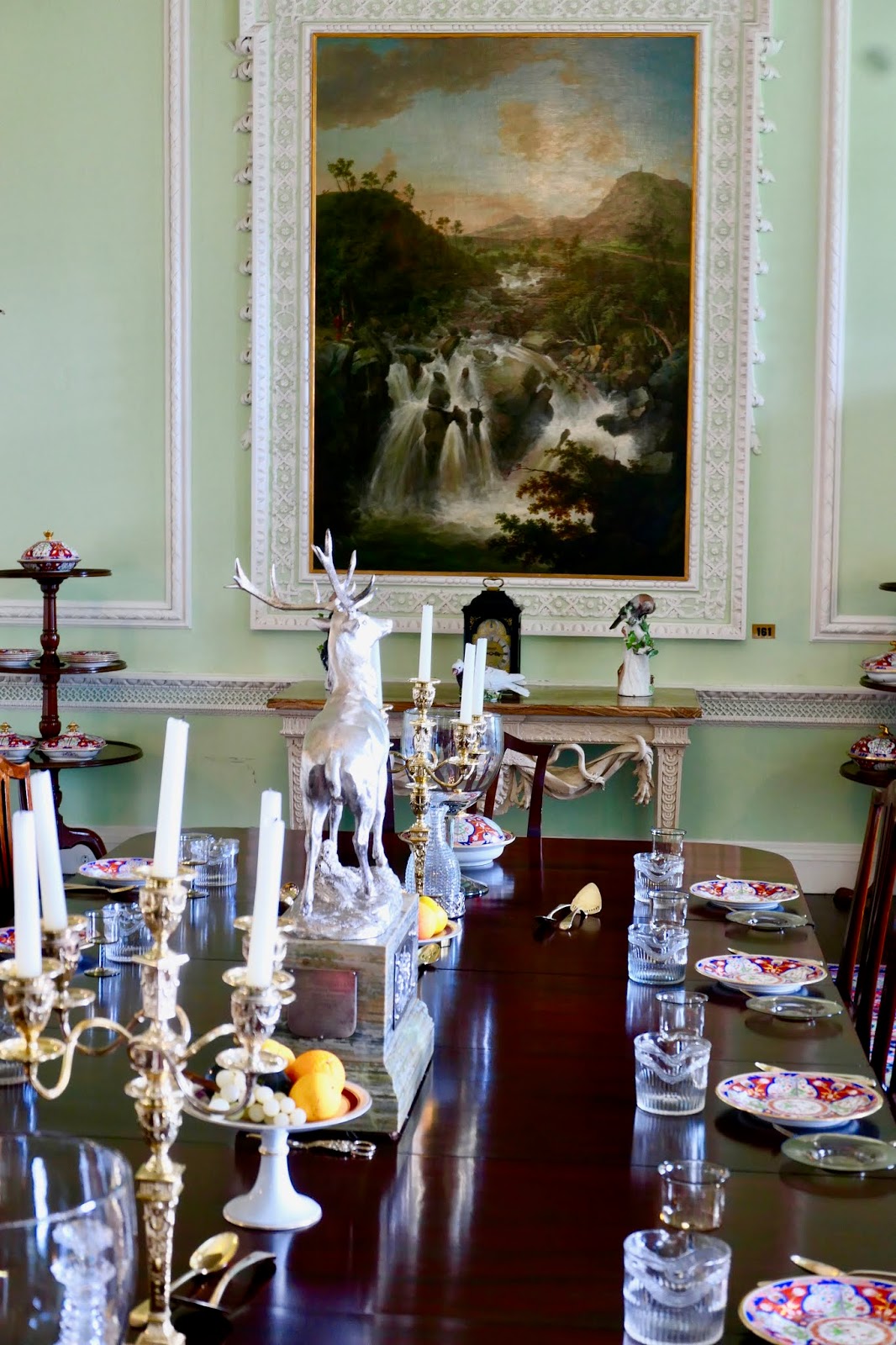
Blair Castle, home of Clan Murray in Blair Atholl, has also opened its tour to photography. The Scotland home of the 11th Duke of Atholl, John Murray of South Africa, Blair Castle is the also home to the only private army in Europe, the Atholl Highlanders, having been granted that right by decree of Queen Victoria. The castle has about 30 rooms available for view and photos whereas most other castles open only six to eight rooms.
Blair Castle

During the tour at Blair Castle we saw rooms filled with china.

The impressive dining room.

Enough weaponry for an army...oh, that's right, they have an army.

A grand coat room.

One new tour we took this trip was of Skaill House on the main island of Orkney. Since this was the first time we’d toured the house, I can’t say if they had a “No Photo” policy previously or not. It was nice, though, to tour and take pictures of the house of William Watt, the Laird of Skaill, who in 1850 was the one who after an October storm discovered the 5000 year old Neolithic village of Skara Brae just meters away from the house.
Skill House seen from the 5000 year old Skara Brae Neolithic village.

Skill House has a cozy dinning area.

Books make a great still life photo.

Anne examining some early needle work on display at Skaill House.

Love this desk.
One of the spots where we thought allowing photography was unusual was at the Sheila Fleet Showroom outside of Kirkwall on Orkney. Sheila Fleet OBE is a leading gold and silver Celtic inspired jewelry designer/maker. A graduate of Edinburgh College of Art (1967), Sheila started her Orkney shop in 1993 and now has six galleries in Scotland. It was fun photographing Anne as she shopped—expensive, but fun.
Shiela Fleet's showroom and cafe is housed in a former church.

Anne is looking!

Anne is buying!

Nice art in the gallery beside the jewelry.

Finally, a place where you wouldn’t think photography would be allowed, but it has been since we first visited in 2000, is Innerpeffray Library about four miles out of Crieff in central Scotland. Innerpeffray was the first lending library in Scotland, opening to borrowers in 1694. The collection was moved into part of St Mary’s Chapel in 1739. Although Innerpeffray ceased lending books in 1968, the library remains open to visitors and researchers—it’s a recognized facility for genealogical research. It’s also a lovely atmospheric spot to photograph.
We got a tour of the library by Lara Haggerty, Library Manager and Keeper of the Books.

Some visitors were doing actual research.

We got shown this 18th century tome--the dark edges are the smallest explications I've ever seen.

In the 1520s when this book was written they thought unicorns really existed.

This photo is of the "new book" section...all written after 1850.

The castles, great houses, distilleries, and other Scottish attractions are well worth visiting whether they allow photography or not. But it is oh so nice when they do.
The Hielan' Coos (highland cows or hairy cows) are always ready to be photographed.


NEXT: Some of the best photos from our fall trip.

Monday, June 6, 2016

Scotland Spring 2016 #3: To the Orkneys


Arctic Tern
       In the last post on this blog site I told you about time we spent in Durness in the far northwest corner of mainland Scotland.  In this installment we go even further north to the Orkneys Islands.  The islands are an archipelago of 70 islands (20 of which are inhabited) ten miles north of the Scottish mainland.  The islands are populated with Neolithic and Iron Age sites rather than people—the population of the islands is just over 21,000.  We spent our time on the main island, called Mainland, with its two major towns, Kirkwall and Stromness.  
       In the two and a half days we spent in the Orkneys we visited some ancient sites we’d been to before and a few sites new to us.  The most impressive ancient site on Mainland is Skara Brae, a Neolithic village which lay hidden under sand for over 3000 years until a major storm in the 1850s swept away the sand and revealed the buried village.  


The dwellings were built into the ground for protection from the weather and were quite sophisticated for having been lived in from 3000 to 2400 BCE—stone beds, cupboards, central heating, etc.  We walked above the structures and marveled at the designs of which early people were capable. In the northwest corner of the island we next went to the Birsay Bay Cafe for lunch.  

The cafe is literally at the end of the road at the end of the island, and you’d think you were at the end of the world except for the crowds.  The cafe with its homemade sweets and locally grown products is so well known that both days we had to wait for a table.  
Anne at the Earl's Palace in Birsay village.


After lunch we toured the Earl’s Palace, a castle belonging to a former Earl of Orkney, and now an interesting ruin.  Since the tide was out (low tide) we took the opportunity to walk
The causeway to Birsay Island at low tide.

The Brough of Birsay and view back to Mainland.


Birsay Lighthouse
over the causeway of cement, stone, and sand to the tidal island of Birsay.  Here we wandered the remains of foundations of an Iron Age brough (small agricultural village) and then climbed to the top of the island for a look at the Birsay Lighthouse.
      On our second day we took the morning tour of Highland Park Distillery in Kirkwall, the capital of the islands and where we had booked our B&B stay (Avalon House, a great B&B just out of town along the bay).  
The tour guide shows us peat which is burned to dry barley and to add flavor to the whisky.


Highland Park pot stills

Coal fire also used to dry malted barley.

A little too expensive for my taste, although I'd love a taste.

The Highland Park whisky is considered by many to be the best of Scotland’s single malt whiskies (with the awards to back up the claim).  The tour was conducted by a very knowledgeable guide (engineer-type) who also gave us a guided tasting of the distilleries most popular malt, the 12 year old.  After our bit of liquid refreshment, we drove out to   Barnshouse, the remains of a Neolithic village near the Stenness standing stones and Ring of Brodgar.  
Sternness Standing Stones

Part of the large stone circle (as big as a football field) called the Ring of Brodgar.

Barnshouse Iron Age village.

The village was interesting, but I was fascinated by a herd of swans [That’s the official group name for swans.  Personally, think they are too graceful to be called a “herd.”  That’s for cows, not swans.] in the nearby loch.  

The rest of the afternoon was spent in a tour of Maeshowe, a Neolithic chambered cairn and passage grave.  
Anne walking out to Maeshowe Chambered Cairn.


Our archeologist guide.

Built around 2800 BCE, Maeshowe along with Skara Brae was designated a UNESCO World Heritage Site in 1999.  We walked the quarter mile out to the tomb and then took a tour of the interior guided by an Historic Scotland archeologist who obviously loved her job.  

     Our last full day in Orkney was spent first playing golf at the Stromness GC and then touring the Broch of Gurness.  


The broch is the remains of an Iron Age (500-200 BCE) broch village, a defensive structure indigenous to Scotland.  The structure, besides the broch tower itself, shows some of the same constructions we saw at Skara Brae.  
Kirkwall Harbour at sunset.


That evening as we wandered around Kirkwall harbour, we were treated to a grand sunset over Kirkwall bay.  A fitting end to our three day stay on Mainland Orkney.
A fence of wool.