Showing posts with label brochs. Show all posts

Monday, November 19, 2018

Stories and More

Forest walk from Rumbling Bridge

New Word Learned in Scotland. Mahlneid (maul-need) means “meal envy”—seeing others’ meals go by in a restaurant and wishing you’d ordered that. We’re all guilty of mahlneid.
Journaling Our Travels

Fall Flowers


A Couple of Firsts. For these stories I have to go back a few years—51 or 52 is a few isn’t it? As a senior at Linfield College and president of our debating team, my partner (Michael Harrell, who had been my debate partner in high school) and I traveled extensively for speech and debate tournaments and had some unique experiences, a couple of which were “firsts.” For instance, Mike and I qualified for Sr. Division finals at the University of Montana tournament.  That in itself wasn’t a first, but then they told us that the final debate would be held in the university’s television studio and that it would be broadcast over the state’s public broadcasting service. The tournament director also said it was to be the first televised final tournament debate in history (or at least it was to their knowledge). I honestly don’t remember if we won the debate or not, but it doesn’t matter because we know we were the first.
One of my best Brookings HS debaters, Stacy Shiver.

Another first happened to us at the Brooklyn College Tournament. Every other year the Linfield debate squad took what we called “The Transcontinental”—a month long trip by train to several special tournaments in the eastern US and ending with the National Championship tournament (that year in Whitewater, WI). At the Brooklyn College Tournament Mike and I found ourselves again in a finals round, this time against Harvard. As we set up in the auditorium for the championship debate, our coach Dr. Roy D. “Hap” Mahaffey (a giant in the forensic world and a truly great coach and man) came over to our table to talk to us before the round. We guessed we were in for a good pep talk, but instead Hap looked at us seriously and said, “You must lose this debate!” As he saw our startled reactions he said more strongly, “Don’t ask, just make sure you lose this debate!” I don’t know if we could have beaten Harvard in that debate, but we did as Hap asked and made sure we dropped some important arguments so that we lost the debate. At the awards we were called up to receive our second place awards and then Harvard was called up. Hap said to us, “Here is why you had to lose.” Harvard was awarded first place and a six foot tall Winged Victory trophy and it was announced that Harvard would be back next year to defend their championship. If we had won we would have had to buy another seat on the train for the trophy and would have had to guarantee to return to the tournament the following year — neither of which our minuscule Linfield forensic budget could ever stretch to cover.  
Participating in the first televised championship debate was indeed a privilege, but throwing our first championship debate seems like a better story fifty years later.
Anne at our tablet Samhain Festival in Salem.

First he danced to the bagpipe, then he showed us how to put on a Great Kilt...

You lay it out on the floor, pleat it, lay on it, and roll to get it around you, then tie it off with a belt. I'll stick to my small kilts.


A See’s Success Story.  A few years ago we took our Scottish friend, John Clifford, a birthday present of a one pound box of See’s Famous Old Time Candies. We heard later that he’d had one piece of the See’s and not more because his wife Jacky thought it was the best chocolate in the world and ate the rest of the box. Now we are sort of expected to bring See’s with us when we come to Scotland as birthday gifts or as a thank you for Jacky—a task we are always happy to perform.
This last trip we brought a box to Jacky as per usual and one as a thank you gift for our whisky guru, Andrew Cuthbert, for storing our golf clubs over the summer. When we presented the gift to Andrew and his wife Evie I said, “Do you like chocolate?” “Oh, yes!” was the reply. Then I asked, “Do you like fine Belgian chocolate?” They sell it in their store, J L Gill, so of course they said, “Very much!” Then I said, “Well, I have something that we think is better than Belgian chocolate,” and gave them the box of See’s. They thanked us appropriately, if not enthusiastically.
Rainbow over the Village

     A couple of days later I asked Andrew if he had tried the See’s. He said, “It’s gone!” and he told me this story. He told me the two of them weren’t very excited about the gift because neither thought very highly of American chocolate, preferring Belgian or even Scottish chocolates to American. Then they tried the See’s and were amazed. They ate the whole box in a couple of days fighting over every piece.
From now on our suitcases will have several boxes of See’s on the way over, to be replaced with bottles of whisky for the trip back. 
Proof that I was in Scotland.


The Rousay Ferry.  From Mainland Orkney, the largest of the Orkney islands off the north coast of Scotland, we had to take a small ferry (it held only about six vehicles) to get to Rousay Island, a treasure trove of ancient Neolithic sites such as burial cairns and brochs.
Historic Scotland, a national trust, preserves this 4000 year old burial tomb on Rousay.

We visited two brochs in the Orkneys; this one is the Broch of Durness on the main island. A broch is a circular defensive structure from about 100AD.

I pulled our rental car into the back of the queue for the ferry and went into the office to buy a return (roundtrip) ferry ticket. We sat in the car for a few minutes until the ferry arrived from Rousay. The queue seemed to be facing the wrong way to get onto the ferry, but it only took a minute to understand that we would back onto the ferry via a narrow slip and that I would go first. A ferryman came over to our car and told Anne she had to walk on and for me to go ahead—well, really, to back up. I asked him if he really wanted an American to go first. He laughed and said I’d be alright. I started backing up the very narrow ferry ramp and wildly waved at Anne to get some photos. She thought I was having trouble and quickly told a ferryman she thought I needed help. He assured her I was doing fine.
Backing our rental car onto the Rousay ferry.

 I parked right where I was directed the first time. Loading onto the ferry on our return trip was just as interesting—we had to fit three cars and huge tractor with mower—and yes, we all had to back on.
Our Canby home in full fall colors.


HAPPY THANKSGIVING


Monday, June 6, 2016

Scotland Spring 2016 #3: To the Orkneys


Arctic Tern
       In the last post on this blog site I told you about time we spent in Durness in the far northwest corner of mainland Scotland.  In this installment we go even further north to the Orkneys Islands.  The islands are an archipelago of 70 islands (20 of which are inhabited) ten miles north of the Scottish mainland.  The islands are populated with Neolithic and Iron Age sites rather than people—the population of the islands is just over 21,000.  We spent our time on the main island, called Mainland, with its two major towns, Kirkwall and Stromness.  
       In the two and a half days we spent in the Orkneys we visited some ancient sites we’d been to before and a few sites new to us.  The most impressive ancient site on Mainland is Skara Brae, a Neolithic village which lay hidden under sand for over 3000 years until a major storm in the 1850s swept away the sand and revealed the buried village.  


The dwellings were built into the ground for protection from the weather and were quite sophisticated for having been lived in from 3000 to 2400 BCE—stone beds, cupboards, central heating, etc.  We walked above the structures and marveled at the designs of which early people were capable. In the northwest corner of the island we next went to the Birsay Bay Cafe for lunch.  

The cafe is literally at the end of the road at the end of the island, and you’d think you were at the end of the world except for the crowds.  The cafe with its homemade sweets and locally grown products is so well known that both days we had to wait for a table.  
Anne at the Earl's Palace in Birsay village.


After lunch we toured the Earl’s Palace, a castle belonging to a former Earl of Orkney, and now an interesting ruin.  Since the tide was out (low tide) we took the opportunity to walk
The causeway to Birsay Island at low tide.

The Brough of Birsay and view back to Mainland.


Birsay Lighthouse
over the causeway of cement, stone, and sand to the tidal island of Birsay.  Here we wandered the remains of foundations of an Iron Age brough (small agricultural village) and then climbed to the top of the island for a look at the Birsay Lighthouse.
      On our second day we took the morning tour of Highland Park Distillery in Kirkwall, the capital of the islands and where we had booked our B&B stay (Avalon House, a great B&B just out of town along the bay).  
The tour guide shows us peat which is burned to dry barley and to add flavor to the whisky.


Highland Park pot stills

Coal fire also used to dry malted barley.

A little too expensive for my taste, although I'd love a taste.

The Highland Park whisky is considered by many to be the best of Scotland’s single malt whiskies (with the awards to back up the claim).  The tour was conducted by a very knowledgeable guide (engineer-type) who also gave us a guided tasting of the distilleries most popular malt, the 12 year old.  After our bit of liquid refreshment, we drove out to   Barnshouse, the remains of a Neolithic village near the Stenness standing stones and Ring of Brodgar.  
Sternness Standing Stones

Part of the large stone circle (as big as a football field) called the Ring of Brodgar.

Barnshouse Iron Age village.

The village was interesting, but I was fascinated by a herd of swans [That’s the official group name for swans.  Personally, think they are too graceful to be called a “herd.”  That’s for cows, not swans.] in the nearby loch.  

The rest of the afternoon was spent in a tour of Maeshowe, a Neolithic chambered cairn and passage grave.  
Anne walking out to Maeshowe Chambered Cairn.


Our archeologist guide.

Built around 2800 BCE, Maeshowe along with Skara Brae was designated a UNESCO World Heritage Site in 1999.  We walked the quarter mile out to the tomb and then took a tour of the interior guided by an Historic Scotland archeologist who obviously loved her job.  

     Our last full day in Orkney was spent first playing golf at the Stromness GC and then touring the Broch of Gurness.  


The broch is the remains of an Iron Age (500-200 BCE) broch village, a defensive structure indigenous to Scotland.  The structure, besides the broch tower itself, shows some of the same constructions we saw at Skara Brae.  
Kirkwall Harbour at sunset.


That evening as we wandered around Kirkwall harbour, we were treated to a grand sunset over Kirkwall bay.  A fitting end to our three day stay on Mainland Orkney.
A fence of wool.


Monday, May 25, 2015

The Isles of Harris and Lewis: Natural Beauty and Antiquities


The attraction of the Outer Hebridean islands of Harris and Lewis rests in the natural beauty of the landscape and a multitude of ancient and historic sites.  
Loading the ferry from Uig to Tarbert.
We traveled by ferry from Uig on the Isle of Skye to the main town on Harris, Tarbert.  It was rough crossing the Little Minch, an area of wild and changing currents, in winds up to 35 miles per hour, 
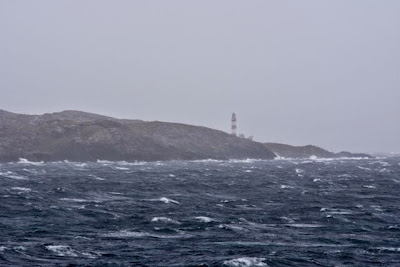
Rough seas and the lighthouse near Tarbert.
but not as rough as the crossing a few years ago over to the Orkney islands.
The small village of Tarbert on Isle of Harris.
While we expected to be awed with the ancient stone circles at Callanish, we had not expected the show nature puts on in the islands. First, we found [Well, others had seen it before, obviously, but it was a discovery for us.] a series of cascades or small waterfalls on a river on Lewis.  


Right along the side of the road we stopped to photograph the picturesque river and falls.  Next, we were surprised by the beaches of Harris and Lewis.  Anne and I live in Oregon only an hour away from the Pacific Ocean, we had lived for four years in Brookings on the Southern Oregon coast, and we’d seen the beaches of southern California and Hawaii.  We didn’t expect to be too impressed by the island beaches even though people had said they would be quite an attraction.  

Two beaches on Harris.

Surf was high on this windy day on Harris.
People were correct: the beaches of Harris and Lewis are big, spectacular, and empty.  With a warmer climate these beaches would create a tourist industry on their own.  As it is, the beauty is there for those intrepid travelers willing to drive for hours on small roads, make a lively sea crossing, and drive again for hours on even smaller roads. 
Uig Sands


Two photos of the Bosta Beach on Great Bernera island (Lewis).
At one beach, Uig Sands, we stopped for a look, then drove several miles to another beach lookout.  We got out of the car thinking we were seeing new sands only to discover we were now in the middle of the same beach.  Absolutely huge and almost empty!
Butt of Lewis Lighthouse.
Our next adventure took us to my main reason for venturing onto the Outer Hebrides, 
Callanish Stone Circle from Callanish II, about a mile away. 

the Neolithic or Early Bronze Age Callanish Standing Stones and Stone Circle on Lewis.  
Callanish I


The stones, Tursachan Chalanais in Gaelic, are a set of standing stones in a cruciform pattern with a central stone circle of thirteen stones with a monolith (five meters tall) near the center.  


The chambered tomb at Callanish I.


This circle has a diameter of about twelve meters with a chambered tomb in the middle.  Five rows of standing stones connect to this circle and two of the rows run parallel north to northeast forming an “avenue” of nineteen stones.  
Looking at the circle down the "avenue."
The circle dates back to between 2900 and 2600 BC, with shards of Beaker pottery dating the tomb to about 2000 BC.  No one knows for certain the purpose of the Callanish stones, but a widely suggested purpose is that the circle and rows form a lunar observatory.  Most researchers agree that whatever else Callanish was used for, it certainly had ritualistic or gathering purposes.  
The light begins to change as we get nearer to sunset.


To see the stones on a pleasant day was awe inspiring, but we returned to the circle at sunset.  That visit was even more magical.  We had had to fight crowds during the day (including two bus loads of tourists), 
The sun is ready to drop behind the hills surrounding Callanish.
but in the evening there were only six of us who braved the near freezing temperatures and chilling winds to watch the setting sun light up the stones and then disappear slowly behind the mountains and the stones.   
Besides the main stone circle of Callanish, called Callanish I, we saw three other large stone circles (II, III, and IV) 
Ceann Hulavaig stone circle, also known as Callanish IV.

all visible from the main stone set, as well as a small set of standing stones 
Three stones and the Bridge Over the Atlantic.

near the Bridge Over the Atlantic to the Great Bernera Island, and the largest standing stone in Scotland 

(Clach an Truiseil) at over 22 feet tall.
From Callanish it was a short drive to dun Carloway, a broch built between 100 BC and 100 AD.  

Approaching the broth

Brochs are unique to Scotland and are Iron Age dry-stone hollow-walled structures used either as fortifications or simply wealthy family homes.  Dun Carloway is fairly well preserved and now has walls reaching nine meters tall with an external dimension of 14 meters and an inner courtyard of about seven meters—that means the walls are almost three meters thick.  
The broch's inner passage.

The courtyard of Dun Carloway.
I could climb into the broch through a narrow passage and have views down to the courtyard.  We’ve seen other brochs in Scotland, but this was the most complete we’ve seen.
  The village of Gearrannan on Lewis is a Blackhouse village that was occupied until 1975.  Blackhouses are stone crofts with double wall dry-stone walls with thatched roofs.  Floors were generally flagstone or packed earth.  


Originally each house had a central hearth for fire (heating and cooking), but no chimney for smoke—instead, smoke just made it way out through the thatched roof.  Modernized Blockhouses now come with real fireplaces and chimneys.  At one end of the house was accommodation for animals including sheep and chickens.  

A friend of John Clifford’s (our B&B host), John Angus, was actually born in one of the Blackhouses in this village.  We’ve met John Angus several times at Merlindale B&B, and now we’ve seen where he was born.  Today, the village is in the care of a trust and includes seven or eight complete Blackhouses, a few in ruin, a museum, and a tearoom (good egg mayo sandwich).  
Cut peat--the fuel supply used in the Blackhouses.
The name Blackhouse may mean “inferior” as opposed to the upper class “white houses.”
We’ve only scratched the surface of what the Isles of Harris and Lewis have to offer in the way of natural beauty spots as well as ancient archeological or historical sites.  The ferry ride back to Uig on the Isle of Skye was even rougher than the trip over had been—winds this time were over 40 mph.  Both of us though, only slightly green around the gills, were firm on one thing: we’ll get back to Isles a Harris and Lewis and we’ll get to some of the other Outer Hebrides on future trips.

Our trip is at an end.  We leave in a couple of days for home.  The next post on the blog will come when we've gotten rid of jet lag.