Showing posts with label kilts. Show all posts

Monday, November 19, 2018

Stories and More

Forest walk from Rumbling Bridge

New Word Learned in Scotland. Mahlneid (maul-need) means “meal envy”—seeing others’ meals go by in a restaurant and wishing you’d ordered that. We’re all guilty of mahlneid.
Journaling Our Travels

Fall Flowers


A Couple of Firsts. For these stories I have to go back a few years—51 or 52 is a few isn’t it? As a senior at Linfield College and president of our debating team, my partner (Michael Harrell, who had been my debate partner in high school) and I traveled extensively for speech and debate tournaments and had some unique experiences, a couple of which were “firsts.” For instance, Mike and I qualified for Sr. Division finals at the University of Montana tournament.  That in itself wasn’t a first, but then they told us that the final debate would be held in the university’s television studio and that it would be broadcast over the state’s public broadcasting service. The tournament director also said it was to be the first televised final tournament debate in history (or at least it was to their knowledge). I honestly don’t remember if we won the debate or not, but it doesn’t matter because we know we were the first.
One of my best Brookings HS debaters, Stacy Shiver.

Another first happened to us at the Brooklyn College Tournament. Every other year the Linfield debate squad took what we called “The Transcontinental”—a month long trip by train to several special tournaments in the eastern US and ending with the National Championship tournament (that year in Whitewater, WI). At the Brooklyn College Tournament Mike and I found ourselves again in a finals round, this time against Harvard. As we set up in the auditorium for the championship debate, our coach Dr. Roy D. “Hap” Mahaffey (a giant in the forensic world and a truly great coach and man) came over to our table to talk to us before the round. We guessed we were in for a good pep talk, but instead Hap looked at us seriously and said, “You must lose this debate!” As he saw our startled reactions he said more strongly, “Don’t ask, just make sure you lose this debate!” I don’t know if we could have beaten Harvard in that debate, but we did as Hap asked and made sure we dropped some important arguments so that we lost the debate. At the awards we were called up to receive our second place awards and then Harvard was called up. Hap said to us, “Here is why you had to lose.” Harvard was awarded first place and a six foot tall Winged Victory trophy and it was announced that Harvard would be back next year to defend their championship. If we had won we would have had to buy another seat on the train for the trophy and would have had to guarantee to return to the tournament the following year — neither of which our minuscule Linfield forensic budget could ever stretch to cover.  
Participating in the first televised championship debate was indeed a privilege, but throwing our first championship debate seems like a better story fifty years later.
Anne at our tablet Samhain Festival in Salem.

First he danced to the bagpipe, then he showed us how to put on a Great Kilt...

You lay it out on the floor, pleat it, lay on it, and roll to get it around you, then tie it off with a belt. I'll stick to my small kilts.


A See’s Success Story.  A few years ago we took our Scottish friend, John Clifford, a birthday present of a one pound box of See’s Famous Old Time Candies. We heard later that he’d had one piece of the See’s and not more because his wife Jacky thought it was the best chocolate in the world and ate the rest of the box. Now we are sort of expected to bring See’s with us when we come to Scotland as birthday gifts or as a thank you for Jacky—a task we are always happy to perform.
This last trip we brought a box to Jacky as per usual and one as a thank you gift for our whisky guru, Andrew Cuthbert, for storing our golf clubs over the summer. When we presented the gift to Andrew and his wife Evie I said, “Do you like chocolate?” “Oh, yes!” was the reply. Then I asked, “Do you like fine Belgian chocolate?” They sell it in their store, J L Gill, so of course they said, “Very much!” Then I said, “Well, I have something that we think is better than Belgian chocolate,” and gave them the box of See’s. They thanked us appropriately, if not enthusiastically.
Rainbow over the Village

     A couple of days later I asked Andrew if he had tried the See’s. He said, “It’s gone!” and he told me this story. He told me the two of them weren’t very excited about the gift because neither thought very highly of American chocolate, preferring Belgian or even Scottish chocolates to American. Then they tried the See’s and were amazed. They ate the whole box in a couple of days fighting over every piece.
From now on our suitcases will have several boxes of See’s on the way over, to be replaced with bottles of whisky for the trip back. 
Proof that I was in Scotland.


The Rousay Ferry.  From Mainland Orkney, the largest of the Orkney islands off the north coast of Scotland, we had to take a small ferry (it held only about six vehicles) to get to Rousay Island, a treasure trove of ancient Neolithic sites such as burial cairns and brochs.
Historic Scotland, a national trust, preserves this 4000 year old burial tomb on Rousay.

We visited two brochs in the Orkneys; this one is the Broch of Durness on the main island. A broch is a circular defensive structure from about 100AD.

I pulled our rental car into the back of the queue for the ferry and went into the office to buy a return (roundtrip) ferry ticket. We sat in the car for a few minutes until the ferry arrived from Rousay. The queue seemed to be facing the wrong way to get onto the ferry, but it only took a minute to understand that we would back onto the ferry via a narrow slip and that I would go first. A ferryman came over to our car and told Anne she had to walk on and for me to go ahead—well, really, to back up. I asked him if he really wanted an American to go first. He laughed and said I’d be alright. I started backing up the very narrow ferry ramp and wildly waved at Anne to get some photos. She thought I was having trouble and quickly told a ferryman she thought I needed help. He assured her I was doing fine.
Backing our rental car onto the Rousay ferry.

 I parked right where I was directed the first time. Loading onto the ferry on our return trip was just as interesting—we had to fit three cars and huge tractor with mower—and yes, we all had to back on.
Our Canby home in full fall colors.


HAPPY THANKSGIVING


Sunday, July 24, 2016

Scotland Spring 2016: The Best of the Rest

     This post contains what I believe to be the Best of the Rest of the spring trip to Scotland.   Either they represent the Best Photos from the rest of the trip, or they relate to the Best of the Stories from the rest of the trip.  I hope you enjoy.
     The two photos below represent the best and the worst culinary experience of the trip.  First, the best, a wonderful lamb shank dinner at Anderson's in Boat of Garten (Highlands).  Next there is an absolutely awful cider at a seaside bar in Nairn--tasted like watered-down dishwater.


     We also had some pleasant visits to castles and abbeys.  At Arbroath Abbey in Arbroath (where the Declaration of Arbroath was signed by Robert the Bruce declaring Scotland an independent nation, www.bbc.co.uk/history/scottishhistory/.../features_independence_arbroath.shtml) we watched bunches of bunnies playing amounts the graves.

On a rainy day we discovered that Duone Castle near Sterling was one of the main sites used for the filming of the Outlander TV series, as well as Falkland Palace, Aberlour Castle, and Blackness Castle.

Blair Castle in the foothills of the Highlands has Europe's only private standing army.  A piper plays in front of the castle every couple of hours.  The castle also has a lovely walled garden, and although the flowers weren't plentiful when we were there, the birdlife was.

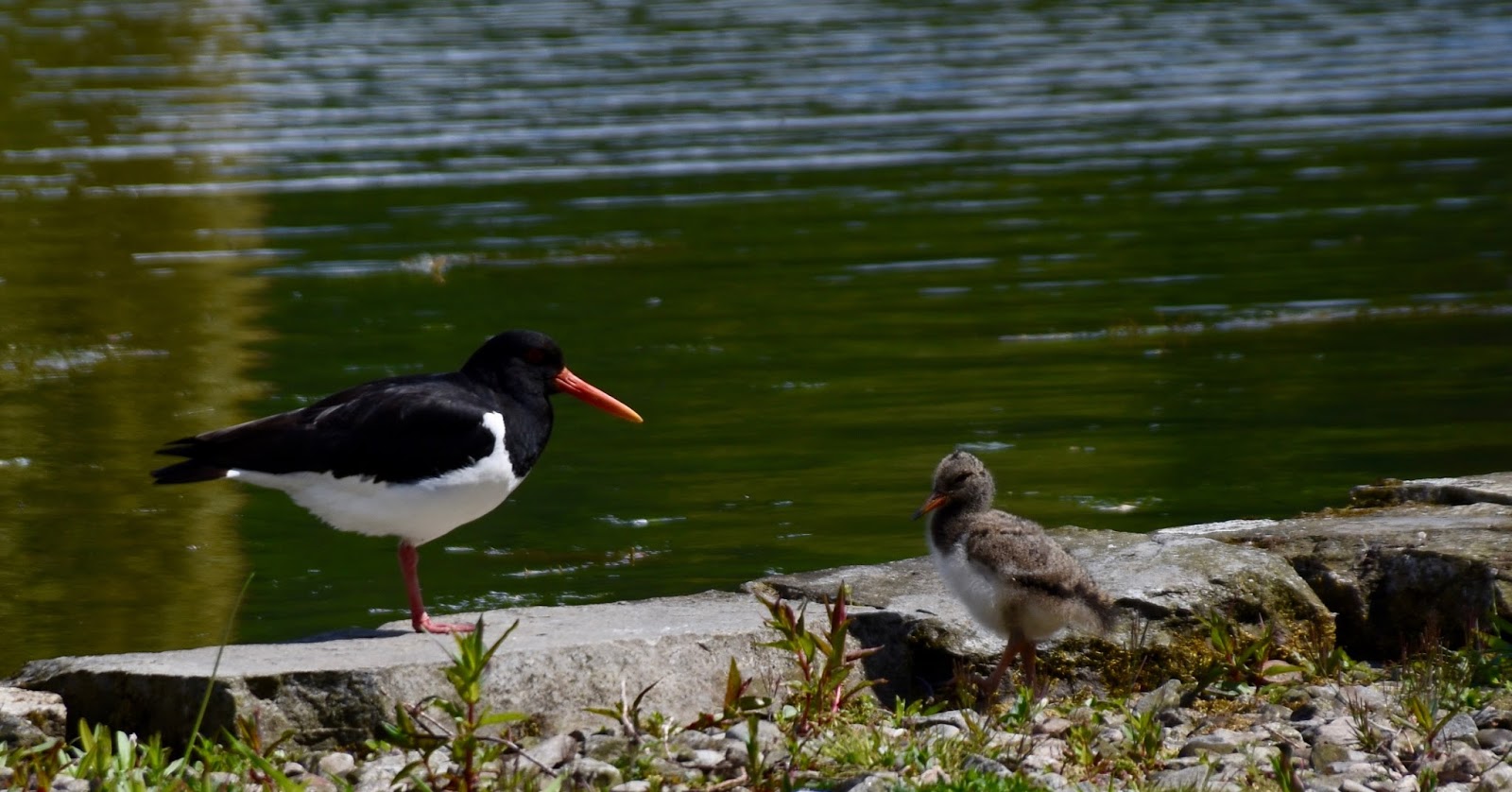
Oyster catcher and chick.

Swan and cygnets.
Another garden which was very much in bloom was the two acre Branklin Garden in the middle of Perth.  It's a place we often visit and it has never disappointed us.
Himalayan Blue Poppy


     The small villages of Scotland are a main draws for me.  It's like stepping back 50 years to a much more simple lifestyle.
Comrie is about seven miles from our home in Crieff.

Crail's harbour is one of several along the edge of the Kingdom of Fife, the county of St Andrews.

Most of the villages host Highland Games--traditional sporting events with a county fair type atmosphere.  The Blackford Games (about 15 miles from our home base in Crieff) are held on the last weekend of May, usually just before we come home from our spring trip.
Girls and boys of all ages compete in traditional Highland dances.

One of the main "heavy" events is the caber toss where the competitor attempts to throw a 140 pound pole end over end.   Distance isn't a factor, but the toss is judged on how close to straight the toss is--a straight up 12:00 toss is perfect.
The people in the villages are a big reason for our travels.  They are now family and friends.  The Scots are genuinely friendly and we find very few remain strangers long.

Jacky Clifford (our Scottish sister) opening a birthday present from America.

Our friend, confidant, and whisky guru, Andrew Cuthbert at J.L. Gill Whisky Shop in Crieff.

Yannick Grospellier, chef and owner of Yann's, the best restaurant in Crieff.

Met this gentleman on the streets of Nairn on the Moray coast.  He started a conversation as I was photographing village scenes.  We chatted about village life, and of course, he asked if Donald Trump were for real.

     One of the biggest draws to Scotland is the land itself--it has some of the most beautiful and dramatic geography of any place on earth.  Moors and mountains grab our attention every trip.
Lone tree growing out of a rock on the edge of Rannoch Moor.

Two views of Rannoch Moor and Black Mount.


Glen Etive.

The mountains of Glencoe. Glancoe is know as the Glen of Weeping because of tragedy which befell the McDonalds of Glencoe at the hands of the Campbells and British.  For more information about the Glencoe Massacre see  https://en.wikipedia.org/wiki/Massacre_of_Glencoe


     Ancient sites as well as modern sculpture are intriguing and provide great photo opportunities.
The Dupplin Cross in St Serf's Church in Dunning is a Pictish carved cross from about the 9th century.

The Croft Moraig stone circle between Kenmore and Aberfeldy is an example of the type of stone circle found throughout Scotland.

The Loch Earn Mirror Man is a sculpture by Rob Mulholland set in the loch. The sculpture represent one of the seasons of the loch.


     While we spend most of our time in the villages and small towns, we enjoy some time in Edinburgh at the end of every trip.
Stairs going up to the Royal Mile.

Anne at the end of a close (pedestrian alley).

The park, Princess Street Gardens, between Princes Street and the Royal Mile, is always full if the weather is nice. 

A tradition for us to have our last meal in Scotland at the Mussel Inn on Rose Street in Edinburgh--a fish stew that is outstanding.

       A final adventure for me on this trip was celebrating newly found Scottish ancestory by getting fitted for my McAllister Clan kilt at McNaughton's in Pitlochry.  The kilt is being shipped this week.  It will have an honored place with my Welsh National and Jones of Wales kilts.

The tartan on the right is my Ancient McAllister tartan.


      We are already well into our planning for our fall trip.  Hopefully there will be many more adventures and many more photos.
Got a good view of the mountains of Greenland on the flight home.


Saturday, January 12, 2013

THE KILT'S THE THING


The History of the Kilt


There’s no more iconic Scottish symbol than the kilt--the bagpipes are a close second with the wild Highland haggis a distant third.  Kilts have been the traditional dress of men and boys in Scotland since the 16th century.  
Dance Competitor Blackford Games, Scotland

Young Drummer, Portland

The kilt has also received wider association with celtic heritage (Welsh, Irish, Cornish) in the late 19th century.  Today’s kilt, though, isn’t what the Highland Scot wore several hundred years ago; that would be the Great Kilt, Big Kilt, or Breacan (Gaelic).  Originally Norse, the Great Kilt was a full length garment with the upper half worn as a cloak draped over the shoulder or brought up over the head.  The wearer had to actually lay down on the garment, made of several yards of wool cloth, and wrap it around himself.  The Great Kilt was a full function wrap which could serve as a blanket when snuggling down in the heather and had enough material left at the top to be able to make a pouch in which to carry your essentials.  After the Battle of Culloden (1746), when the English Duke of Cumberland defeated the Highlanders fighting to return Bonnie Prince Charles Edward Stewart to the throne, tartan attire, along with weapons and bagpipes, were banned in Scotland.  Non-Jacobite lowland Scots didn’t really mind the banning of the tartan kilt which many condemned as a barbarous form of apparel.  It took Queen Victorian’s fascination with her Scottish roots and her display of enormous pride in her Stewart ancestry (1860s) to bring the kilt back into vogue for all Scots--Highland and lowland.

The modern kilt, short kilt, walking kilt, or little kilt (Feilreadh Beg in Gaelic) was invented by English Quaker (to the Scots‘ chagrin) Thomas Rawlinson in 1720 for use of working Highlanders.  
Highland Dance Competitor, Portland Highland Games

Today’s kilts are usually 18-22 ounces per yard of wool for formal heavy weight models and 10-11 ounce weight for lighter kilts.  Most common are the kilts in the 13-16 ounce range which equal about six to eight yards of material for an adult.  Although you will see utility kilts made of cotton or canvas in solid colors, 
Utility Kilt and Unicyclist in Portland

the traditional kilt will be of a tartan (patterned) material called a sett.  Setts are associated with particular families or clans.  These patterns began to be formalized in the Victorian era and are now registered with the International Tartan Index.  Besides family or clan tartans, setts have been registered for districts (such as the counties of Ireland), countries, corps, 

Pipe Band at Portland Highland Games

Pipe Band in Peebles, Scotland
and schools as well as numerous generic patterns.  For instance, the tartan Welsh National is a pattern of green, red, and white--the colors of the flag of Wales.  
Welsh National Tartan

Since the modern kilt isn’t long enough to provide material for a pouch, one had to be invented.  The sporran (Gaelic for pouch or purse) is a small leather or fur bag worn by chain in front of the groin of a kilt wearer.  The sporran, 
Anne with Craig the Piper at Edinburgh Castle

serving as a wallet (and from experience I can tell you that it carries little more than a wallet), comes in various styles from the a simple pouch for day wear to a highly decorated formal sporran worn by pipe band members.  Whether a kilt is utilitarian or formal, a family tartan or a generic, there is a level of truth to the Scottish saying, “A man in a kilt is a man and a half!”

The Wearing of the Kilt (or Cilt)

I don’t know if I should share this secret or keep it all to myself, but it’s a shame for all other males who have Scottish, Irish, Cornish, or Welsh heritage not to know the advantages of wearing a kilt (in Welsh it’s a cilt because the Welsh language doesn’t have a “k”).
 Jones of Wales Tartan 


Many advantages have been written about including freedom of movement and ventilation, but I have yet to see anyone discuss the positive attention factor.  The wearing of a kilt/cilt definitely attracts much attention from both females and males. From the ladies I always get very appreciative looks, more than my naturally attractive legs would garner.  I often get comments like, “I think kilts are so sexy,” and “a man always looks sexy in a kilt.”  Considering I’d get those comments at no other time, except from my adorable wife, I find it a little embarrassing and a great thrill to hear those type of compliments. 
Anne and Two of My Former Speech Students, Sarah and Joanne

Women, also, are constantly asking “The Question”--Is it true about what men wear under a kilt?  I have been known to “Go Commando,” as they say, on occasion--all right, most of the time--and I have developed a stock answer: “They say if a Scotsman wears a kilt, he wears nothing under it.  If he wears something under it, he’s wearing a skirt.  I wear a cilt, but I’m a Welshman, so make your own guess.”  It leaves some room for their imagination, which may or may not be better than the real thing.  I have had a couple of women joke about reaching under my kilt to find out.  I always invite exploration in the name of discovery, but have yet to have anyone be bold enough to find out for themselves.  While all this banter is going back and forth, the lady in question is often snuggling close and rubbing her female charms about.  It’s a hell of a position to put a man in, but I’m man enough to take it.
The reaction from men is interesting as well.  Only a couple of time have I been asked what I wear under my kilt.  More often my wearing of the kilt is acknowledged with a “way to go,” a thumbs up, or a high-five.  I think other men realize and recognize that to wear a kilt an individual has to be a little bit of a performer and very self-confident.  
Highland Game Competitors Wear Kilts

One other advantage to wearing a kilt is that it makes me feel dressy in a way that a business suit never did.  There’s a flair associated with wearing a beautiful and meaningful tartan, accessorized with a striking sporran, hose, and flashes.  It just makes one feel good.
I know there won’t be many out there who will jump on the kilt band wagon, but if you’ve got balls enough there are definite advantages.  
Highland Sculture, Kenmore, Scotland