Scotland Coastal Villages
In the far northeast corner of Scotland on the Morayshire coast north of Aberdeen, Anne and I visited two very interesting villages. We drove down to the village of Pennan which sits on a small bay with houses practically in the water,. Pennan is famous for its iconic red telephone box which was featured in the 1983 British comedy/drama Local Hero starring Burt Lancaster and Peter Regent, and directed by Bill Forsyth (who won the BAFTA for Best Director).
 |
| Pennan Village |
The phone box was originally just a movie prop, but it became so famous BT had to install a working phone so people could call from the booth. The other village we visited is Crovie a little further west along the coast. There we couldn’t drive down to the village because it is so tightly squeezed between the sea and the coastal cliffs that only residents are allowed to drive down to it. Both villages are so interesting that I looked into the history of each.
Pennan is an 18th century fishing village where most families had small boats and were dependent on the men catching fish and the wives and children selling to clients in the area.
In the last 50 years most of the native families have moved out and the houses are now let as holiday homes.
Except for the movie connection of Pennan, Crovie has the more interesting history.
Crovie is what is known as a Clearance Village.
 |
Crave village
The Highland Clearances (Fuadach nan Gaidheal, the “expulsion of the Gael”) was a forced displacement during the 18th and 19th centuries of small-scale farmers or crofters. The reasons for the Clearances were mostly economic. Lairds, Clan Chiefs, or large land owners could make more money raising sheep than leasing plots of land to small farmers. Also, the breakup of the clan system after the Battle of Culloden in 1745, the final battle of the last Jacobite uprising, contributed to the Clearances. |

Clan Chiefs wanted to now be accepted into higher society and didn’t feel the former obligation to clan members. A third factor in the later Clearances was the Great Potato Famine of 1846. With starvation and death came the opportunity to turn the land over to more modern agricultural practices--read that also as more profitable practices. A final contributor to the Clearances was that Lairds saw some profitability in relocating families to the seaside for harvesting kelp (at its peak between 1750 and 1815). At times, the Clearances became extremely brutal, especially in Sutherland in north central Scotland. There the Duke and Countess of Sutherland began the eviction (1811-1820) of 90 families in order to plant “turnips,” raise sheep, invest in coal-pits and salt-pans, and increase herring fishing. People were physically thrown out of their homes and the homes were burned to insure residents wouldn’t return.

Tenants were given due process, usually three months notice. But when they refused to leave the farms they had worked (some for more than 100 years) the evictions were enforced at gun point. Crovie is one of the Highland Clearance villages. Seeing it, one understands that no one particularly would choose to live there, except perhaps for a week at a time.
On another trip Anne and I visited one of the Highland Clearance villages in Sutherland. This is what I wrote in my journal after a visit to Badbea:
Our tee time at Wick GC was one o’clock which gave Anne and me plenty of time to visit the clearance village of Badbea (BAD-bay) on Scotland’s east Caithness coast five miles north of Helmsdale. I’d seen the village listed on our map, but had no idea what we’d find there. In the lay-by on the A9 near Ousdale informative signage told us a little about the history of the village and gave a few insights into the lives of the families brought here.
The footpath is now more of a sheep trail--for about 100 yards we actually followed a sheep until she bolted off the path. We could be the only visitors this day or this week; the three-quarter mile trail was little visited. As we approached the precipitous Berriedale cliffs above the North Sea, the monument, built in 1939 by David Sutherland in memory of his father and the people of Badbea, signaled we had reached the village site.
At first the monument was all we noticed--that and the quiet.
Even the gulls seemed to sense the sadness in this site as they slid by in respectful silence. Then we noticed a few drystone walls and the outlines of stone longhouses and byres crofters from the straths of Ousdale, Langwell, Auchencraig, and Kildonan had built when they were evicted from their land and moved to the cliffside Badbea village. Sheep and politics had instigated the Highland Clearances and created places like Badbea, which started in 1792. Landowners like Sir John Sinclair of Ulbster evicted the crofters in preference to more profitable sheep. At its largest the village was home to 35 inhabitants, with the last leaving in 1911.
As we wandered about the site under dramatically darkening skies, we could hear in the wind the stories of families forced onto these windswept cliffs as they were uprooted from ancestral lands--lands cleared and farmed by hand, lands which for generations had given a meager, but adequate life. Stories about men of the land forced to seek livelihood on the herring or salmon boats. Stories of many, who not knowing the ways of the ocean, did not return from the sea. Stories of children and livestock having to be tethered to rocks or posts so they would not be swept over the cliffs to the sea below by the fierce winds. Stories of a people who for more than a hundred years adapted, lived, and at times even flourished, under horrendous conditions. It didn’t take long before we too were hushed like the gulls by the stories that hung heavy on the wind.
It was a quiet walk back to the car and drive on to the Wick golf course. As we played that afternoon on the lovely Wick links, every breeze brought back the stark scene and stories of the Highland Clearance village of Badbea.
The Highland Clearances aren’t a pretty part of Scottish history, but the Clearances are definitely interesting and give us insight into the harsh conditions crofters faced.
Photo Essay: The Oregon Coast in November
 |
| Rivers were running very full (Three Rivers near Hebo). |
 |
| Even the cormorants were taking time to dry out. |
 |
| Manzanita and Nehalem Bay from Rockwork Lookout. |
 |
| Looking further south from Rockwork Lookout. |
 |
| Cove Beach and Cape Falcon |
 |
| Anne shopping in Cannon Beach for a new hat...the red one. |
 |
| Lone figure sits contemplating the sea at Cannon Beach. |
 |
| Sunset at Seaside |
 |
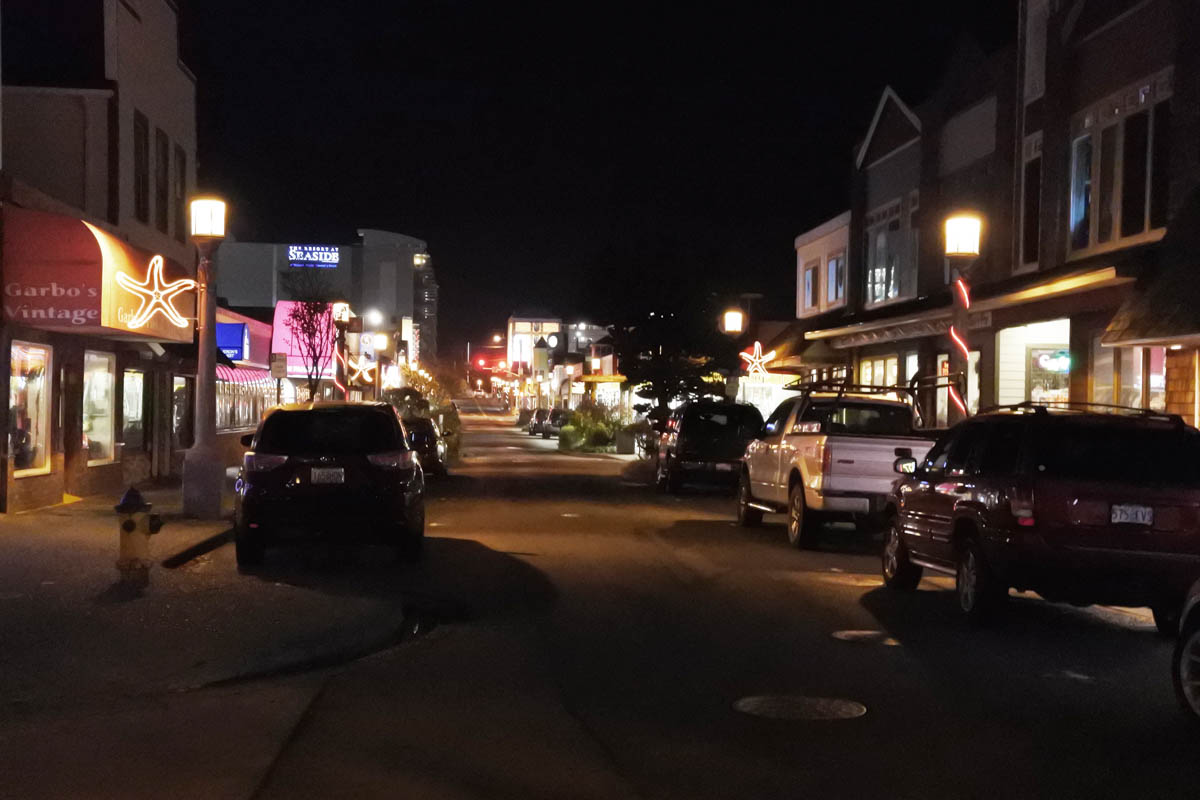
| Seaside at night. |
 |
| Gearhart GC is one of Oregon's oldest golf courses, and one of the best. |
 |
| Tillamook Rock Lighthouse |
 |
| Sea stacks at Cannon Beach. |
 |
| Not quite a full moon to end our journey. |