Showing posts with label cathedrals. Show all posts

Wednesday, October 3, 2018

Scotland Fall 2018 #1


It may be trite to call this "a Scottish traffic jam," but that what it is.

The AMS Toilet Adventure

In the men’s toilet at Schiphol Airport in Amsterdam I was at one urinal and there was a lady cleaning the urinal next to me. We both agreed it was no big deal.
Anne, Dave, Charleen, and the docent at St Serf's Church in Dunning. The cross is  a Pictish carved cross from the 9th century, the Dupplin Cross.

Being Tour Guides
The group heads in to tour Duone Castle, an Outlander site.

We didn't get to tour Tullibardine Distillery, but we still had a taste.

We did tour Edradour Distillery, the smallest commercial distillery in Scotland.

We’ve been talking to Anne’s younger sister Charleen and her husband Dave for years about coming to Scotland with us—both have Scottish heritage. After both finally retired, we got the opportunity to be tour guides to family travelers. Charleen and Dave joined us for nine days of our month long fall Scotland trip.


Anne, Charleen, and Dave ready to visit Drummond Gardens, one of the best formal gardens in Britain.

The drive into Drummond Castle and Gardens is stunning.


Dave examines Earthquake House in Comrie village, home to the most seismic activity in the UK.

The trip actually started long before any of us got to Scotland. Charleen and Dave had research to do to determine what kind of things they wanted to see—distilleries, gardens, ruined castles, lived-in castles, ancient sites, big cities, small villages, etc. Anne and I had major and sometimes lively discussions about what they must see or ought to see or need to avoid considering where we were going to stay (self catering in central Scotland and timeshare in the Highlands). A couple of dinner meetings and numerous emails confirmed our itinerary, always with flexibility.
After nine successful days as tour guide here are some of my observations:
Our group (minus the photographer) assembled outside one of the reconstructed early dwellings in the Highland Folk Village in Newtonmore.

First, much of the success of the trip owes to the fact that Charleen and Dave did their homework both before the trip and nightly while in Scotland. They had good ideas of what they were seeing and thus could really enjoy the experience. Even when we threw in some last minute site, they were knowledgeable enough to understand what they were seeing or to ask the right questions. 
Charleen and Dave's first dinner in Scotland at the Tower Hotel Gastro Pub just across the road from our self-catering Thistle Cottage in Crieff. Notice, I managed to get in the picture, too.

Visiting a Crannog, a family dwelling build out into a loch, on Loch Tay.

Second, for me, the pressure was intense. I much better appreciate those tour guides who take on the responsibility for someone else’s good holiday. I think I checked too much on whether Charleen and Dave were enjoying what we were doing, but they were always positive.
Dave hand feeding a member of the Cairngorm Reindeer herd.

Impressive!

Third, I felt like I was controlling too much of the time and needed to let go more. We did separate as couples in St Andrews and met up later and we did tour Urquhart Castle independently. I probably should have planned in more of that kind of experience (Or is planning free time an oxymoron?).
We gather in front of Anderson's in Boat of Garden before going in for Pie Night--meat or fish pies.

The Packhorse Bridge at Carr-bridge not far from Boat of Garden.

Fourth, for Anne and I it was the most intense touring we’ve done for quite a while, but it was great fun. We wore them out each day which is what they wanted, but it wore us out too. In nine days we put more than 1100 miles on our rental car with me doing all the driving. As tiring as it was, the driving was never too much for me, and for Charleen and Dave it was sort of break time. Anne was stuck with her same old job, Grand Wizard of Navigation, which she did admirably.
Dave discovers the Scot's love of sweets as he tries a butterscotch sunday at the Cairngorm Hotel in Aviemore.

Lastly, Charleen and Dave’s enthusiasm and excitement energized us as we saw things through their eyes. For instance, Anne and I have toured almost forty distilleries (many more than once), but Dave’s interest in learning about the process and tasting infected us all. And though we’d been to Innerpeffray Library (the oldest lending library in Scotland) four times before, we got a new appreciation for the facility through Charleen’s experience as a school librarian. 
We got a personal tour of the Innerpeffray Library from the curator.


The massive ruins of Elgin Cathedral.

For Anne and me it is always a joy to share our Scotland with our friends, especially those who visit Scotland with us. This was even more special. And even if we still need work to be accomplished tour guides, at least we can say we had a perfect time.
At the largest commercial distillery in Scotland, Glenfiddich, we got to watch part of the bottling process.


NEXT: Part 2 -- Photos Allowed plus more

Monday, October 7, 2013

A Week in the Kingdom of Fife, Part 1


Note: This blog post has been delayed because Craggendorrach Hilton in Ballater chose to solve their internet complaints by eliminating Wi-Fi., and punish the customers rather than solve the internet reliability issue.  Juvenile decision-making if you ask me; just like the US Congress.
Fife: a county of Scotland consisting of the peninsula of land between the Firth of Tay on the north to the Firth of Forth on the south and from the North Sea on the East inland to Dunfermline and the M90 motorway.  The Kingdom of Fife contains the Home of Golf, the city of St Andrews, and a multitude of great golf courses, such as the Old Course, Kingsbarns, Crail Balcomie, Leven, Lundin, and a plethora of lesser known courses.  This post is an accounting of a week Anne and I spent in the Kingdom of Fife on this trip.
Our move from our B&B home at Merlindale in Crieff (central Scotland) to Fife began inauspiciously.  Five miles away from Crieff I remembered that we hadn’t brought copies of our books that we would need to give to golf courses we were scheduled to play.  Back track, start over.  Our drive to our new digs in time share was only about an hour and a half which left plenty of time for sightseeing.  

We wanted to tour the abbey at Balmerino, but found the structure was fenced off as too unstable for safety.  Next was a visit to the village of Leuchars, home to an RAF base, to find a cup of tea and more importantly a public toilet.  The only tea room open was a hole-in-the-wall so small it had no public facility.  No toilet meant no tea.  

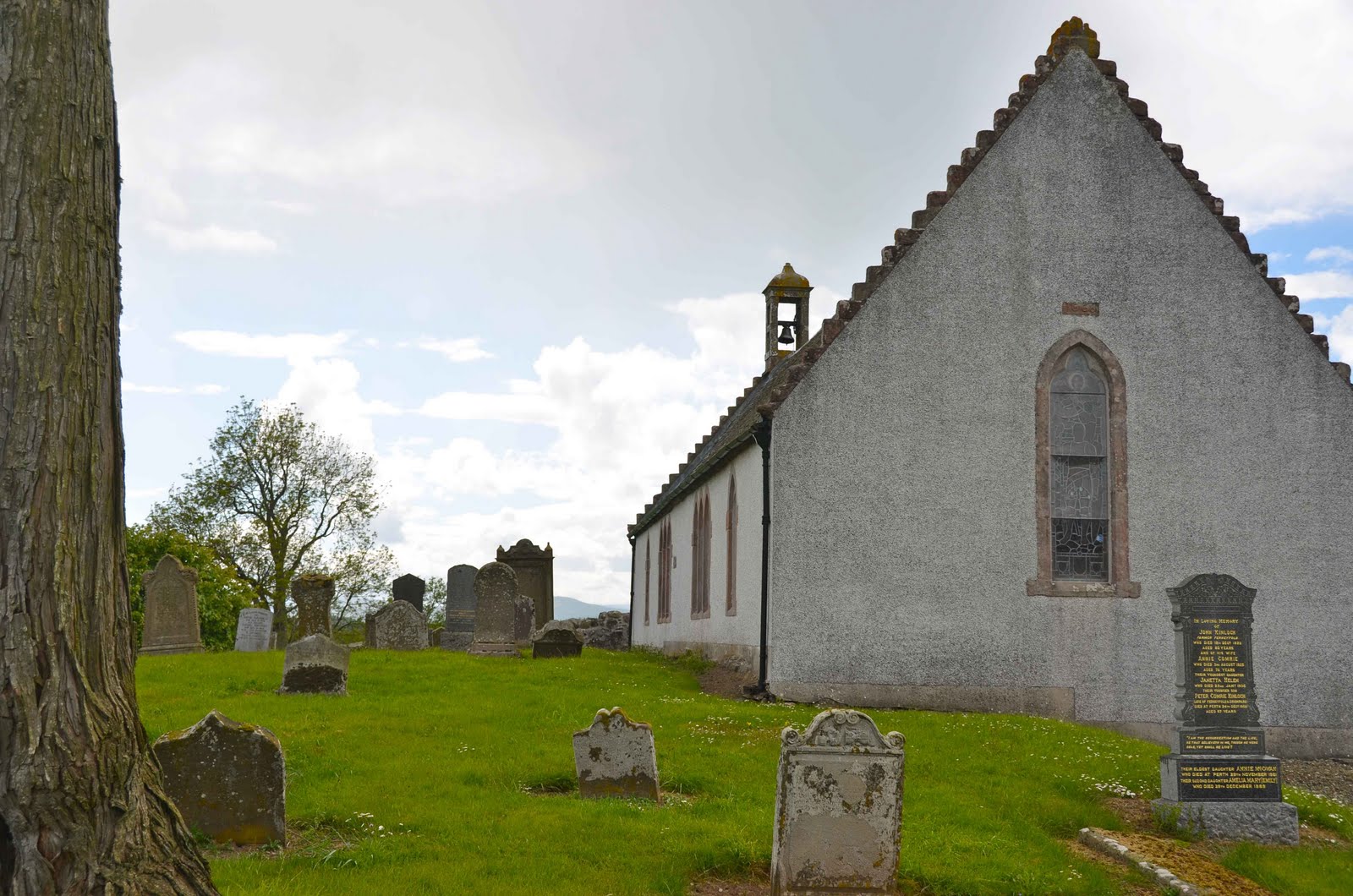
We toured a local church (St Athernase) with interesting architecture instead.  We found toilets and lunch--in different rooms--at The Balgove Larder just outside of St Andrews.  

In St Andrews, after watching a couple of golf matches tee off on the Old Course, it was a quick tour of the huge ruined St Andrews Cathedral and a latte in the local Starbucks.  Late that afternoon we checked in to our Unit 8 at Kilconquhar Castle (pronounced kil-con-ker).  
Kilconquhar Castle with our unit on the left side.

Our bedroom in Castle Unit 8.

The apartment had three bedrooms upstairs and kitchen, dining, and living room downstairs.  All Five Star! This would be our home for a week.
Our first day on Fife started with a round at Charleton Golf and Country Club in the village of Colinsburgh.  

The course, owned by Baron St Clair Bonde, provides employment opportunities for locals and stress-free golf for visitors.  After golf we drove along the southern coast of the peninsula looking for photo opportunities in the small harbours of St Monans and Pittenweem.  
 
Pittenweem Harbour


St Monan's Harbour

St Monan's Harbour

     Monday’s golf was more challenging (but still fun) at the Open qualifying course Scotscraig in Tayport on the Firth of Tay coast.  

The links course is lovely and has some very tough holes.  Near Tayport is an interesting church in the hamlet of Kirkton of Barns.  


The small kirk is picturesquely sited on a hill and displays some fascinating gargoyles and grotesques.  A drink before dinner in the castle’s White Cockade Bistro provided a relaxing break.
Tuesday’s golf--yes, this trip is really about golf--was at a course new to us.  Dunnikier Park GC in Kirkcaldy is a very enjoyable municipal course. 

 Not nearly as tough as Scotscraig, Dunnikier Park proved to be a fun track--enough of a test to be interesting, yet easy to get around even the first time.  For dinner that evening we drove down to the harbour at Anstruther to enjoy the award winning fish and chips from the Anstruther Fish Restaurant.  

Anstruther Fish Restaurant

Anstruther Harbour at night.
On weekends lines will be two hours long for eating in and an hour long for take-away.  The fish and chips is that good.


The rest of the week in Part 2.


Wednesday, August 17, 2011

Travel Planning 102


The first one that we really took note of was probably the one near the sixth tee at Maybole Golf Club in Ayrshire.  After that one we started noticing War Memorials on several golf courses (Turnberry, Strathlene Buckie, Anstruther, Abernethy) and in most villages (Crieff, Muthill, Kenmore, Dornoch, Dunkeld).  

These memorials to parish or village soldiers lost in World War I, II, and other conflicts would make an interesting subject of study for the visitor interested in the historical and sociological aspects of those wars.  They, though, have not yet become a compelling subject for us.  As we return again to Scotland for our 18th time in eleven years I find that I do seek out special topics to plan our trip around, sometimes with Anne’s active encouragement and other times with her reluctant consent.  Other travelers may have no need of special subjects as they explore one new place after another, as we did when we traveled to Alaska on our first cruise or took a road trip to Banff National Park in Canada.  Yet as we try to explore Scotland in depth, special topics to research or study help focus our travel days.
We’ve had a variety of topics which have directed our trips over the past few years including castles, religious structures, standing stones or stone circles, waterfalls, gardens, and, of course, distilleries.  

 It would be quite easy to build several trips around exploring Scotland’s castles--lived in, ruins, great houses.  In fact, in the northeast of Scotland there is a designated “Castle Trail,” which includes Drum, Crathes, Kildrummy, Fyvie, Huntly, and others.  In the Ayrshire area on the west coast are the great castles of Dean and Culzean (cul-een) with its apartments on the upper floors dedicated the President Dwight D. Eisenhower for his services in World War II.  
The Borders area in the southeast may not be rich in castles, although Floors Castle is nice to tour, but it has a wealth of abbeys to tour.  Melrose, Jedburgh, Dryburgh, and Kelso abbeys are individually fascinating, but as a group only a few miles apart these David I structures are phenomenal.  The ruins of St Andrews Cathedral and St Rule’s Tower just blocks away from the ruined St Andrews Castle in the golfing mecca of St Andrews are not to be missed.  Glasgow has its impressive Cathedral and Edinburgh has St Giles on the Royal Mile.  As impressive as these are, we enjoy visiting the smaller (a relative term) cathedrals at Dunblane, Dunkeld, Dunfermline, Dornoch, and
St Magnus in Kirkwall on the Orkney Islands. 

Books such as The Explorer’s Guide to Abbeys, Monasteries and Churches of Great Britain by Frank Bottomly (Avenel Books, 1981) and The Ancient Stones of Scotland by W. Douglas Simpson (Robert Hale, 1968) have helped direct our explorations.  
In the last couple of years we’ve used local booklets or guides, such as Stone Circles and Standing Stones of Perthshire by David Watson (Simple Guides, 2006) and The Stones of Strathearn by Andrew Finlayson (One Tree Island, 2010), to direct our searches for these very ancient monuments.  I pick up the guide on one trip and then use it to plan the next trip or a portion of it.  Last fall I picked up A Cycle of Saints: The Medieval Chapels of Strathearn by Perth and Kinross Heritage Trust (2004) and used it to plan our last day of touring on our spring trip--kept us actively touring and close to our home base of Crieff which is in central Strathearn (the valley of the River Earn).  
This brings me to this fall’s quest: Scottish graveyards.  Some might say such a search is a dead end, but then we’d have to punish them for saying that.  From two recently acquired books from Amazon, A Scottish Graveyard Miscellany by Hamish Brown ( Birlinn, 2008) and Understanding Scottish Graveyards by Betty Willsher (Canongate Press, 2006), I have convinced a reluctant Anne to join me in searching through interesting Scottish graveyards for folk art carved on the gravestones. 

We’ve seen and I’ve photographed some picturesque carvings on gravestones in the past, but now I will seek them out with some ideas about what they mean.  I have in our travel itinerary visits to cemeteries in Muthill, Methven, Perth, and Kinfauns, St Madoes, Logierait, and Tulliallan to look for and photograph stones with carvings of Biblical stories and occupations.  We will still visit or revisit castles, stones circles, gardens, and, of course, distilleries, but will add the new graveyard search to aid our in depth understanding of Scotland. 

Photos in Order: Muthill War Memorial; Ring of Brogar; Culzean Castle; Dunkeld Cathedral; Scottish Medieval Church; Adam & Eve carving.
Look for our blog entries from Scotland soon after we arrive on September 1.