Showing posts with label abbeys. Show all posts

Monday, October 7, 2013

A Week in the Kingdom of Fife, Part 1


Note: This blog post has been delayed because Craggendorrach Hilton in Ballater chose to solve their internet complaints by eliminating Wi-Fi., and punish the customers rather than solve the internet reliability issue.  Juvenile decision-making if you ask me; just like the US Congress.
Fife: a county of Scotland consisting of the peninsula of land between the Firth of Tay on the north to the Firth of Forth on the south and from the North Sea on the East inland to Dunfermline and the M90 motorway.  The Kingdom of Fife contains the Home of Golf, the city of St Andrews, and a multitude of great golf courses, such as the Old Course, Kingsbarns, Crail Balcomie, Leven, Lundin, and a plethora of lesser known courses.  This post is an accounting of a week Anne and I spent in the Kingdom of Fife on this trip.
Our move from our B&B home at Merlindale in Crieff (central Scotland) to Fife began inauspiciously.  Five miles away from Crieff I remembered that we hadn’t brought copies of our books that we would need to give to golf courses we were scheduled to play.  Back track, start over.  Our drive to our new digs in time share was only about an hour and a half which left plenty of time for sightseeing.  

We wanted to tour the abbey at Balmerino, but found the structure was fenced off as too unstable for safety.  Next was a visit to the village of Leuchars, home to an RAF base, to find a cup of tea and more importantly a public toilet.  The only tea room open was a hole-in-the-wall so small it had no public facility.  No toilet meant no tea.  

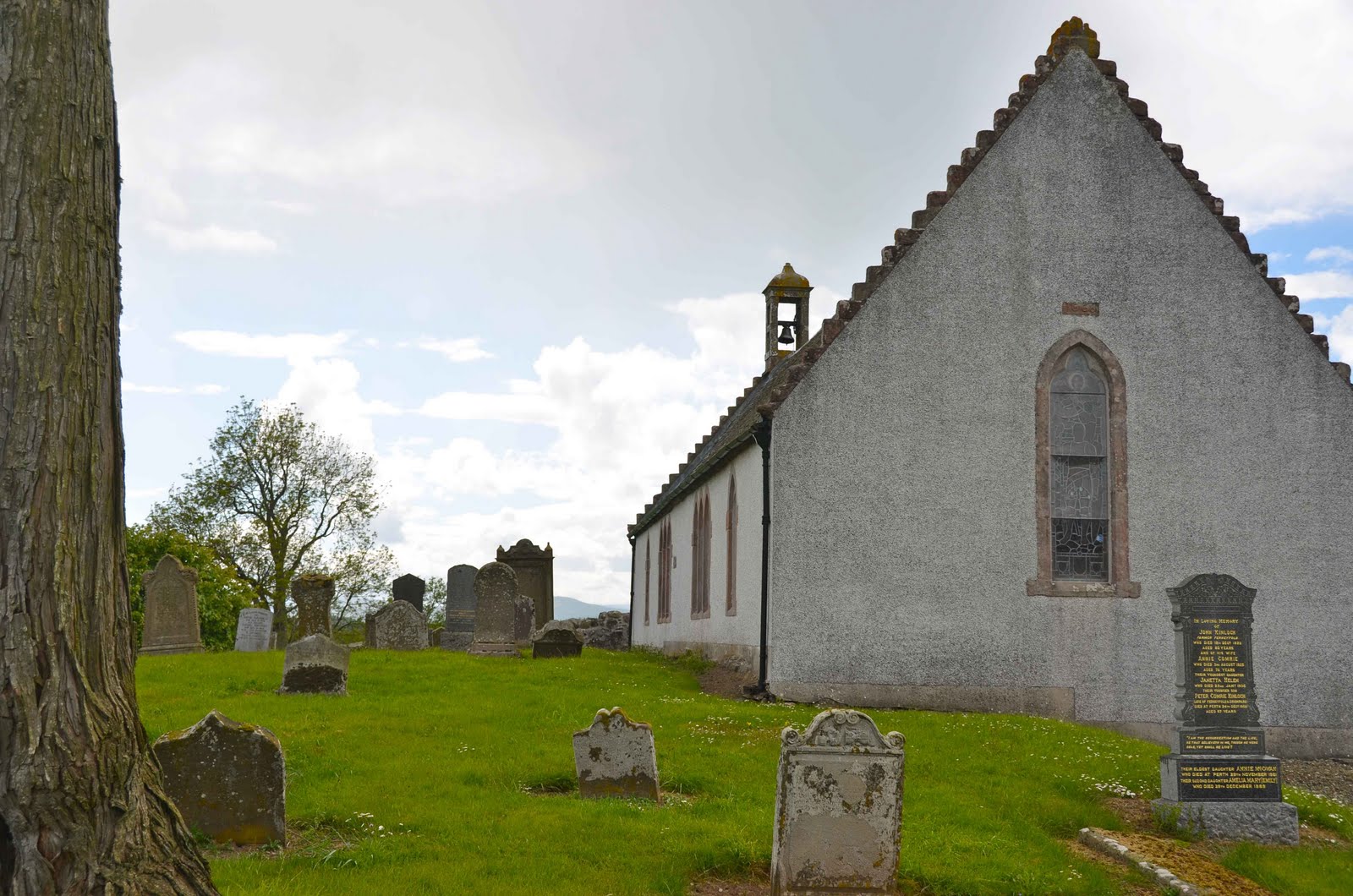
We toured a local church (St Athernase) with interesting architecture instead.  We found toilets and lunch--in different rooms--at The Balgove Larder just outside of St Andrews.  

In St Andrews, after watching a couple of golf matches tee off on the Old Course, it was a quick tour of the huge ruined St Andrews Cathedral and a latte in the local Starbucks.  Late that afternoon we checked in to our Unit 8 at Kilconquhar Castle (pronounced kil-con-ker).  
Kilconquhar Castle with our unit on the left side.

Our bedroom in Castle Unit 8.

The apartment had three bedrooms upstairs and kitchen, dining, and living room downstairs.  All Five Star! This would be our home for a week.
Our first day on Fife started with a round at Charleton Golf and Country Club in the village of Colinsburgh.  

The course, owned by Baron St Clair Bonde, provides employment opportunities for locals and stress-free golf for visitors.  After golf we drove along the southern coast of the peninsula looking for photo opportunities in the small harbours of St Monans and Pittenweem.  
 
Pittenweem Harbour


St Monan's Harbour

St Monan's Harbour

     Monday’s golf was more challenging (but still fun) at the Open qualifying course Scotscraig in Tayport on the Firth of Tay coast.  

The links course is lovely and has some very tough holes.  Near Tayport is an interesting church in the hamlet of Kirkton of Barns.  


The small kirk is picturesquely sited on a hill and displays some fascinating gargoyles and grotesques.  A drink before dinner in the castle’s White Cockade Bistro provided a relaxing break.
Tuesday’s golf--yes, this trip is really about golf--was at a course new to us.  Dunnikier Park GC in Kirkcaldy is a very enjoyable municipal course. 

 Not nearly as tough as Scotscraig, Dunnikier Park proved to be a fun track--enough of a test to be interesting, yet easy to get around even the first time.  For dinner that evening we drove down to the harbour at Anstruther to enjoy the award winning fish and chips from the Anstruther Fish Restaurant.  

Anstruther Fish Restaurant

Anstruther Harbour at night.
On weekends lines will be two hours long for eating in and an hour long for take-away.  The fish and chips is that good.


The rest of the week in Part 2.


Monday, May 27, 2013

To the South, To England (Part 2)


I Ain’t ‘Fraid of No Ghosts.  Most of the tourist shops in southern England sold small books about local ghosts (ie., the Ghosts of Dartmoor, Southern Ghost Stories, etc.).  I also have a book I’d been reading at home before the trip called “Britain’s Most Haunted Pubs and Inns.”  This led me to start asking at the pubs and inns we visited if there were any local spooks.  
In Staple Fitzpaine near Taunton in Somerset we stayed at the Greyhound Inn which has been a coaching house and inn since the 1700s.  
Greyhound Inn, Staple Fitzpaine, Somerset

A great steak dinner
While visiting with the landlord I jokingly asked if there were any local ghosts we could visit with.  He said that while he’d never felt a presence, the kitchen staff say that sometimes they feel someone else is in the room with them when no one is about.  He also said that a burly Irishman had stayed one night a couple years before.  In the morning when he was asked how he’d slept, the Irishman replied, “I barely slept at all.  I woke up in the middle of the night with hands around my neck and no one was there.”  The landlord didn’t know if the Irishman had had a supernatural experience or just too many pints the night before.  
Our next opportunity came at The Dolphin Inn in Penzance, Cornwall.  

The Dolphin Inn

We picked out this pub because of its very nice menu and reputation for food, as well as its reputation as a quite haunted inn. At least three ghosts haunt the inn: the old retired ship’s captain, a young man who had committed suicide in the pub, and an elder lady who wanders amongst the upstairs rooms.  We had a pint one night and a meal the next and never did see any of the resident spirits except the ones in our pints of cider.
On our exploration of Dartmoor National Park in Devon we were told by a visitor’s centre docent to stop by the Warren House, the third highest inn in England.  
The Warren House, Third Highest Inn in England
It was quite foggy on the moor, very atmospheric, so the Warren House pub was a lovely stop with its welcoming fire (which has been going for almost 200 years).  The landlord here was very chatty and when I asked about ghosts he said he wasn’t sure if the inn was haunted or not.  
Landlord of the Warren House
 He then proceeded to tell us that there were certain places in the pub house that dogs wouldn’t set foot, that the kitchen staff had seen fleeting images outside the kitchen when no was there, and that a publican had once been murdered behind the bar, but he wasn’t convinced their spirits still roamed the house.  Even when we went back for dinner later in the day, we still didn’t find any evidence of ghosts, just friendly locals enjoying Sunday dinner.
Our last spooky place is considered the most haunted pub in England. The Red Lion in Avebury in Wiltshire is indeed special.  
Avebury Stone Circle
The inn is in the middle of the largest ancient stone circle in the world.  The Avebury circle, about 30 miles north of Stonehenge, is three-quarters of a mile around and consists of scores of very large stones.  

The Red Lion Pub has numerous eating areas as well as five resident ghosts.  The staff have also reported seeing a phantom horse drawn carriage pull into the inn at night and hearing the ghostly clattering of hooves in the courtyard outside the pub. 

Though Prince Charles has eaten several times in the pub, not even his presence had brought any of the spirits to seek a Royal audience.  
Although we weren’t successful in finding any evidence of real phantoms (now there’s an oxymoron for you), we did enjoyed the search for English ghosts.  

The Moors.  Our trip to the south shires of England took us through or around several of  the famed English moors--areas of grasslands, heathers, fern, and stone, usually quite desolate,foreboding, and very Hound of the Baskervillean, except that they were all full of walkers or trekkers.  Exmoor in Somerset and North Devon was disappointing.  It was mostly stonewall-fenced farmland hidden behind tall hedges (see the last blog post).  On the way from Penzance (Cornwall) to Tavistock (Devon) we got into more typical moorland on Bodmin Moor.  After quite a drive along the southern England coast it was pleasant, even in light rain, to walk a half mile out to Hurler’s stone circle, 

Hurlers' Stone Circle on Bodmin Moor

one of the more ancient of the Neolithic circles.  A much less strenuous 50 foot walk was needed to see Trethevy Quoit (aka. the Giant’s House) 

with its 12 foot long top stone, a form of burial chamber we’ve seen more in Ireland where they are called dolmens.  
It was Dartmoor though where we got the real moorland experience, complete with heavy fog and swirling mists.  
Anne walking in the moors

A Tor, a naturally sculpted rock outcropping in the moors

We drove from our rather forgetable Mallards B&B in Tavistock to the main Dartmoor National Park Visitors’ Centre in Princetown, where we got suggestions for what to see on our one day visit to the park.  First on the list was the Warren House, a great inn in the heart of the moors.  
The Warren House, Dartmoor
Then, after coffee, a flapjack (a sweet homemade oat biscuit), and some conversation, we stopped to see a clapper bridge (a stone bridge over a stream or river) in Postbridge.  

Luck was with us as we had the bridge to ourselves for a few minutes before a bus of tourists arrived to swarm the bridge and get into each others’ photos.  
Anne in one of the stone huts at Grimspound, Dartmoor

It was about three miles from Postbridge to the turnoff to the trailhead of the hike up to Grimspound, a low stonewall encircled Bronze Age settlement of 24 stone huts dating to 1300 BC.  For a break from the foggy moors we drove down a horrendously small road to the village of Buckfast and a visit to Buckfast Abbey, 


an active working monastery. 

In the abbey church I visited with Father Christopher who knew about the Mt Angel Abbey and the Benedictine Assisted Living Center where my mother is getting well cared for.  After the dry weather of the abbey we headed back into the moors to find either stone circles or remains of stone huts (I couldn’t be sure which) 

before again visiting Warren House for a good dinner.  One interesting note about dinner at the inn was that while in the morning the specials board had listed a special of Sunday roast, by mid-afternoon the roast had been replaced with a different special.  As we ate we watched the bar staff change the specials three more times--either they were one-of-a-kind or they were yesterday’s left-overs.  Lastly, we wanted to see a second ancient village with a unique stone row feature.  

We started out past the wild Dartmoor ponies, but soon were turned back by fog so thick we were afraid of getting lost on the trackless moor.
Although the villages of southern England, such as St Ives (made famous by the Doc Martin TV series) and Mousehole, 
Mousehole harbor, a few miles from Penzance, Cornwall

were picturesque, I much more enjoyed traipsing around Bodmin Moor and Dartmoor.

At the Theatre.  A Rick Steves’ travel show turned us on to the open-air Minack Theatre at Porthcumo about four miles from Land’s End in Cornwall.  We booked from home an evening  performance of a Cornish Celtic Folk Group at the theatre and were looking forward to the music and to seeing the venue.  When the weather on performance day turned nasty with 40 mile an hour winds and heavy rain, we decided to visit the theatre during the day knowing that the evening performance would be cancelled.  


The hand-built rock amphitheater is the dream child of Rowena Cade, who used her back garden to stage a local production of The Tempest in 1932.  Her work and that of a faithful gardener produced a dramatic seaside theatre which today hosts 17 plays in a season running from June through September and seen by 80,000 theatre-goers in a typical year.  


As we toured the theatre in high wind and driving rain we were told that the performance would probably not be cancelled--evidently the group would perform for anyone silly enough to sit out on grass or stone seats in 40 degree wind-blown rain.  We were not in attendance, but the theatre is still a highlight of our trip.  


Next: More highlights from England and Scotland and our trip summary--all written from home.
    

Wednesday, August 17, 2011

Travel Planning 102


The first one that we really took note of was probably the one near the sixth tee at Maybole Golf Club in Ayrshire.  After that one we started noticing War Memorials on several golf courses (Turnberry, Strathlene Buckie, Anstruther, Abernethy) and in most villages (Crieff, Muthill, Kenmore, Dornoch, Dunkeld).  

These memorials to parish or village soldiers lost in World War I, II, and other conflicts would make an interesting subject of study for the visitor interested in the historical and sociological aspects of those wars.  They, though, have not yet become a compelling subject for us.  As we return again to Scotland for our 18th time in eleven years I find that I do seek out special topics to plan our trip around, sometimes with Anne’s active encouragement and other times with her reluctant consent.  Other travelers may have no need of special subjects as they explore one new place after another, as we did when we traveled to Alaska on our first cruise or took a road trip to Banff National Park in Canada.  Yet as we try to explore Scotland in depth, special topics to research or study help focus our travel days.
We’ve had a variety of topics which have directed our trips over the past few years including castles, religious structures, standing stones or stone circles, waterfalls, gardens, and, of course, distilleries.  

 It would be quite easy to build several trips around exploring Scotland’s castles--lived in, ruins, great houses.  In fact, in the northeast of Scotland there is a designated “Castle Trail,” which includes Drum, Crathes, Kildrummy, Fyvie, Huntly, and others.  In the Ayrshire area on the west coast are the great castles of Dean and Culzean (cul-een) with its apartments on the upper floors dedicated the President Dwight D. Eisenhower for his services in World War II.  
The Borders area in the southeast may not be rich in castles, although Floors Castle is nice to tour, but it has a wealth of abbeys to tour.  Melrose, Jedburgh, Dryburgh, and Kelso abbeys are individually fascinating, but as a group only a few miles apart these David I structures are phenomenal.  The ruins of St Andrews Cathedral and St Rule’s Tower just blocks away from the ruined St Andrews Castle in the golfing mecca of St Andrews are not to be missed.  Glasgow has its impressive Cathedral and Edinburgh has St Giles on the Royal Mile.  As impressive as these are, we enjoy visiting the smaller (a relative term) cathedrals at Dunblane, Dunkeld, Dunfermline, Dornoch, and
St Magnus in Kirkwall on the Orkney Islands. 

Books such as The Explorer’s Guide to Abbeys, Monasteries and Churches of Great Britain by Frank Bottomly (Avenel Books, 1981) and The Ancient Stones of Scotland by W. Douglas Simpson (Robert Hale, 1968) have helped direct our explorations.  
In the last couple of years we’ve used local booklets or guides, such as Stone Circles and Standing Stones of Perthshire by David Watson (Simple Guides, 2006) and The Stones of Strathearn by Andrew Finlayson (One Tree Island, 2010), to direct our searches for these very ancient monuments.  I pick up the guide on one trip and then use it to plan the next trip or a portion of it.  Last fall I picked up A Cycle of Saints: The Medieval Chapels of Strathearn by Perth and Kinross Heritage Trust (2004) and used it to plan our last day of touring on our spring trip--kept us actively touring and close to our home base of Crieff which is in central Strathearn (the valley of the River Earn).  
This brings me to this fall’s quest: Scottish graveyards.  Some might say such a search is a dead end, but then we’d have to punish them for saying that.  From two recently acquired books from Amazon, A Scottish Graveyard Miscellany by Hamish Brown ( Birlinn, 2008) and Understanding Scottish Graveyards by Betty Willsher (Canongate Press, 2006), I have convinced a reluctant Anne to join me in searching through interesting Scottish graveyards for folk art carved on the gravestones. 

We’ve seen and I’ve photographed some picturesque carvings on gravestones in the past, but now I will seek them out with some ideas about what they mean.  I have in our travel itinerary visits to cemeteries in Muthill, Methven, Perth, and Kinfauns, St Madoes, Logierait, and Tulliallan to look for and photograph stones with carvings of Biblical stories and occupations.  We will still visit or revisit castles, stones circles, gardens, and, of course, distilleries, but will add the new graveyard search to aid our in depth understanding of Scotland. 

Photos in Order: Muthill War Memorial; Ring of Brogar; Culzean Castle; Dunkeld Cathedral; Scottish Medieval Church; Adam & Eve carving.
Look for our blog entries from Scotland soon after we arrive on September 1.