Saturday, June 17, 2023

#204 Story, Photos, and News


       This post contains a story from our travels to Scotland, some favorite old photos (film that's been digitalized), and some other news. Hope you enjoy.


The World, It Is Exploding


Our first time using timeshare for lodging in Scotland was in the fall of 2003. We spent a week at Scandinavian Village in Aviemore in the central Scottish highlands. Our apartment had two bedrooms and a kitchen/dining/living room. What we missed by staying in self-catering (mostly the grand B&B breakfasts) was made up for by doing our cooking. With a stove, oven, and microwave we had plenty of cooking options.

Scandinavian Village unit in 2014


For breakfast on our first morning of cooking I planned to cook a microwave soft egg like I do at home. I had a correct size microwave proof bowl, but unlike home where I use Syran Wrap I had no plastic cling film to top the bowl. I just covered the bowl with a paper towel. I set the timer for 45 seconds on high heat (at home I use 55 seconds at 80%) and turned it on. Something made me turn and look at the microwave just in time (about 40 seconds) to hear a loud bang! The door of the microwave was blown open. Egg bits splattered everywhere and steam poured out of the open door.

Surveying the disaster scene I discovered nothing but particles of my egg were left in the oven, but that no real damage had been done in the room—the microwave was a mess, but still worked. As I cleaned up I mulled over the cause of the explosion. Were the eggs different enough in Scotland that they couldn’t be done in the microwave—after all, eggs in Scotland aren’t cleaned and are almost never refrigerated? Was the microwave too powerful at my settings? Did I really need cling wrap with holes poked in?

I never did find out the true cause of my eggsplosion, but in the more than 25 trips I took to Scotland after, I never tried to duplicate my experience.


Favorite Photos


    Astronomy: an interest of mine since Jr High days.


Telescopes on Mona Kea at over 13,000 feet. Grainy photo from 800 ASA film.

Solar eclipse from Biggs, OR, 1979--published by Sky & Telescope magazine.

Sled Dogs: Raised and raced Siberian huskies from 1970 to 1985.


Anne running at team at one of the Oregon beach races in mid-70s.

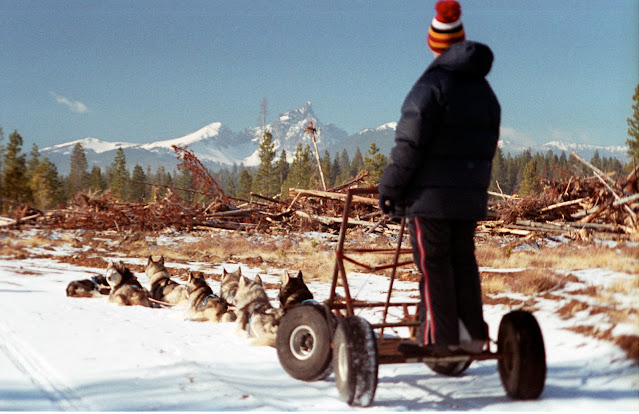
A winter run on a wheeled rig with limited snow at Beaver Marsh, view of Mt Thielson.

Forest Fire: in the early 80s we were on Mt Ashland when a major forest fire threatened a friend's home.


Backpacking with Dogs: we backpacked from the early 70s into the mid-90s.


Backpacking into Chambers Lakes basin for an article for Cascades East magazine.

Me and Myko in the Three Sisters Wilderness area.

Myko early morning in the Green Lakes area on South Sisters.


Other News


This next section of the post isn’t the fun stuff, that was all in the story and the photos. This section is a report about us. First, Anne is working hard at recovery from total shoulder replacement surgery on her left shoulder—no golf for her most of the summer. Her surgery was three weeks ago and she is doing fine, but the hardest part, physical training (otherwise called physical torture) is to begin in a week and a half. We know how hard it is going to be, she had the same surgery on the other shoulder about eleven years ago. It’s amazing how strong she is and how independent.


Anne has to wear her sling for at least 4 weeks, but rides along while I play.


Second, while I live with the spinal stenosis that makes walking difficult, I continue to learn about life with Parkinson’s. My symptoms are so far quite mild and mostly controllable with medication. I know that things will change, there is no cure, but one of my hardest challenges is accepting that I won’t know how PD will affect me until it happens. I’ve always relied on my old Boy Scout training and tried to be prepared. I find that it’s difficult to prepare; all I can do is adapt—it’s a new concept. I still play golf, although my balance is completely different than it used to be. All I can say is have one of the more unique swings out at my golf course.


I lose my balance when I swing the driver, but I haven't fallen...yet.


Although we can’t really do much travel planning currently, we are both thankful for all the support we’ve received from friends and family.


Thursday, May 4, 2023

#203 Central Oregon Beach Trip


A two night trip to the Oregon coast is the meat of this post. The plan was to visit some of our favorite sites and eat at some of our favorite seaside restaurants. A great plan got even better when the weather turned super nice on the coast—sun and fog, while the valley sweltered in unseasonably hot conditions. My photo kit included three cameras—a Nikon Z50 with a 24-200 lens and a Nikon Z5 with a 24-70 lens for landscapes, and a Lumix LX 100ii for quick grab shots and interiors. The trip also included short stops at the two local casinos (Spirit Mountain in Grand Ronde and Chinook Winds at Lincoln City) where Anne won enough to almost cover my losses.


Book Store


Our first stop at the coast was at our favorite used book store, Robert’s Bookshop (SE Hwy 101 in the old Nelscott District of Lincoln City). Opened in 1987, the bookstore has more than 200,000 used and antiquarian books—1.64 miles of bookshelves. Anne found some art books for her watercolors and I bought two photo  books of Ansel Adams’ work. Check with the shop about trading or selling books. 


Anne found the books she needed for her watercoloring.


Bridge and Marina


We stayed in Newport at the Hallmark Resort near the Nye Beach District. It’s not inexpensive, but then nothing is today. Our accommodations were lovely and we had a great beach view. Our hotel was close to the famous Yaquina Bay Bridge and the Newport marina. During our stay we made a couple of trips there for photos. The bridge was started in 1934 and opened in 1938. It’s over a half Mile long and is 133 feet above the river. There are good views of the bridge from its base and from the active marina.


Even tattered and wind torn Old Glory still looks good.


Beach Scenes


One of our favorite spots to visit in the area is the Yaquina Head Lighthouse Natural Area (BLM). Here you can visit the lighthouse (tours available in season), see seabird rookeries, go tide pooling, and see sea lions. The lighthouse saw first light in 1783 and stands 93 feet tall. Another area worth a visit for the views is the Devil’s Punchbowl on Cape Foulweather between Newport and Depot Bay. The punchbowl is a large natural sea cave (without a roof) that can spout at high tide. We visited at low tide, but the views from the overlook are grand.


A foggy view of the lighthouse.

Yaquina Head Lighthouse at sunset from Nye Beach.


Several varieties of seabirds nest on the rocks around Yaquina Head.


Piles of driftwood are put to interesting use on the beaches at Lincoln City (old Taft). 

Sea lions lounge on the spit at Salishan south of Lincoln City.


The view north along the coast from Devil's Punchbowl.

At the Devil's Punchbowl overlook we saw this poor squirrel clinging desperately to a tall dead tree. Obviously frightened, the squirrel let me get quite close. Its perch was very precarious with a long drop beneath. Perhaps it had been chased to this perch, but we could see it wasn't comfortable.


Food


There are some great places to eat on the Oregon coast and we are blessed with a nice variety of eateries in this section. Two of our selections were rebuilds. Both Dory Cove Restaurant and Otis Cafe had had thier original shops burned down. And both have comeback stronger in nearby locations. There are also plenty of fine dining restaurants in the Newport area as well. We couldn’t get a table at Local Ocean (the beach restaurants do get crowded), but we did eat at Georgie’s next to the Hallmark Resort. The restaurant, opened in 1998, has wonderful ocean views. Not far from our accommodations in the heart of the Nye Beach District is a great Irish pub called Nana’s. It’s a staple in the area and we think it’s a little touch of Ireland a block from the beach. We also found Triple-D funk at the 24 hour Newport Cafe on Hwy 101 in the middle of town. As you can see from the pictures, we never go hungry when we travel.


Late Lunch at Dory Cove.


Breakfast at Georgie's (Thanks Charleen and Dave)


A chicken pot pie for me and steak and ale pie for Anne.


Breakfast at Newport Cafe


Highlight of the Trip


The Siletz Bay Wildlife Refuge was established in 1991, but we’d never visited it. That’s a mistake we won’t make again. This is a hidden gem. The refuge contains salt marshes, mud flats, sloughs, conifer/hardwood forests, and rivers which attract a good variety of birds. The refuge has a nice parking area, several hiking options, is open from sunrise to sunset, and is free, though no pets are allowed. Look for the sign on the east side of Hwy 101 after crossing the Siletz River south of Lincoln City.  We had a wonderful time on an easy 3/4 mile walk.


Wood Thrush

This pair of noisy Canadian geese were creating quite a racket defending their nest from another pair.


The path we took in the refuge was well maintained.


We packed a lot into our two days in Newport. And even though we been there many, many times before, there’s always something new to see or discover.

A Newport Sunset


Friday, March 31, 2023

#202 Four Stories


Sqiddy, Our Resident Squirrel, taken yesterday


This post is a mixed bag of stories—one suggested by a good friend and former debater, Dave Carlson, two stories from early travels to Scotland and Ireland, and one unbelievable story that just occurred [actually, I do believe it because it happened to us]. The accompanying photos will be a mixed bag of whatever I can find that might be appropriate to share—sorry, I’ve not been getting out much recently (weather, a cold, and a bout of Covid).


The Fiats in My Life


We bought our first Fiat sports car in 1969, a new red Fiat 124 Sports Spyder, when we were newly married and teaching in SoCal. It was a fun and comfortable car to drive, classy and sporty. We loved that car and the love affair lasted until we moved back to Oregon in 1970. Oregon and the SoCal Fiat did not get along. We soon learned that FIAT really did stand for “Fix It Again Tomorrow.” Bye-bye Fiat 124.


Fast forward to about 1990. We were living in Canby where I was a speech teacher and high school speech coach. A sexy yellow 1981 Fiat X1.9 came on the market for a good price and my Fiat memories had mellowed—golfers always forget the bad shots and dwell on the good ones. Anne said I could get the car if I was sure it was okay. I had the car thoroughly checked by a local foreign car mechanic—at least I thought he was thorough—and he said it would be a short list of repairs to get it into top shape. So, we bought it. Then came the short list of repairs which got longer the more we broke it down. To make it road worthy I had spend half again what I bought the car for. Finally, with the repairs done, the car was ready to drive.

I loved driving the car to school, it was the coolest of teachers’ cars. Exciting to drive on the twisty back roads, the car commonly called the Poor Man’s Ferrari was loud, fast, low to the ground and soon proved that it really was a Fiat, “Fix It Again Tony.”

The first problem came when the gear shifter came away in my hand as I shifted into 2nd gear on the way home from school. Soon after the engine overheated when at high speed, then at slow speed, then upon start up. The brakes went bad. The wheels wouldn’t align. The targa roof panels wouldn’t fit right. My beautiful little car was spending more time in the repair shop (the same foreign car mechanic) than on the road. All the Triple AAA tow drivers knew both Anne and I by first name. Anne refused to drive the car because she didn’t know what was going fall off next.

The car sold quickly and for practically nothing. It had been an expensive second chance for Fiat. All this came flooding back to me when Dave sent me an email with an ad for a modified ’81 Fiat X1.9 for sale. It was a pretty car. He sarcastically asked if I was interested. I thanked him kindly and immediately started writing this post.


Ardvreck Castle, Northern Scottish Highlands


Petrol Strike in Scotland


On our first trip to Scotland in September of 2000, we had plans to see a lot of the small country driving our rental Vauxhall Wagon on the Other Side. After our third day in the country our plans were put in jeopardy by a nationwide petrol strike—petrol delivery drivers were refusing to deliver fuel because of high government taxes on petrol. We tax gas mostly for money for roads and transportation while in the UK petrol taxes are much higher and cover things such as education and health care as well as roads. At first there were reports of limited outages, but then we started hearing that 80-90 percent of stations had only reserves left for emergency vehicle. Poor us: foreigners not knowing the country, on our first trip, in a rental car, driving on the other side.


A Gathering of Lotus Super 7s in Crieff, central Scotland


We started making plans with the remains of our first tank of gas in mind. Local stations were closed. For a couple of days we would only drive a few miles to see sights or play golf, always keeping enough reserve to get back to Glasgow and the car rental company. One afternoon in a local pub we were accosted by a drunk trucker who blamed the Americans and Tony Blair for the troubles and what were we doing in his pub! [BTW, that was the only time in 34 trips to Scotland that we had trouble with anyone over anything—a real One Off.] We considered turning our car in at Glasgow and turning the trip into a train trip. In a couple of days the claims were getting wilder: all stations everywhere were closed, they were rioting in the streets of even small villages, even the potato crop was rotting in the fields because farmers had no fuel.


One of our many Scottish rental cars.


It was decision time because we were scheduled to move on. Our B&B host arranged to get us a small amount of petrol to make us more comfortable and said he didn’t believe what we were hearing. He said, “I’m sure you’ll be alright once you get the motorway (freeway).” He was correct. The stations on the motorway were operating fully and there was plenty of petrol. We’d had our welcome to the UK by British Press.


Typical local pub near Dingle, Ireland.


Finding Our Way in Ireland 


We found our way to Ireland on our first trip (May 2002) with no trouble—north from Portland, turn right at Vancouver, and head east for several hours. Finding our way to anything in Ireland was a different matter. First we discovered that highway signs didn’t contain important information, such as road numbers. In fact, when we were leaving our first B&B near Swords we asked our host how to get to highway R3200 and his reply was, “Our roads don’t have numbers. To get to where you want to end up just turn right at the third barn, go a mile and take the left fork with the big white house, and stay on that road for 2 miles.”


Merrick Round Tower, Ireland


We also found out that road signs would often name the furtherest large city or town on the route. So to use a map, the navigator had to find the destination and then look further to see what might be mentioned. For instance, you might want to go to Macroom from Cork to play golf, but there are no signs to Macroom. All the signs say Killarney, but don’t tell you Macroom is on the way to Killarney. It only takes a little work to figure it out, but it’s the Irish way. Another stumbling block is that some destinations have more than one name. We discovered this when looking for the route to Londonderry in Northern Ireland while we were in the Republic. We kept seeing signs for Derry, but no Londonderry. Duh! We were in Ireland where they wouldn’t say Londonderry. To the Irish it was Derry. When we crossed the border into Northern Ireland the speed limits changed from km/h to mph, road numbers changed from Ns and Rs to As and Bs, roads got wider, and signs said Londonderry.


Corcomroe Abbey near the Burren, Ireland


The last major problem with signs in Ireland is that often there aren’t any—or at least not enough. This is especially true when the destination is some tourist point. At one point we were looking for an abbey listed on our map. From the main highway we could actually see the ruin in distance and a sign told us where to turn off to head to the abbey. They forgot the four signs needed at four intersections to get to the abbey. We made our best guesses, looked for other clues on our map, backtracked several times, and finally found the abbey. There was a sign that said “Abbey” which was a ruin in a farmers cow field—even the road was so mucky I couldn’t get out of the car for a picture.


This Winkle seller was easy to find in the middle of Tuam, Ireland.


Don’t get me wrong, we loved our four, month-long Ireland trips. We love the country and the people. And though the craik and music is great in Ireland, the signage was not.  


Has this Happened to You


A little over a week ago Anne got a text on her phone that an Rx was ready at the local RiteAid pharmacy. The only thing unusual was that we quit going to RiteAid about two years ago and now use Fred Meyer pharmacy. Anne thought the prescription might be for an inhaler from her allergy doctor, a prescription that comes only every couple of years. Since I was going out I said I’d stop at RiteAid and check on the prescription. It was an inhaler so I pickled it up and brought it home.

Now it gets stranger. When I got the Rx home Anne said she’d never used that medicine before and couldn’t have because it contains sulphur which she is allergic to. Reading the label closely we discovered that although Anne’s name, address, and DOB were correct, the Rx was from a doctor she’d never heard of in Oakland, CA. How does a doctor she’s never seen or heard of prescribe her a medicine she didn’t order and can’t take?

We called RiteAid and they don’t know why or how it happened, but we can’t take it back and have already paid the $15 co-pay which we can’t get back. Our insurance company says medicine which can’t be returned will still be charged against our account. They did say they’d check into how it happened and get back to us in a day or two (that was 10 days ago). We’ve paid for medicine we didn’t order and can’t use or return. Thoughts anyone? 


Friday, February 17, 2023

#201 A Long Time Coming

It’s been a struggle getting this post ready for publication. More than a month has passed since the last post. The fight is part of my battle with Parkinson’s Disease. Besides the more visible motor symptoms—tremors, slowness, shuffling, stooped posture—one of the numerous non-motor symptoms of the disease is apathy, a lack of interest in what were normal activities. It’s been hard to convince myself to get going and do things. The Blog has been one of the victims of my apathy, but I’m working my way through it.

I haven’t been traveling or doing much photography. I have, though, recently done a little more writing on my life stories. This post contains three of my stories from earlier years; one from high school, one from college, and one from hillclimbing days.

1978 solar eclipse visible from central Oregon. A photo of mine similar to this one was published in Sky and Telescope Magazine.

One of the Reasons I Became a Teacher


As a freshman at Montclair HS in SoCal I was very active in the science club and even wanted to be an astronomer as an adult. Two field trips I vividly remember were a lunar eclipse and a visit to Griffith Park Observatory opened to the public in 1935. 

Not Griffith Park Observatory, but the Keck Observatory on Kitt Peak near Tucson.


The first trip was to Griffith Park in Los Angeles (famously used in the 1955 movie “Rebel Without a Cause” staring James Dean, Natalie Wood, and Sal Mineo). It was a fantastic place to visit with all kinds of firsts for me. I saw my first large telescope (a 12" Zeiss refractor), first Foucault pendulum (used to demonstrate the earth’s rotation), and saw my first planetarium show. I can vividly remember the sights and sounds of the whole complex. That experience certainly increased my desire to become a professional astronomer.

Lunar Eclipse in April of 2014


The lunar eclipse trip did also. I believe it was a Friday night when I was picked up by Mr. E.P. Gossweiller (my general science teacher) and Mr. Orville Peterson (head of the school’s science department) at about 9:00 pm. We drove into the mountains for about an hour to a spot where we’d have a good view of the moon as it gets covered by the earth’s shadow. We watched with a small telescope and binoculars while we drank hot chocolate. It was a great and memorable experience—the kind I later wanted to give to students. [Oh, BTW, the dream of becoming a professional astronomer died in advanced maths class.]


Solar Eclipse of August 2017 Photographed from Salem, Oregon.


Defeating the Undefeated


At one of the speech tournaments that the Linfield College Speech Team attended when my partner, Mike Harrell, and I were seniors was the New York City College tournament. Early in the tournament we were matched against a superior team from Harvard who had an unbeaten record on their affirmative case about reducing US foreign policy commitments. We knew their reputation and their record, after all, it’s hard to hide when you haven’t lost an affirmative case all season (they weren’t as good on the negative, though). As we started the debate and listened to the affirmative case Mike panicked. He was supposed to be first negative speaker, but he whispered to me, “I don’t know what to say—I’ve got no arguments against their case.”

Sam Donaldson one of my top Canby HS debaters, 1986.

Stacy Shiver, one of my top debaters at Brookings Harbor HS, 1984.


I didn’t know what to say either, but I told him I’d take his speech and he could be second negative speaker. Just before I got up for my ten minute speech I told Mike, “You’re job is to figure out how to beat them!” I got up and babbled on for eight minutes without saying anything significant or coherent. The second affirmative speaker pointed out to the judge how weak my arguments were and the judge agreed—I got the lowest speaker points I’d ever received.

As he got up to give the second negative speech, the one that should have been mine, Mike said he had an idea. In his speech he brought up one small logical flaw in the affirmative case that undermined all their assumptions. It was a small point, but the affirmative case completely fell apart. We won that debate and ended up in the top two in the tournament. The team we beat never used that affirmative case again.


The End of My Car Racing Career


VW Golf GTI 1988


It was probably 1989 or '90, a few of years after we moved to Canby, that the Big Crash happened. We were racing our red VW GTI in the Larison Rock Hillclimb (off Hwy 58 east of Oakridge) and making a good show of it. Each day of the hillclimb each car got two runs on the closed two mile mountain road with lots of turns and several hundred feet of elevation gain. I was entered in the Stock Class (unmodified) for my size vehicle. Anne didn’t drive in this race, she was the head timer for the races which had several check points with observers. On the third run I had set the course record for my class car—it was a good racing year and I had set several class records on other courses.

As I got ready for my fourth run I planned where I could pick up a few seconds on my own record. About half way though my run I knew I had picked up time and pushed harder at one of the fastest turns on the course. I made my error as I exited the left-hand corner—I lifted my foot off the gas as the car started to skid toward the right edge of the road and the forest below. What I needed to do was keep my foot in it (stay on the gas) and power through the skid. Instead, I tried to steer through the skid and pulled the car off the left side of the road into a ditch and dirt bank. It was better than hitting the trees sideways at 60+ miles an hour, but I still ended up on my nose (the car’s front) after plowing up about 40 feet of ditch.

I was shaken but not hurt—the car had racing seatbelts (harness) and I wore a helmet. The car was another matter. The front wheels dangled from the suspension barely attached to the car and there was little left of the front end. The engine wasn’t too damaged, but was pretty useless with no front wheels.

My first thought, after checking that I had all my parts, was to let Anne know I was okay. Her story was that as timer of the race she would get reports of a car’s progress through the course—“Car 20 though turn 4,” and so on. On my run she heard, “Car five though turn 6,” then nothing else. At this point she knew I had f**ked up and something was wrong with the family car. I told the first of the rescue crew, “Tell Anne I’m okay!” And that we’d be walking home.

There are several take aways from this story. It was the last hillclimb I ever entered. It wasn’t a good idea to risk the family car. It cost over $5000 to repair the damage to the GTI. I then took up golf seriously—much safer.

Our first VW Rabbit GTI in an autocross race, 1983.


NEXT: I'm looking forward to getting some good photos on a short trip to central Oregon.