Saturday, March 1, 2025

#223 Coos and Sheep


#223 Coos and Sheep

This post is dedicated to two iconic animals associated with Scotland. Besides the well known castles, kilts, and wild highland haggis, Scotland is known for its highland cows (hei’lan coos) and its abundant sheep with their darling lambs. The long-coated highland cattle and fuzzy sheep are particularly favorites of tourists—including myself. So, this post brings you a couple of stories from my travel book and many photos from my files. I sincerely hope you enjoy both.

These two weren't friendly as they guarded an ancient stone circle near Loch Ness.

Near Bushmill Distillery in Northern Ireland.

One of the more unusual varieties of highland sheep--Boreray, I think.

Saw these two lambs on our way to Machrie Moor on the Isle of Arran off Scotland's Ayrshire coast. They were as interested in me as I was in them.


First a little background. Scottish highland cattle are considered a rustic hearty breed effectively bred to withstand the harsh highland winters. The cattle are characterized by their long double coats and long horns. They generally are gentle by nature, but you should still always approach warily. The colors vary from an off-white to pure black (reds are often the most photographed). 


As for the sheep who outnumber the Scots, they are everywhere—most usually in the road—and the breeds are almost as many as there are hills in Scotland.

On the hills in Glen Clova, central highlands.

Typical. We're hurrying to a tee time on Fife near St Andrews and the sheep don't care.

In Sma'Glen, central Scotland, about 20 minutes away from Crieff where we spent most of our time.

The sheep keep the grasses cropped around the Kilmartin Valley standing stones.


Cows and Sheep on the Courses 

We knew something special was going on when the first green at Narin and Portnoo GC in County Donegal, Ireland, was surrounded by electrified fencing. We discovered that the land on which the first four holes of the course are sited was leased in the winter to a local farmer. To keep the sheep and cows off the greens, the club has surrounded the greens with electric fencing. The second time we played the course a couple of years later, the fencing was gone. The farmer’s lease had run out. Narin and Portnoo is not the only course where electric fencing is used to keep the animals off the greens. Brora GC, a championship track north of Royal Dornoch in Scotland, Achill Island, a beautifully sited nine-hole sheep pasture course off the west coast of Ireland, and Pennard GC in southern Wales still use the electric fencing to protect greens. It makes for an interesting round having to step over a live wire to get to the putting surface. Achill Island GC has another interesting feature. To break up the sheep droppings throughout the course, the grounds crew of one drags an old bedsprings behind a tractor. It does the job as well as fertilizes the fairways.


At Leadhills GC, the highest course in the UK at a little over 1200 feet elevation, in the southern uplands of Scotland has no fencing around the greens, but it has plenty of sheep. When we played no people were on the course except us, but there were sheep on practically every green. There were droppings from the sheep and their friends the rabbits on every green as well. At home we brush away droppings from our local oak and fir trees with our hats or hands. At Leadhills you cleared a path with your shoes or you moved the ball to an unobstructed location. It was a little difficult to play to a sheep infested green when your playing partner is saying, “Don’t hit them; they’re so cute.” Anne eventually had to hit right at a couple of sheep, but they quickly got out of the way. The sheep must get very good at dodging golf balls on their course. 

Tourists have to get used to sharing the road with locals at Staffin Bay, Isle of Skye.

Glen Quaich, southern highlands.


The same, evidently, wasn’t true at Southerndown GC in South Wales. The club’s centenary book contains a story of an early competition where a player’s shot hit a sheep and lodged in the wool at the animal’s posterior. The offended sheep bolted forward toward the green. The ball fell out much closer to the green than it would have had it not been carried. The argument then ensued about where the ball should be played--where it hit the sheep or where it finally came to rest. We’ve heard this story told at several other courses. Either sheep behinds have a magnetic attraction for golf balls in competition or it’s a Celtic golfer’s version of an urban myth. 

Black Angus cattle have the run of the northwest beaches near Durness.

The Black Angus do share the dunes with the lambs.


The St Fillans Cow Incident 

St Fillans Golf Club, a club where we are the only international members, is not a cow pasture course--most of the time. The course is a nine-hole gem in the Perthshire hills about 12 miles from our home-in-Scotland base in Crieff. St Fillans is nestled in a small valley surrounded by Highland hills and crags. Running along one side of the course is the small River Earn which flows out of Lochearn. Along the opposite side are cow and sheep pastures which butt up against the hills and an ancient walled off graveyard of the Stewart clan. Although quite flat, the course has interesting holes highlighted by the 3rd which is the only hole with any elevation. It plays from the top of a crag down toward the green about 280 yards away. With wind behind, I’ve driven the green. With the wind into us, a trap and rough on the right are seriously in play. The next two holes play around the edge of the crag which affects shots considerably. The course may be short and flat, but it’s definitely not easy. This sets the scene for our adventures at the sixth green. 


We were playing the course one day with our American golfing friends, Helen and Grady Morgan, who spent four days traveling with us on their tour of the UK. We had all teed off on the 220-yard par 3 (par 4 for ladies) 6th and were half way to the green when the course greenskeeper jumps off of his mower and starts yelling at us to stop the bulls from trampling the green. We quickly turned around just in time to see three young bulls or steers (I didn’t stop to look, but could tell they weren’t Bessies) who had broken through the fence and were heading for the green and us. Neither Grady nor I are farm boys and we didn’t want to start then, but we did what we could and jumped and yelled to try to turn the herd away from the green. We stalled the animals long enough for the greenskeeper to reach us with his mower and he herded them back into their field. We basked in our glory of a job sort of well done and finished our game. 

Scottish White Face, I think.

A Glen Quaich rancher is semi-famous for coloring his sheep in oder to thwart rustlers.


Several years later Anne and I were playing the course and caught up with a couple of women on the sixth who wanted to let us through. As we waited for the group ahead to clear the green, the ladies told us a story they heard about this hole and the day the whole herd of cows got out. Anne and I looked at each other and giggled and said, “We know that story. We’re the ones who corralled the herd, but it was only a herd of three young cows.” 

Galloway belted cattle (belties) are a hybrid breed of highland cow bred to survive on poor upland or highland moors. We saw these examples in Dartmoor Park in southern England. Remnants of a tin mine form the background.


Evidently our story has a life of its own. 

Shop on Edinburgh's Royal Mile.

A mom calling for her second lamb.

NEXT: I'll hunt up something.


Saturday, February 1, 2025

#222 The Beasties


In the last post we visited with the birds and the bugs, and now it’s time we saw the beasts, which is about as wild as I ever get. The stories come from my travel book, Sixteen Years of Travel in Scotland, Ireland, England, and Wales (available at Amazon), and the photos come from travels in the UK, the American Southwest, Canada, and locally. As always comments and questions about the stories or photos are appreciated.


Red Squirrel, Scotland


The Golf Wildlife 

One year at the Gearheart Golf Links on the Oregon coast we came upon some real wildlife. A party of businessmen had brought with them some girls in business and they were driving around the course in all manner of undress. We haven’t seen that kind of wildlife on courses in the British Isles, but we have observed other wildlife. 

Arizona

Valley of Fire, NV

Grumpy Guy, Santa Fe golf course


Twice we’ve encountered hedgehogs in Scotland, once at Crieff and once at Tulliallan. We learned though that as cute as the hedgehog is it is probably just as full of fleas and other small critters and better left alone. Jamie Montgomery introduced us to black grouse which inhabit the Montgomery and Bruce courses he owns in Kinross. At Boat of Garten while looking for my wayward ball I flushed a covey of ptarmigan, and I was so startled that I just pointed (Good dog, Bob!). On a recent visit to Panmure GC on Scotland’s east coast I was lucky enough to get a decent picture of a harrier hawk as it fluttered above its prey. 

Pallas's Cat, Wildlife Refuge, Scotland

We definitely know that a coyote does shit in the woods around Lake Tahoe.


I was hoping for some special photos when I spotted a large bird at Blairgowrie’s Landsdowne course in the fairway ahead of us. I took several shots and moved closer for more. I thought perhaps I’d have special photos of the rare Capricallie (a large colorful wild grouse) until I got close enough to see that it was just a colorful rooster. The pro at the shop said the bird had appeared about five weeks before and was getting quite good at dodging golf balls. 

The wild deer are friendly in Scotland, St Fillans GC.

Mule deer, Painted Hills, Oregon


There are no serpents in Ireland; St Patrick cast them out. On Isle Arran’s Corrie GC we saw a sign which said, “Beware of Snakes.” It was at Pwllheli Golf Course in northern Wales that we finally heard that indeed there were snakes in the British Isles, and not just the harmless garden variety. Our golfing hosts told us that there were reports of black adders (relative to the cobra) in the area. At Milford Haven GC in southern Wales I hit a tee shot over a stone fence into an old croft orchard next to the course. Our playing companion told me to just play one from outside the stone fence. I asked if the area was Out of Bounds? He said, “No, but nobody goes in there.” After my quizzical look he emphatically added, “Black adders live there!” I took my penalty and dropped a new ball well away from what the locals call “The Snake Pit.” 

Elk, Banff National Park, Canada


One of our most unusual encounters was one we only heard, but never saw. As we played the St Fillans course in central Scotland on October 5 (the last round of our 2009 trip), we heard strange noises as we came up the 7th fairway. It sounded like a cow was in distress in the hills north of the club. We asked a local playing through if he’d heard anything strange, but he said he hadn’t. On our second time around we could still hear the noises coming from the hills. As we stood listening the player we’d talked to earlier came over from an adjoining fairway and asked if that was the sound we’d heard before. We said it was. He then explained that it was the bellowing of red deer stags at the beginning of the rutting season. He added, though, that it was the earliest he’d ever heard their calls, which explained why we’d never heard them before since this was the time we always would end our fall trip. Anne and I played the last three holes badly because we kept looking into the hills trying to glimpse the deer. 

Dartmoor Wild Pony

Exmoor Wild Horses


We’ve had two run-ins with fox on golf courses. One was quite fleeting as a large coyote-sized red fox ran across the path in front of us just before the twelfth tee at St Andrews Duke’s course. The other meeting was more interesting. At the East Clare Golf Club golf shop in Ireland the pro told us to be on the lookout for a red fox around the ninth or tenth hole. The fox was still wild but was becoming quite adept at begging for, of all things, chocolate. On the eleventh fairway the fox came trotting up towards Anne, who offered a carrot instead of chocolate (which isn’t supposed to be good for canines). That offering was rejected. He came within about five feet of me (great for photos) before realizing I had nothing for him and moseying on. 

We really found these kind of fox more fitting with the golf environment than the foxes we saw at Gearheart--although, they were an interesting distraction, too. 

Big Horn Sheep, Rio Grande Gorge, NM


Mt Goat and Kidd, Banff, Alberta, Canada


Midgies--the Scourge of Scotland 

We’d heard stories, had warnings, but had never had a personal introduction to Culicoides impunctatus. Most of our travel has been off-season, April-May and September-October. We’d never been in the Highlands in the peak season of early June through late August. According to one book, “During the Second World War Scottish soldiers training in the Highlands branded her worse than Hitler.” The “she” referred to is none other than The Midge. 

Of the 34 different species of biting flies in Scotland, only five are attracted to people and 85% of the attacks are by Culicoides impunctatus. Midges or midgies are small biting flies that appear in mid to late summer, especially in the Highlands and around water. In the Northwest we would call them “No See ‘Ems” or gnats, but ours don’t bite. 

Pronghorn Antelope, near Moab, Utah

Cool Dude (coyote), Rio Grande Gorge, NM


September 2007 was our tenth trip to Scotland, and it was the first time for us to come face-to-face (or rather mouth-to-arm) with the midges. When we played Ullapool GC in the northwest of the Scottish Highlands it was a wind free, overcast with light showers day. We thought we were prepared with insect repellant, but I was in for a surprise. By the time we’d reached the tee at the second we knew we needed protection. We sprayed our necks and heads with Off! and played on. The repellant worked fairly well, except that I didn’t think about the fact that I was wearing short sleeves while Anne had on long. Even though I hadn’t felt a single bite, by the end of the round there were a few welts on my arms that were beginning to itch. By that evening I was putting on the only anti-itch medicine we had by the gobs. The next morning I could count more than forty bites per arm and nothing was stopping the itch. Midge bites are not like mosquito bites which sting, swell up, itch for a couple of days, and are forgotten. Midge bites itch for a month! I tried every remedy available from every chemist (pharmacy) at which we stopped. Some worked a little or for a while, some didn’t work at all. We’ve since learned a lot more about the midges. As far as repellents go, the Off! worked fairly well, but we’ve since heard that Avon’s Skin So Soft is the preferred repellent by locals. One description I heard said that you slathered it on good and thick, and then any midges who do land on you drown in the lotion. 

Reindeer have been reintroduced into Scotland.

Very different look, but from the same herd.


Midges like the twilight and the females, who do the biting, are most voracious at dawn and dusk. Sun and wind are actually the enemies of the midge. They will never bite in the midday sun and can’t fly in breezes more than seven miles per hour. If the weather is dull and overcast, as our day at Ullapool, they can bite anytime. Businesses have refused to locate in the Highlands because of the midges. Scotland loses millions of pounds in lost work-time a year at Highland outdoor employment because of the “wee beasties.” 

Harbour seals lounge off the southern tip of the Kintyre Peninsula, Scotland.

The same picture could be taken at every village harbour in Scotland.


As I say, it took us ten visits to Scotland to become personally acquainted with the Scourge of Scotland. When we next travel in the Highlands in Midge Season we will be better prepared with a good repellant, protective clothing, and as much anti-itch lotion as we can carry. 

Black bear near Canmore, Alberta, Canada.

Moose in high mountain lake, near Canmore, Canada.


NEXT: Some more old pictures--I've got plenty to choose from.

Wednesday, January 1, 2025

#221 Two stories and Two Sets of Photos


Bald eagle with dinner in claw, WA state.


HAPPY NEW YEAR! This post contains two stories that are sort of related and two groups of photos (the birds and the bees/bugs) that are related to each other, but not related to the stories. I hope both the stories and the photos are enjoyable in their own way. It’s going to be that kind of year—all mixed up. but we still find joy where we can.


Goshawk in forest, Perth, Scotland.


Goshawk in flight.


Voices in the Wall 

It was a lovely afternoon for watching the Lamlash Bay lap on the shore of Isle Arran, Scotland. After a great round of golf at Shiskine GC, we had stopped at Arran Cheese and picked up a couple of rounds and some crisps (what we’d call crackers) for snacking. Back in our room at Lilybank B&B we had cut into one of the cheese rounds, broken out some crisps, poured two generous drams of Lochranza single malt scotch, and were sitting back enjoying the view of the bay and the Holy Isle. We were the only guests so far in the B&B, but yet we could hear voices. The closer we listened, the more the voices seemed to be coming from the wall of our room. Was it the whisky? Was our room haunted? The voices were indistinct, yet they were recognizable as voices. I walked over to the wall for a closer listen.

Gannet

A very patriotic gull.


I couldn’t tell what they were saying or where exactly the voices were coming from, but they seemed to be repeating the same refrain. I went to the door and listened outside the room. No, they seemed to be just in the wall of our room. As I moved along the wall to try to pinpoint the voices, the sound moved from the wall to my backpack which leaned against the wall. 


It took me only a moment to find my mini voice recorder, the one I use for verbal notes as we play a golf course. Somehow it had turned on and was playing back the same sentence describing a hole from the previous day’s golf. Mystery solved, but it might have been a better story had it been a talking mouse in the wall or the spirit of a former guest who really didn’t want to leave the place. 

Pheasant near St Fillins, Scotland.
Red grouse in Glen Quaich, Scotland.


Duck, Lower Slaughter, Cotswolds, England
Meadowlark, Taos, NM

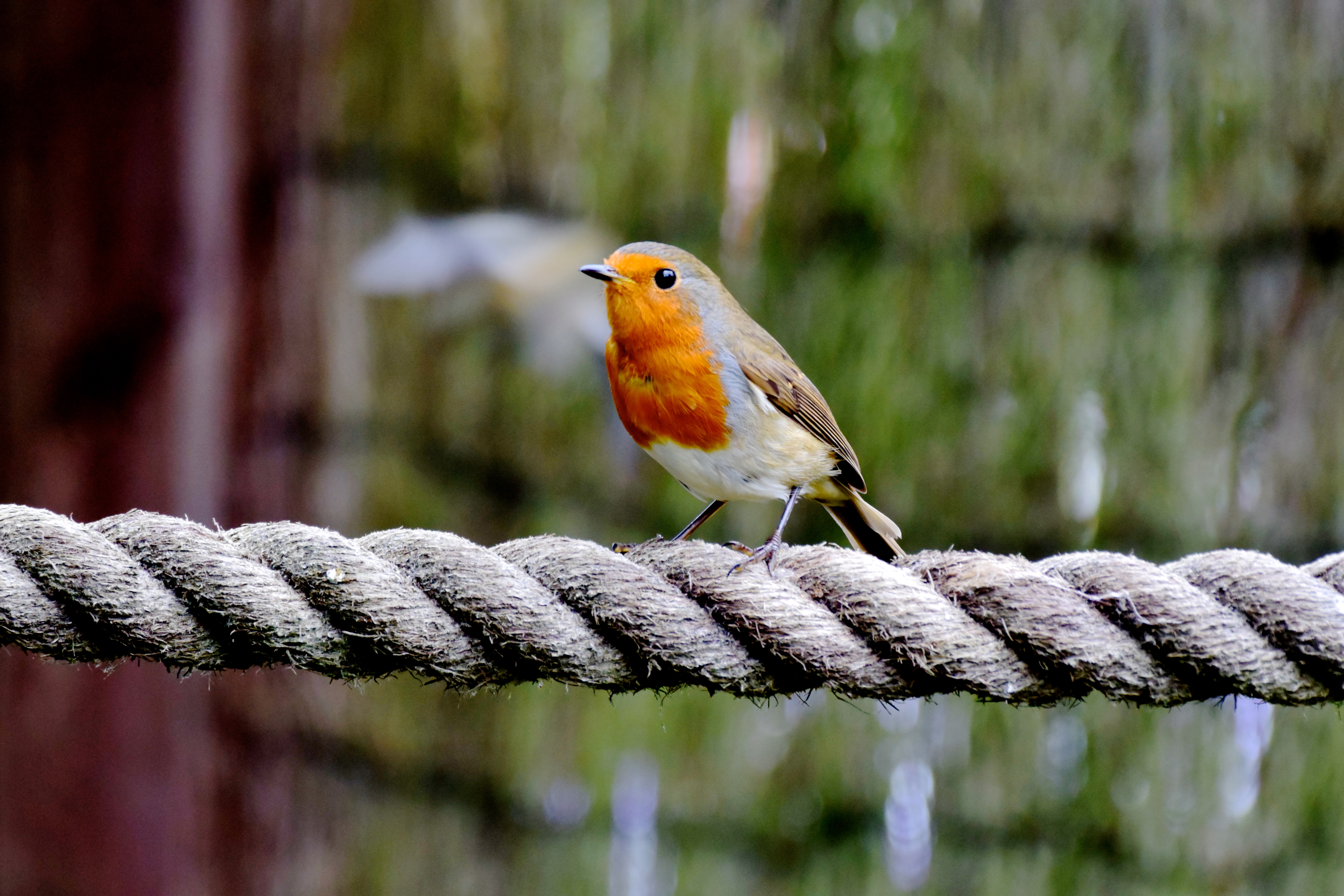
Scottish Robin


The Noise at Home

First, some background. A couple of months ago in the middle of the night one of our smoke detectors started beeping one chirp about every 15 seconds. We checked all the rooms in our unit (two bedroom with a den) to make sure there was not a real emergency. When we were satisfied that we were safe, we realized we were still being annoyed by the constant chirp telling us the battery in the detector was running out. With no ladder or willingness to climb up one if we had it, we called maintenance. Even though it was 1:30 in the morning a worker came to the house and changed all the batteries in all our alarms. Ah, senior living.


Now to the real story. A couple of weeks ago, again in the middle of the night, about 2:30, I was awakened by a very piercing but soft noise—a whistle or alarm sound. I had been sleeping in my living room recliner— something I often do when my Parkinson’s tremors are acting up. I looked around to see if I could see a source for the now irritating noise. I couldn’t. So, I got up and looked at every electric item we had in the room (tv, radio, DISH module, alarms, clocks, stove, fridge, microwave, etc.). Nothing was making the noise. By turning my head I tried to triangulate the location. Nothing was definitive. I checked every other room and outside, but I was sure the sound was emanating from the kitchen-diningroom-livingroom area. I still couldn’t identify a source for what now sounded like constant electric screaming. 

Canmore, Alberta, Canada

Yellow Swallowtail

"Let me out!" Huntingtower Castle, near Perth, Scotland


I finally woke Anne, who had slept through the noise and my noise because, of course, she doesn’t wear her hearing aids at night. Together we went through the whole process again and came up blank. We were just to call for help when she said, “Wait a second.” She moved a couple of books on a shelf, “Look at this.” She was pointing to a small, very old Sharper Image travel clock. It was indeed the culprit. I turned the clock over to see battery acid leaking out of the battery compartment. It was so corroded that the alarm must have been shorted out. Plying the batteries out shut off our noise invasion. Not as interesting a tale as voices in the wall, but certainly closer to home.

Assassin Bug (?)


In Scotland this would be called a ginger wooly bear.

This walking stick hitched a ride on my golf club bag.

If you want to view some really fine wildlife photos, check out the sites that feature two of our great friends from Canada. See Kathryn Delany's website -- www.colorsplashes.com -- and find Nick Delany's work by going to www.psa-photo.org and searching for Nick Delany.


NEXT: We've had the birds and the bees; next is, of course, the Beasts.