Wednesday, March 20, 2013

New Book, Eastern Oregon Trip Part 1, George the Cat


Anne and I both worked hard to get our latest golf travel guide done in time for our spring trip to Scotland.  We published Golf in Scotland: The Hidden Gems on February 28.  

Even though the book is just a revision of our first golf travel guide, because we completely changed the format and added numerous courses, eateries, and B&Bs, the book was as much work as doing a completely new product.  The book is done now and is already selling well (for a golf guide) on Amazon (a Kindle edition is due out in a couple of weeks).  For our efforts we decided to treat ourselves with a Road Trip to Eastern Oregon. 
We began with the drive over to Redmond where we stayed in timeshare at Worldmark at Eagle Crest.  
Mt Hood
The view of the mountains (Hood, Jefferson, Washington, Three Finger Jack, the Three 
Mt Jefferson
Sisters, Broken Top, and Black Butte) as well as a profitable stop at the Indian Head Casino at Kah-Nee-Ta enhanced the drive.  While having a light lunch at the casino, we watched a young worker pay close attention to the announcement of the new pope.  She was rooting for an American to be selected and was mildly crushed when Francis I was introduced.  I suspect that she was reacting much the same as many American catholics.  Photos of the Crooked River Gorge and Smith Rocks State Park helped to make the trip an artistic as well as financial success. 
Crooked River Gorge

Smith Rocks
The Worldmark resort at Eagle Crest is a five star stay--we had a one bedroom unit in the main hotel which had a full kitchen and views out to one of the Eagle Crest golf courses.  Dinner at the Brickhouse in Redmond was excellent, though expensive.  

Best of all was a killer marionberry cobbler ala mode large enough for the two of us to share.  The only slight negatives to the day were not getting to see Comet Pan-STARR because of cloud cover (one of the reasons for going to Eastern Oregon) and pulling down a Redmond one-way street the wrong way--can only blame that on lack of attention, I hadn’t had anything to drink.
Day two was an exploration day between Redmond and John Day.  After a forgettable breakfast in a local restaurant which we promptly forgot the name of, the day brightened up when I spotted a bald eagle and he landed close enough for photos. 

Very majestic!  Our first tour stop was at the John Day Fossil Beds Painted Hills Unit.  We had been to the Painted Hills once before for a sled dog race, but that was probably in 1978 and neither of us remember too much about the area through the alcohol fog of the trip.  


The scenery is truly spectacular and the colors are as vivid as the picture postcards we’ve seen--the red color comes from oxidized iron, the golden color from a mixture of magnesium and iron, 

and the black from oxidized magnesium.  Both getting to see three mule deer (we think) and 

being the only visitors to the Hills for the hour we spent there added to the experience.  
We made Mitchell, an 1860s gold mining town 50 miles east of Prineville and 80 miles west of John Day, our people refueling stop.  We didn’t know what to expect from Mitchell, but loved what we found.  In the Sidewalk Cafe and More I enjoyed a lovely slice of walnut 

pie, while Anne (good girl that she is) had a salad.  We also enjoyed the conversation between mother and daughter owners as they decided what to have on the menu for Sunday dinner--they decided on beef tacos for St Patrick’s Day dinner because that’s what they had the most of in the freezer.  As we explored the almost ghost town of Mitchell we were accosted (in a friendly way) by the Auntie Wainwright (BBC’s “Last of the Summer Wine”) of Mitchell.   Judy, from Judy’s Place (second-hand and souvenir shop), came out into the street and started telling us stories of Old Mitchell and invited us into her shop to see her historic photos.  

A Mitchell Boarding House
We finally bought some postcards so we could make our exit and continue our trip--actually I felt like I was paying for the stories which really were interesting.  
The main unit of the John Day Fossil Beds National Monument is the Sheep Rock Unit which hosts the Thomas Condon Paleontology Center and Visitor’s Center.  


Besides holding the fossil museum, the Thomas Condon Center has a viewing area where we watched a paleontologist working on extracting a small fossil fragment from its bed stone.  We also hiked into the Blue Basin Area 

and stopped for photos of Cathedral Rock.

Our stop for the night was the Best Western Motel in John Day, a very nice inexpensive room.  Dinner, at the suggestion of the hotel manager, was at the Snaffle Bit Dinner House. 

For $12 we got salad, a main course (mine was fried chicken, veg, and potato), dessert, and drink.  I didn’t know bargains like this existed anymore.  It was delicious as well.
John Day Adventist Church

GEORGE THE CAT --  (?) 1997 - March 20, 2013

George, named by the neighbors, was a stray abandoned by the people who lived behind the neighbors across the street from us.  The neighbors neutered George and feed him, but he was just one of several outside cats the neighbors fed.  I started hand feeding George Tender Vittles in the mornings before I went to work.  He soon discovered that he liked coming into the house in the evenings, even if he had to share it with Muffy, Queen of the House.  Muffy took all the best sleeping spots, but George decided that even the second best spots were better than living on the street.  After talking with the neighbors and taking George to the vet for his jabs, he became our cat although weighing between 12 and 15 pounds he freely claimed the neighborhood as his.  
George was a lovey cat, but fairly shy among people.  He tolerated us having groups over, but relished group dinners when he’d get his own chair at the table--he was content to sit at the table and watch us eat, knowing he’d eventually get some scraps when everyone was done.  Ice cream was of course his favorite and almost any meat would attract his interest.  
In the 12 plus years we had George he got used to having sitters when we were away, first to debate camps and then to UK adventures.  For a while we used live-in house/cat sitters, then we had neighbors who would watch over things while we were gone--letting George in and out on a regular basis.  He didn’t like our traveling and started sulking as soon as saw the suitcases come up from the basement.  He never knew whether the trip was to be for a weekend, a week, or six weeks--after all, as smart as he was he never learned to read the calendar or the itinerary we always left on the table.  He was almost always happy to see us return.  In fact, one time we had left our car at the airport for a friend who was coming back from a trip a couple of days after we left.  When Scott pulled into our carport with our car George came anxiously running until he saw it wasn’t us.  Scott said he looked so dejected when he left in his own car. George would punish us, though, for leaving him (even if he had been well cared for) by demanding to be let in and out at his whim for several days.  Out of guilt (and fear, for George had claws which he kept very sharp) we always gave in to his demands.  This was the pattern for years, until this last short trip to Eastern Oregon.  When we got home George greeted us, wanted pets and a little lap time, but was far more interested in curling up in the bed we had for him in front of the heat vent.  This now was the pattern for several days--George became harder and harder to wake up.  He’d get up to eat his breakfast and dinner and wait beside us for our scraps, but then it was back to sleep in front of the heater without much lap time.  I had a chat with George’s vet, made an appointment, and took him in for his final visit.  

We hope George, good friend that he was, is now enjoying his long, permanent nap.   


Next: Eastern Oregon Trip, Part 2


Saturday, February 23, 2013

The January Arizona Trip


In late January we traveled to Phoenix and Tucson 

to get out of cold wet Oregon, to visit Anne’s sister, Bev, and her family, to do a little touring, and play a little golf.  Though on our eight day trip we were only moderately successful in accomplishing our goals, the trip was uniquely interesting.  
Catalina Mountains near Tucson
Family came first.  We spent three and a half days with Bev and Noel and for the girls it was non-stop visiting.  One evening we spent at our niece Stacie and her  husband  EJ’s getting to know our grand-nephew and grand-niece, Stavros and Alex.


A boy for you and a girl for me.


Although we did play golf twice in Phoenix, at Painted Mountain GC and Toka Sticks GC, the weather was not what we had hoped for.  In Scotland it would be called jumper (sweater) weather. 

In Phoenix it was just called damned cold--below freezing at night and barely into the 50s during the day.  Except for the cactus and other desert flora, the over-seeded grass, the signs about being wary of crawling critters, we could have been playing in Scotland.  Then the weather turned nasty.  On Saturday, Anne and I wanted to have breakfast at a local diner we had heard about, The Farmhouse Restaurant, in Gilbert.  

We knew it had rained overnight, but when we found half the streets on our five mile trip from Chandler to Gilbert flooded we realized it had been a record rainfall.  The Farmhouse was crowded with others trying not to be too discouraged by the weather.  Breakfast was worth the trouble to get to, especially the sugary cinnamon roll.  The sellers at a local Saturday market were more disgruntled 

as they tried to keep products and produce dry in the pouring rain. 
In Tucson, the last four days of our trip, the weather was a little better for some of the things we wanted to do, but then for other things the weather was shiite.  We did play golf at del Lago Resort GC about 15 miles south of town.  

On this round at least the weather was shirt-sleeve warm (though Anne still wore a jumper).  We did manage a good visit to the Arizona-Sonoran Desert Museum southwest of Tucson.  This zoo, natural history museum, and botanical gardens with its restaurants and cafes, gift shops, and aquarium was established in 1952.  


The main features are desert plants in special gardens, a walk-in aviary, a hummingbird aviary, a small natural environment zoo (Mexican wolf, black bear, mountain lion), and a new aquarium.  

Very few birds were about, and those that were seemed to huddle with fluffed feathers against the cold.  

In town, at the Tucson Botanical Gardens, we got out of the cool when we entered the humid 85° temperatures in the garden’s butterfly and tropical flower exhibit. 


Two-hundred-fifty butterflies of 40 different species fluttered around various orchids and other tropic blooms, 

while outside half the plants of the gardens were covered with tarps to protect them from the cold nights.

Because of the poor weather prospects, we had already cancelled one of our planned activities--a night sky observing program at Kitt Peak National Observatory in the mountains southwest of Tucson.  We decided instead to take a 1:30 PM tour of the largest telescope at the facility.  We started the day with a visit to the San Xavier del Bac Mission, known as “the White Dove of the Desert,”


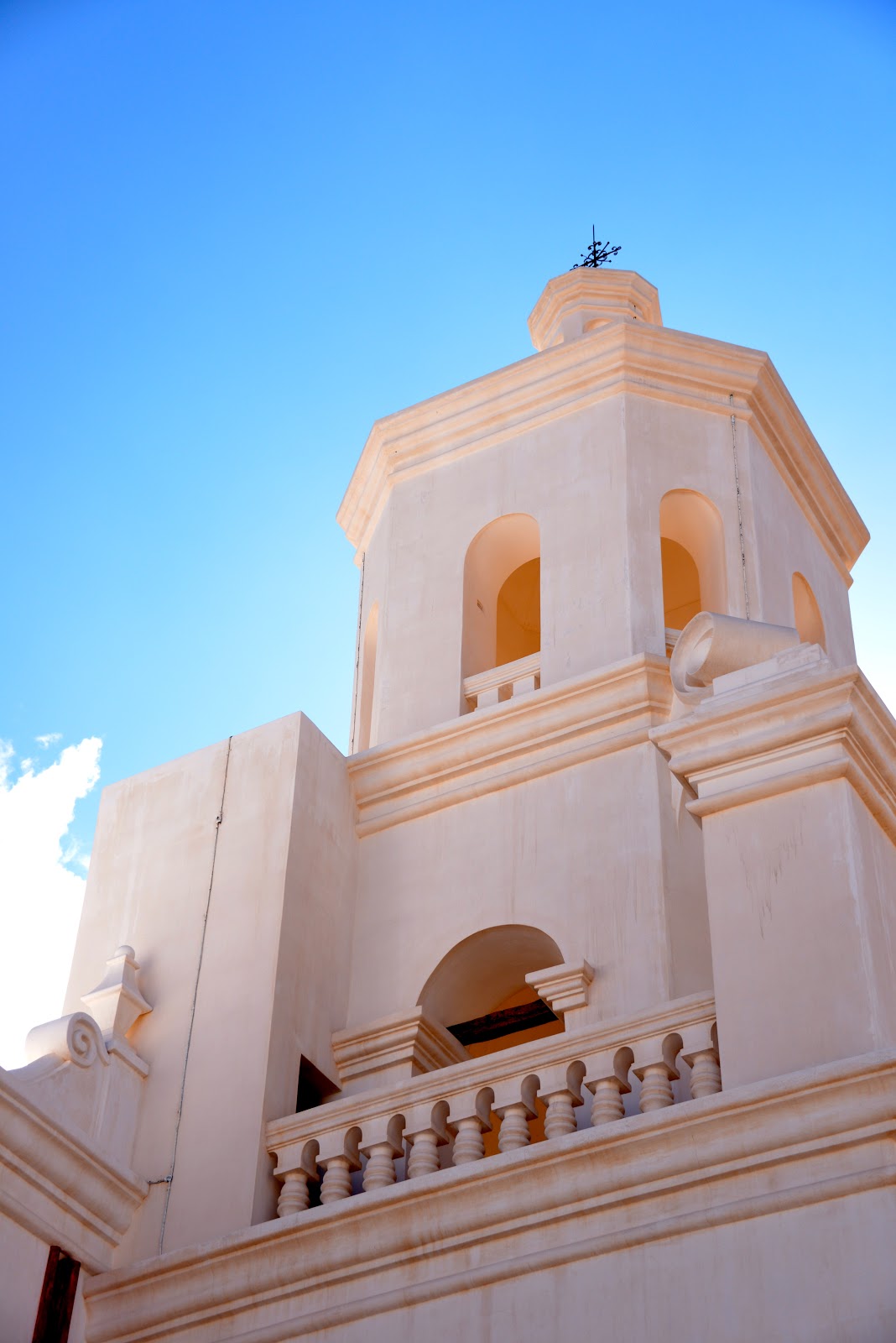
which was on our way to the observatories at Kitt Peak.  The Spanish Catholic mission, established in 1692 by the Jesuits (later run by Franciscans), is a white Moorish-inspired design in the settlement of Tohono O’odham.  It was nice to be able to visit the lovely interior 
since it had been closed for worship the last time we visited.  


Forty-five minutes after leaving the mission we started the eleven mile climb from the base of Quinlan Mountains to the observatory visitor’s center at 6875 feet elevation.  

Observatory in swirling clouds from the base of the mountain.
The Kitt Peak National Observatory complex was started in 1958 on land leased from the Tohono O’odham Reservation.  The complex now consists of 22 optical and two radio telescopes, including the Mayall 4-meter telescope, the WIYN 3.5-meter telescope, the McMath-Pierce Solar Observatory (the largest in the world), and one of the Very Long Baseline Array radio telescopes.  
The solar telescope is odd triangle-shaped building.
As we drove up the mountain the weather got wilder and wilder.  At the top we discovered that we were the only visitors to the mountain (besides resident astronomers who were desperate for the weather to break).  We did get a private tour of the Mayall telescope by Vance,

a retired engineer, but we had to get a special permit to drive to the scope since at 30° in heavy cloud and 60-80 mph winds it was considered too dangerous to walk the 400 yards up to the telescope.   Vance gave us a splendid tour once we got inside the observatory.  
The Mayall 4-m telescope.
It wasn’t a great day for photography--after the tour I could only last about five minutes out in the freezing conditions even though the sun poked through the clouds--but it was a wild and wonderful experience.
Rural Arizona on the way back from Kitt Peak.
Our purpose for the trip had been to visit Anne’s sister and family, to visit the desert gardens and Kitt Peak observatories, to play golf, and to get warm.  We did three of the four--I guess that’s not a bad trip. 

SPECIAL NOTE: I’ve been slow getting this post of the blog published because both Anne and I have been very busy doing the final proof of our fourth golf guide.  Golf in Scotland: the Hidden Gems is a revised edition of our first (2005) golf guide.  It’s a completely new format with the addition of 34 new golf courses, numerous pubs and eateries, and includes recommended B&Bs and Guest Houses.  The book will soon be available from our website and from Amazon as a print or Kindle edition.   

Saturday, January 12, 2013

THE KILT'S THE THING


The History of the Kilt


There’s no more iconic Scottish symbol than the kilt--the bagpipes are a close second with the wild Highland haggis a distant third.  Kilts have been the traditional dress of men and boys in Scotland since the 16th century.  
Dance Competitor Blackford Games, Scotland

Young Drummer, Portland

The kilt has also received wider association with celtic heritage (Welsh, Irish, Cornish) in the late 19th century.  Today’s kilt, though, isn’t what the Highland Scot wore several hundred years ago; that would be the Great Kilt, Big Kilt, or Breacan (Gaelic).  Originally Norse, the Great Kilt was a full length garment with the upper half worn as a cloak draped over the shoulder or brought up over the head.  The wearer had to actually lay down on the garment, made of several yards of wool cloth, and wrap it around himself.  The Great Kilt was a full function wrap which could serve as a blanket when snuggling down in the heather and had enough material left at the top to be able to make a pouch in which to carry your essentials.  After the Battle of Culloden (1746), when the English Duke of Cumberland defeated the Highlanders fighting to return Bonnie Prince Charles Edward Stewart to the throne, tartan attire, along with weapons and bagpipes, were banned in Scotland.  Non-Jacobite lowland Scots didn’t really mind the banning of the tartan kilt which many condemned as a barbarous form of apparel.  It took Queen Victorian’s fascination with her Scottish roots and her display of enormous pride in her Stewart ancestry (1860s) to bring the kilt back into vogue for all Scots--Highland and lowland.

The modern kilt, short kilt, walking kilt, or little kilt (Feilreadh Beg in Gaelic) was invented by English Quaker (to the Scots‘ chagrin) Thomas Rawlinson in 1720 for use of working Highlanders.  
Highland Dance Competitor, Portland Highland Games

Today’s kilts are usually 18-22 ounces per yard of wool for formal heavy weight models and 10-11 ounce weight for lighter kilts.  Most common are the kilts in the 13-16 ounce range which equal about six to eight yards of material for an adult.  Although you will see utility kilts made of cotton or canvas in solid colors, 
Utility Kilt and Unicyclist in Portland

the traditional kilt will be of a tartan (patterned) material called a sett.  Setts are associated with particular families or clans.  These patterns began to be formalized in the Victorian era and are now registered with the International Tartan Index.  Besides family or clan tartans, setts have been registered for districts (such as the counties of Ireland), countries, corps, 

Pipe Band at Portland Highland Games

Pipe Band in Peebles, Scotland
and schools as well as numerous generic patterns.  For instance, the tartan Welsh National is a pattern of green, red, and white--the colors of the flag of Wales.  
Welsh National Tartan

Since the modern kilt isn’t long enough to provide material for a pouch, one had to be invented.  The sporran (Gaelic for pouch or purse) is a small leather or fur bag worn by chain in front of the groin of a kilt wearer.  The sporran, 
Anne with Craig the Piper at Edinburgh Castle

serving as a wallet (and from experience I can tell you that it carries little more than a wallet), comes in various styles from the a simple pouch for day wear to a highly decorated formal sporran worn by pipe band members.  Whether a kilt is utilitarian or formal, a family tartan or a generic, there is a level of truth to the Scottish saying, “A man in a kilt is a man and a half!”

The Wearing of the Kilt (or Cilt)

I don’t know if I should share this secret or keep it all to myself, but it’s a shame for all other males who have Scottish, Irish, Cornish, or Welsh heritage not to know the advantages of wearing a kilt (in Welsh it’s a cilt because the Welsh language doesn’t have a “k”).
 Jones of Wales Tartan 


Many advantages have been written about including freedom of movement and ventilation, but I have yet to see anyone discuss the positive attention factor.  The wearing of a kilt/cilt definitely attracts much attention from both females and males. From the ladies I always get very appreciative looks, more than my naturally attractive legs would garner.  I often get comments like, “I think kilts are so sexy,” and “a man always looks sexy in a kilt.”  Considering I’d get those comments at no other time, except from my adorable wife, I find it a little embarrassing and a great thrill to hear those type of compliments. 
Anne and Two of My Former Speech Students, Sarah and Joanne

Women, also, are constantly asking “The Question”--Is it true about what men wear under a kilt?  I have been known to “Go Commando,” as they say, on occasion--all right, most of the time--and I have developed a stock answer: “They say if a Scotsman wears a kilt, he wears nothing under it.  If he wears something under it, he’s wearing a skirt.  I wear a cilt, but I’m a Welshman, so make your own guess.”  It leaves some room for their imagination, which may or may not be better than the real thing.  I have had a couple of women joke about reaching under my kilt to find out.  I always invite exploration in the name of discovery, but have yet to have anyone be bold enough to find out for themselves.  While all this banter is going back and forth, the lady in question is often snuggling close and rubbing her female charms about.  It’s a hell of a position to put a man in, but I’m man enough to take it.
The reaction from men is interesting as well.  Only a couple of time have I been asked what I wear under my kilt.  More often my wearing of the kilt is acknowledged with a “way to go,” a thumbs up, or a high-five.  I think other men realize and recognize that to wear a kilt an individual has to be a little bit of a performer and very self-confident.  
Highland Game Competitors Wear Kilts

One other advantage to wearing a kilt is that it makes me feel dressy in a way that a business suit never did.  There’s a flair associated with wearing a beautiful and meaningful tartan, accessorized with a striking sporran, hose, and flashes.  It just makes one feel good.
I know there won’t be many out there who will jump on the kilt band wagon, but if you’ve got balls enough there are definite advantages.  
Highland Sculture, Kenmore, Scotland