Wednesday, April 28, 2021

Travel Stories New and Old


BACK TO TRAVELING?

Road's End Wayside


We’ve both had our jabs and waited the required two weeks after the second jab. We’ve visited unmasked with friends who are also fully vaccinated. And now we’re ready to travel. We still have our tickets for Scotland in the fall and we booked six days in Las Vegas next month going by plane. What’s left for us to do was to take a small trip, stay a hotel, eat in a restaurant or two, and see how travel now makes us feel.

We booked a night in the Hallmark Hotel Resort in Newport, Oregon, and came away from this oivernighter to the beach with several thoughts and reactions.

Nye Beach, Newport


First, we were pleased with the hotel—lovely room with a nice ocean view—except for the price (fairly expensive). The room was clean and staff were friendly while being masked and keeping social distance. Both of us felt safe and comfortable.

Breakfast at Newport Cafe


Lunch at Mo's

Nana's Irish Pub

Dinner at Nana's


Second, the three restaurants we visited did a good job of adapting to Covid requirements. Nana’s Irish Pub in the Nye Beach area of Newport had spaced tables appropriate distances and put up plexiglass dividers between the tables. I would, though, suggest sticking with the Irish fare—Anne’s Steak and Ale Pie was very nice, while my oyster sandwich had tasteless deep-fried-to-death oysters. At both Mo’s Chowder House in Taft and Newport Cafe on Hwy 101 in the heart of town we watched people get turned away or entered into a queue because the restaurant was already at state mandated 25% capacity.

Third, a pleasant surprise was to see that so many small businesses had survived the enforced shutdowns. It was also encouraging to see so many “Now Hiring” signs in businesses.

Agate Beach GC


Fourth, we came home with a sense that most people we came in contact with—at the hotel, in restaurants, in a casino, while sightseeing, when shopping at local businesses like Robert’s Bookstore, playing golf at Agate Beach GC—are taking the pandemic seriously (remember, this is in Oregon). People went out of their way, literally, to maintain social distance and we never saw anybody with a mask problem. We did see one lady try to argue that she should be allowed to violate the restaurant capacity limit so she could wait inside for her take-away order instead of out in her car (Karen).


Newport Harbor

Yaquina Head Lighthouse, Newport


Finally, Anne was disappointed that the gray whales which were supposed to be in the area chose to hide from her on this trip.

In conclusion, our short trip left us hopeful that more and better travel opportunities are in our future if we keep working at everyone’s safety.


A NEW STORY OF PAST TRAVEL


In the dark days of no travel we have been trying to keep sane by re-reading some (or all) of our past travel journals—both Anne and I write daily journals of our trips. I found the entry for this day in Anne’s 2006 journal of our fourth Ireland trip. Combining my notes with hers, this is the story of that day.


Wednesday, May 17, 2006 Lipsetts of Coolaney Village near Sligo


Breakfast at the Mountain Inn in the heart of Ox Mountain was in the pub room filled with other guests, most of whom were businessmen. Conversation was slight, but food was good and plentiful—my breakfast was cereal, fruit, eggs, Irish bacon, sausage, black pudding, fried potato, toast and baked beans (aka, canned pork and beans). After breakfast we drove straight through Sligo on a new road the 15 miles to County Sligo GC, known locally as Rosses Point.
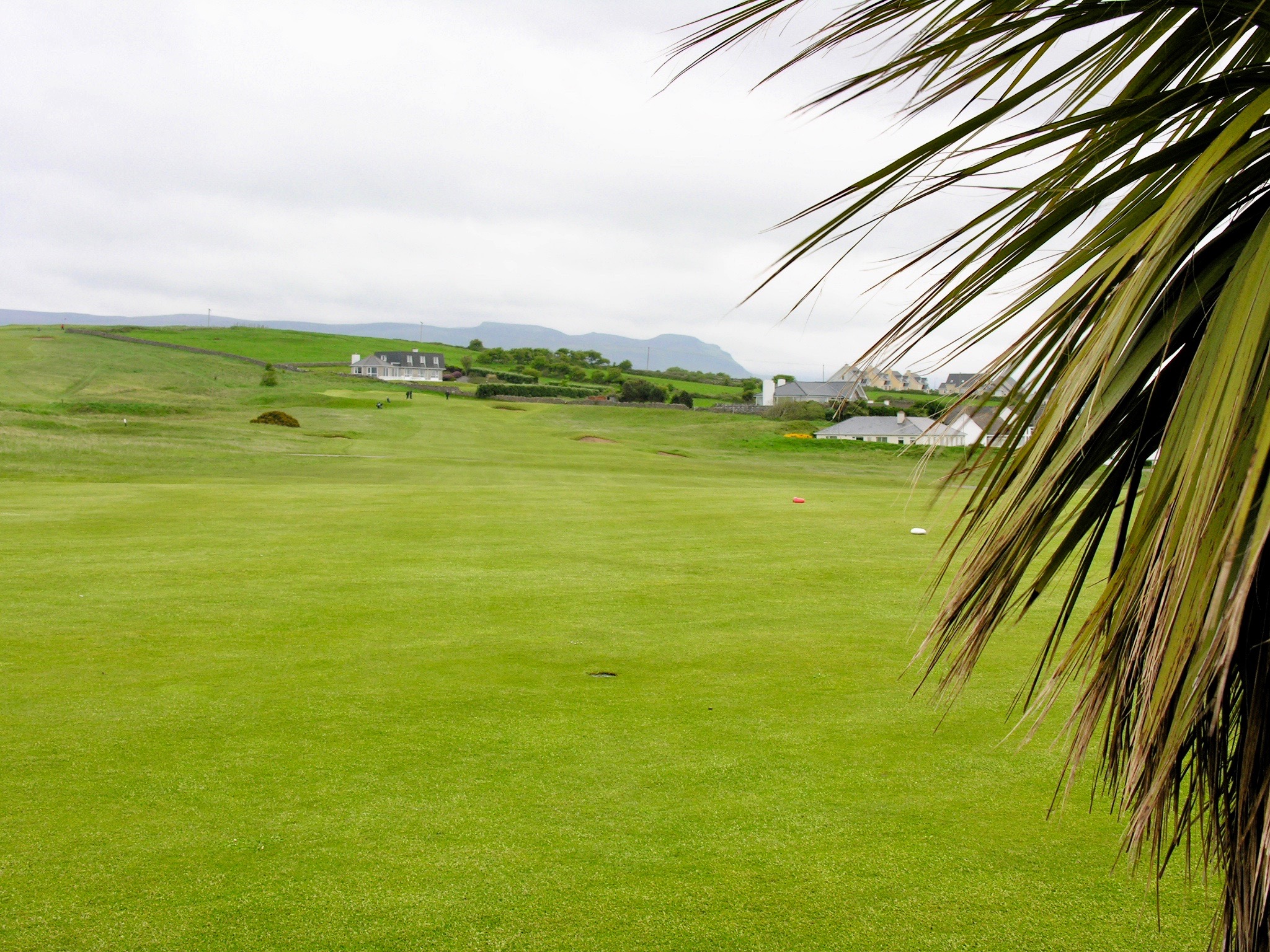


When we arrived at the course the staff was ready for us—we had booked ahead, they knew we were writing about the course, greens fees and trolleys were comped. With the forecast for increasing rain and wind during the day, we were eager to get out onto the course.  And it was a good thing we got out early:


 it was cloudy and calm for the first six holes, 7 though 12 we played in misty showers, on 13 and 14 the wind and rain picked up, by 15 and 16 the rain was steady, and we played 17 and 18 in a downpour with gale winds. Despite the conditions later in our round, we loved Rosses Point. It’s a grand links course surrounded on three sides by water (bay and sea) with mountains on the fourth side.  Views on the course were lovely, especially early in the round from the hills and of the lighthouse in the middle of the round.
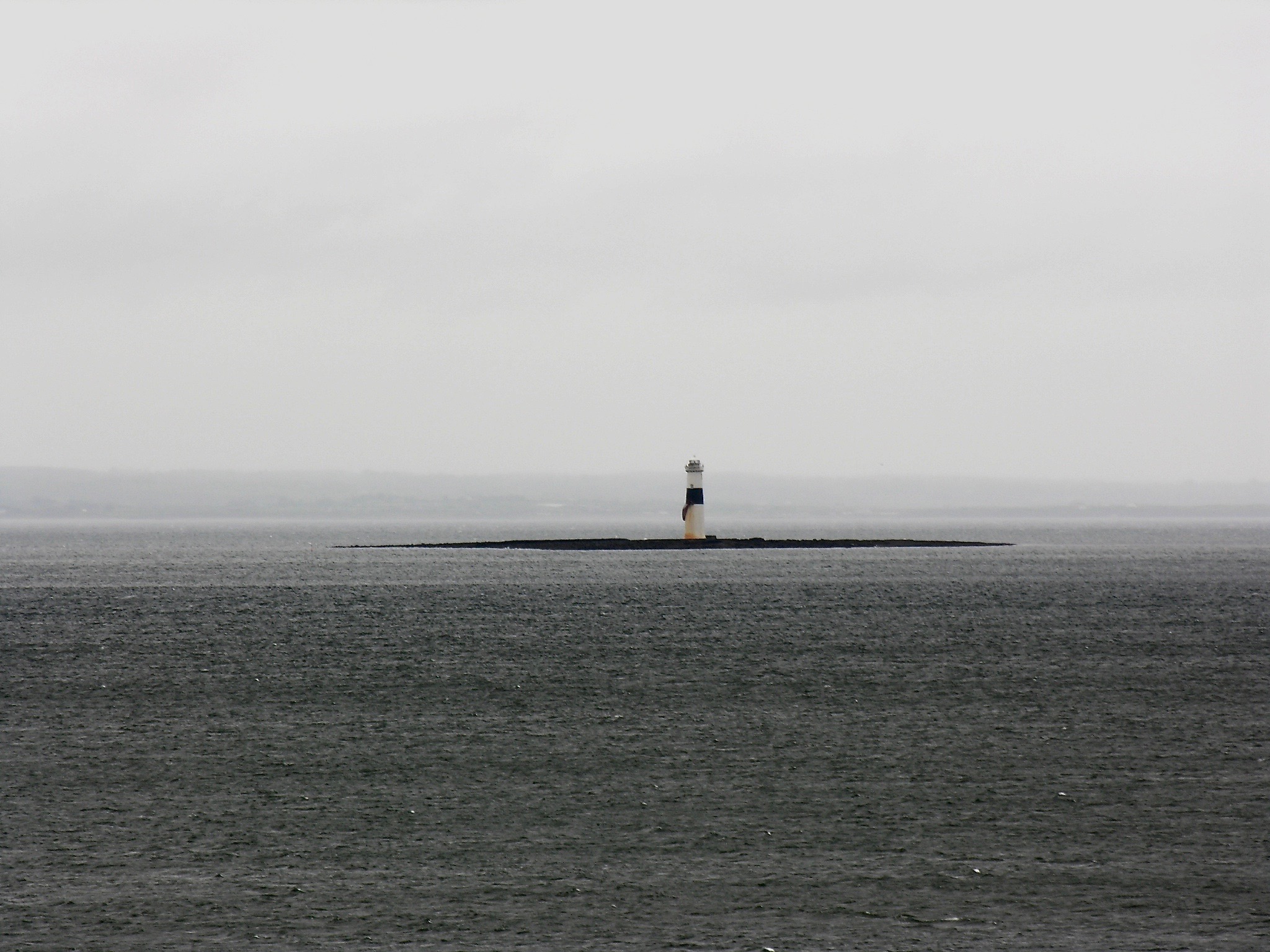
Rosses Point Lighthouse


After our round we put our dripping coats and clubs in the car and went into the clubhouse for a dry-out and some lunch (on the club). We were hosted by the Ladies’ Captain and several members. One older gentleman seeing Anne’s wet and windblown hair asked if she played the course today (it was a real storm outside now). She said that she’d played, and he responded with, “You know, they have a pill for that!” We spent much of the afternoon in the club’s lounge visiting with friendly members.

Back at our lodgings (Mountain Inn is a B&B, pub, convenience store, and petrol station) the first job was to lay out all our wet things—clothes, golf bag, clubs, shoes—so they’d be dry for golf tomorrow. With barely any room left to move, we went downstairs to the pub which only serves dinners to guests of the inn and we had had to order earlier. Although, while eating we saw staff serve dinner to a couple of locals—aren’t rules meant to be broken. After a decent pub dinner (omelette for me, fried scampi for Anne) we stayed in the bar for some serious drinking; a whole pint of Guinness istread of a half. We stayed in the pub for a couple of hours and engaged in some good craic with the locals. The big topic of discussion was how to make the best hot toddy for a cold or just a cold night. 


Sitting in front of the smokey peat fire several interesting ideas came forth. One of the most interesting was to take a small shot of whiskey in your mouth and then sip some hot water and let the whiskey explode in your mouth. Another that I noted was to take a hot fire poker and stick it in a glass of Guinness, then drink it (be sure to take the poker out of the glass first). 


Liam and Mary, the inn’s proprietors, made sure the fire was stoked and the glasses filled. We also learned that there are different kinds of peat—brown peat is wetter and better for smoking things, black peat burns hotter and is better for heating. We eventually trundled up to our damp room and went to bed.

Another full great day in Ireland.


NEXT: most probably a report from Las Vegas


Monday, February 15, 2021

Scottish and Welsh Golf and the World at War, Part 2


This is the second part of the story. For the first part, see the previous post.


Scotland and Wales’ golf courses and clubs suffered tremendous financial loses during the war years. With so many golfers enlisted in the military, club membership took a big hit. North Berwick West’s membership was reduced from 87 members in 1940 to 35 in 1945. On Isle Arran, Shiskine’s membership dropped from 112 to 48. Memberships were so depleted that at Blairgowrie GC in 1917 no quorum showed up for the annual meeting. Even worse, at Kinghorn GC on Fife, the club couldn’t muster a quorum for a club meeting to disband the club. Records for the Aberfoyle GC show that for one five-week stretch in 1917,

Aberfoyle GC was pretty empty this day as well.


 only one person had used the course. Along with a reduction of membership, of course, came a reduction in financial resources which threatened the continued existence of clubs like Kingussie GC in the Highlands. The Bangor GC in Wales was a unique case. 

St Dieniol GC, Bangor, Wales


At the beginning of the First World War club members felt the war would be a short engagement and went ahead with plans to build a new clubhouse. As the war dragged on and prices rose dramatically, financial disaster was imminent. The club declared bankruptcy in 1916. A reorganized St Deiniol GC opened after the war using the same Bangor course.  Further financial damage was done when courses, like Anstruther and Abernethy, completely shut down for the duration of the war. Nine-hole St. Boswell GC in the Borders region of Scotland was closed from 1944 to 1947. Within a year of reopening, the River Tweed flooded the course. It was not rebuilt until 1957. 

Hopeman was one of those courses which only survived by being rebuild after each war.


Although, the St. Boswell course did survive, the ultimate sacrifice was made by many courses whose names are just memories now. Corriecravie on Isle Arran, Acherfield and Fidra in the East Lothians, Falkland in Fife, Longmen in Inverness, Ballinluig and Delvine near Pitlochry, and Penally in south Wales were all closed and never reopened. Sauchhope Links, once a fine Fife golf course, is now a caravan park. Markinch GC reopened for only one year after the war before succumbing to financial pressures. 

For those courses which did survive, some physical scars do remain. The flat holes at Powfoot are one reminder of what war did to golf courses. More dramatic, and of more concern to today’s players, are the remnants of German bombings. Stonehaven GC, south of Aberdeen, has a grass bunker in-play off the left side of the first fairway. The bunker is the result of a bomb dropped in August of 1940, by a German plane heading home from a mission. The hazard is now named, “Hitler’s Bunker.” Powfoot, also, left bomb damage in-play. The ninth hole is called “Crater” after the huge German bomb crater short of the green. Today, that bunker is a reminder of how hard it is to hit that particular green. Anne and I played Buckpool GC on the north coast of Scotland a couple of years after an unexploded ordinance was found near the green on one fairway. 

Buckpool GC now has a new bunker.


The MOD closed the course until they could explode the bomb. The course now has a new bunker more than 60 years in the making. 

The flax mounding gives golfers interesting shots from Forfar GC's fairways.


The rolling fairways of the first few holes at Forfar GC north of Dundee are the result of using fairways in World War I for drying netted flax. In November 1940 a RAF Spitfire fighter made a forced landing at Canmore GC. The landing and the hauling away of the plane did severe damage which can still be seen to several fairways. Perhaps the most devastation was done to the Cardross GC on the River Clyde north of Glasgow. 

Cardross GC with its rebuilt 18th green and clubhouse.

Cardross GC


On May 6, 1941, the local villages and golf courses were bombed as part of a raid on the Glasgow ship works. While nearby Milngavie GC suffered damage to the 18th fairway and clubhouse, the Cardorss GC clubhouse was destroyed by incendiary devices, fairways and greens were hit several times, and several club members were killed in the blasts. 

Besides playing around the bomb craters, avoiding the mines, and, at Aboyne GC, staying out the rough, which was planted with potatoes, golfers had to contend with other special war situations. Conditioning of the courses was much affected by the war. Many courses had to reduce their number of holes. Royal Dornoch and Boat of Garten both stopped maintenance on their farthest four holes because of a lack of grounds crew. 

Boat of Garden GC in the Highlands


After the MOD took much of the course, the remaining holes at Tenby became almost unplayable as moles and rabbits took over the course. Some courses, like Tulliallan in Scotland and St Deiniol in Wales, were maintained only because members were assigned specific holes to tend. At Panmure GC there weren’t enough members left keep the course playable, 

Panmure GC


but the Royal Scots Regiment stationed at nearby Barry Camp helped groom the course in exchange for free playing privileges.  The most interesting example of course shortening was at Shiskine Golf and Tennis Club on Isle Arran. 

Shiskine GC--4th Green, Drumadoon Point, and the Kilbrannan Sound.


Six of the holes created by Willie Park & Sons, extending the course from nine to 18-holes, were permanently lost during World War I. Because of the lack of maintenance staff, the six Willie Park hill holes built on the side of Drumadoon Point were left to revert to their primitive state of gorse, heather, and bracken. After the war, the club chose not to reclaim the holes. Thus was born the world’s first permanent 12-hole course, a number which many visitors find to be just right. 

Lack of staff and money created other maintenance headaches. For instance, because golf courses were only allotted ten gallons of petrol per month, fairways were seldom cut and rough became very deep. We know conditions for golfers during World War I were tough when Pyle & Kenfig GC (southern Wales) 

Me enjoying Pyle and Kenfig GC's bunkers.


club meeting minutes noted the “admirable sacrifice of the club in giving up bacon and ham” for the duration. The toughness of Scottish and Welsh golfers is not to be doubted. During competitions, or casual rounds, special war rules were in effect. One such rule said: “A player whose stroke is effected by the simultaneous explosion of a bomb or shell, or by machine-gun fire, may play another ball from the same place. Penalty, one stroke.” And another one: “In competitions, during gunfire or whilst bombs are falling, players may take cover without penalty for ceasing play.”

Golf equipment wasn’t left unaffected, either. In the First World War, importing hickory shafts for golf clubs was banned and club heads were often melted down for their metal. Golf balls became as valuable as gold to golfers. Since all rubber was needed for war related uses, new balls had almost disappeared by 1940. Players used balls until they were beaten, battered, and broken; then they were repainted and used some more. To lose a golf ball, even in thick gorse, was a crime. Searching for an hour or more was not unheard of in pursuit of a lost, playable ball. At Blairgowrie GC 

Blairgowrie Rosemount GC


two Glasgow Highlanders stationed nearby, stripped to the buff (in other words, took off their kilts) and waded into the Black Loch (part of the course) to look for lost balls which were then out of production. “They found them not by the scores, but by the hundreds.” [Cub Centenary Book] These were sold to local shopkeepers to resell. In one case early in the war years, a competition was held with a fresh turkey as first prize and six new Dunlop 65 balls as second prize. Everyone played for second! 

During the war years, competitions became rarer or nonexistent. The Ryder Cup became the first victim of the Second World War when the 1939 matches in the US were canceled. The competitive spirit wasn’t dimmed, however, as shown by the Secretary of the British PGA’s cable to America: “When we have settled our differences and peace reigns, we will see that our team comes across to remove the Ryder Cup from your safekeeping.” The venerated Open Championship was suspended from 1940 to 1945, as it had been during the war years of 1915 to 1919. Those local competitions which were held, were often changed. The women’s competitions at Grantown-on- Spey, for instance, donated all entry fees to the local Red Cross. There were also many examples of professional and amateur golfers playing exhibitions to raise money for the war effort. In World War I, American superstar Bobby Jones (then only 16) played a match at North Berwick to raise money for the Red Cross. English professional Henry Cotton at about the same time played a match at Dumfries & County GC which raised £150 for the war effort—a small fortune for those days.

Not everything that happened as a result of the wars had a negative impact on the game. The war years brought more women to golf. They played more and their club status often changed from associate members to full members. One of the most dramatic changes to the game, which most would call positive, started at Powfoot GC in southern Scotland. 

Powfoot GC


The Sabbatarian tradition of no golf on Sunday was well entrenched in Scotland and Wales prior to 1914. Because of the war, Powfoot granted workers at the munition factory in nearby Gretna the right to play for free on their only day off--Sunday. Powfoot GC was one of the first to end Scotland’s Sabbaterian tradition, but other clubs in the area followed suit and the Sunday ban slowly lifted. Examples of financial gain by clubs during the war years are difficult to find, though some do exist. A prime example is St Deiniol GC (former Bangor GC) which went bankrupt in 1916. 

Anne tees off at St Denial GC overlooking Bangor, Wales.


During the second war the club profited from the large numbers of evacuees from London who moved to safer Wales. When the BBC offices were relocated to Bangor, alcohol sales in the clubhouse increased dramatically with, according to club minutes,  “bar receipts in one of the war years touching a new high record level.”

It is said that in war there are no winners, only survivors. Golf in Scotland and Wales, for the most part, proved itself a survivor. As we play one of our favorite courses in the world, Shiskine Golf and Tennis Club, we marvel that its unique twelve hole layout is the result of a War-to-End-All-War. 


NEXT: We visit England and the Cotsolds, in Better Days

Monday, February 1, 2021

Golf and the World at War


I’ve been working on this project for several years, using golf history books, personal interviews with golf course managers and historians, and special golf club centenary or anniversary publications. Part of my Scottish material used here was previously published in Highlander Magazine (May/June, 2006).


Scottish and Welsh Golf and the World at War  

War and golf in Scotland and Wales are not inextricably linked, but their paths have crossed several times. One of the very earliest records for “gowf” was King James II’s decree in 1457 to ban the game, so that soldiers and noblemen would spend more time practicing archery to better defend the homeland against English invasion. James III and IV convinced their parliaments to affirm that ban. 

Though that ban was unenforceable, the most important connections were forged during the two World Wars, 1914 to 1919 and 1939 to 1945. These were times of extreme crisis, in which the game of golf was but one of the victims. Golf courses suffered the ravages of war through damages to courses and club finances. At the same time, golfers incurred losses to their own games. 

Anne and I became aware of the golf-war relationship as we played courses with town or parish monuments to those lost in the War-to-End-All-Wars (the names of locals who gave their lives in other wars have been added to many of the monuments). Maybole Golf Club in Ayrshire has such a monument beside the sixth green. 

Maybole GC, Ayrshire, Scotland


Also in Ayrshire, Turnberry displays a monument just to the right of the twelfth hole. While other courses, such as Anstruther on Fife and Bucky Strathlene on the Moray coast, have monuments near greens or tees, Abernethy GC in Nethy Bridge (Highlands) has a monument in-play on the eighth hole. 

Abernethy GC, Nethy Bridge, Highlands


Knowledgeable golfers aim to the left of the monument to find the fairway on this blind par-four. The Birnam War Memorial was a special case. The old Birnam course closed and was sold in 1920 because without transportation nearby it was too far out for players to get to. Some money from the sale of the course was used to build a war memorial and stone from the new Birnam & Dunkeld course was used in the memorial. Whereas monuments, whether in-play or not, are reminders of the casualties of war, golf courses were themselves casualties. 

During both world wars, the MOD (Ministry of Defense) needed golf course land for its own purposes. In 1914 the Old Birnam and Dunkeld course along Scotland’s River Tay was dug up in practice trench digging exercises. The  course didn’t reopen until 1927 in a new location. At Tenby in southwest Wales the defense demands started early. The MOD made a compulsory buy of four holes of land for a training facility early in the century, and then demanded a further two holes in World War I. The course never did get any of the land back, and today Tenby still has a target range next to several of the beginning holes. Local defense volunteer forces used Southerndown GC in southern Wales for training and gunnery practice during the Great War. The west end of North Berwick West Links was used for RAF (Royal Air Force) target practice, and weapons pits and defensive bunkers were built along the sea edge of the course. Also just off the seaward edge of the course, the MOD anchored the HMS Ludlow which was then used as a target for bombing practice. Numerous courses, including Boat of Garden, 

Boat of Garden GC, Highlands


Cardross, and Banchory, were used by the Home Guard for training. 

In World War II Aberdour GC in Scotland became home to Heavy “A” Batteries (air defense), 

Aberdour GC, Firth of Forth, Fife


while nearby Balbirnie Park GC was heavily damaged by placement of ack-ack guns and search lights. Trenches, barbed-wire, and mines were placed on many seaside links courses such as Crail Balcomie, 

Crail Balcomie Links, Fife Ness


Elie, Dunbar, and Peterhead. On the seaward side of Leven Golf Links in Fife you can still see the cement blocks used as tank traps in the Second World War. At Tenby, the dunes on the seaward side of the fairways were fenced and mined. Much of Royal St David’s GC, sited just below impressive Harlech Castle on Wales’ west coast, was torn up as a training ground for tank drivers. Not far away,  Pwllheli GC didn’t suffer as much damage because it was only used as a local officers’ training facility. Golfers at Fraserbugh GC in northeast Scotland continued to play around large poles placed in fairways to thwart enemy glider landings. At St Deiniol GC in Bangor, Wales, the same type anti-glider poles were placed on fairways, which seemed to us a silly decision because when we played the hillside course we couldn’t find a level enough place to land a golf ball, let alone a troop carrying glider. It was the RAF which exacted the biggest toll when it dug up historic Turnberry 

Turnberry GC, Lighthouse, Ailsa Craig, and the North Irish Channel


and the Ladies’ Course at Dornoch to build areodromes or landing fields. 

Golf course land was also in heavy demand for food production. Victory or Friendship Gardens were integral to the domestic war effort. Duff House Royal on Scotland’s Morayshire coast was ploughed up twice, once for each war, and rebuilt twice, as was Hopeman GC to the west. 

Hopeman GC, Morayshire, Scotland


The original course at Portfield Racecoiurse in Haverfordwest (southern Wales) was ploughed up for corn fields in World War I. Haverfordwest GC opened after the war in a new location. In World War II Balfron GC near Loch Lomand was ploughed up for agricultural use. Not much information remains about the old course, but a couple of old trophies turned up recently in a local bank attic.  

Monument at Kirriemuir GC, Angus, Scotland


Powfoot GC on the Solway Firth lost five holes to the plough (today, those rebuilt holes are still the flattest on the course), 

Canmore GC, near Dunfermline


while Canmore GC near Dunfermline lost more land which led to a complete redesign of the course in 1946. In World War I Pwllheli was reduced to nine holes, while the 9th and 10th holes at Baberton in Edinburgh became known as Baberton’s Potato Patch. Many courses, such as Shiskine, 

Third Hole, Shiskine GC, Isle of Arran


Kinghorn, Muirfield, and Aboyne, avoided the plough, but were used to graze sheep and cattle. At the difficult Cruden Bay GC near Aberdeen it is said that the sheep toughened the course even more by enlarging the bunkers. At Panmure GC on Scotland’s east coast, local authorities during the First World War demanded that the course be opened for sheep grazing until the shepherd reported his sheep were starving because of the sparse grass on the links course. In the next war the experiment was tried again with the same results. Panmure is a great links course, but what is good for a long drive isn’t necessarily good for little lambs. 

It fits with Sir Winston Churchill’s words to Hitler, “You can do your worst, and we will do our best” that clubhouses and other golf course buildings found uses in the war effort, as well. Troops were billeted at Boat of Garten, Royal Troon, Alloa, and Lundin Ladies’ Links 

4000 Year Old Standing Stones on the 2nd hole at Lundin Ladies' GC, Fife


(the only time men have been allowed in that clubhouse). At Aberdour on Fife the Polish armed forces billeted from 1942 until 1947 when the clubhouse was given back to the club.  The experience at Panmure was typical of most courses. Even though more than 100 soldiers were billeted for much of the second war, the clubhouse was returned to the club in pristine condition. Not so at Crieff GC in central Scotland. When the MOD took over the Crieff Clubhouse, the club moved its historical records to an equipment shed. 

Small 3000 Year Old Stone Circle on Crieff GC, Central Scotland


Those records were lost when the shed was destroyed in an accidental fire caused by troops staying there. Part of the opulent Gleneagles Resort Hotel, the host club for the 2014 Ryder Cup competition, became the headquarters for Tom Johnston, Scotland’s Secretary of State, and the rest of the hotel served as a convalescent hospital. In 1944, 

Gleneagles Queen's Course, Central Scotland


Southerndown GC in Wales became a safe haven from Hitler’s V1 and V2 rocket attacks for more than 100 mothers and children from the east coast of England. The club’s lounge became a dormitory and the good weather that summer allowed the children acres and acres of playground complete with natural sandboxes.


Next: Second half of the project.