Friday, November 11, 2011

A Dying Fascination

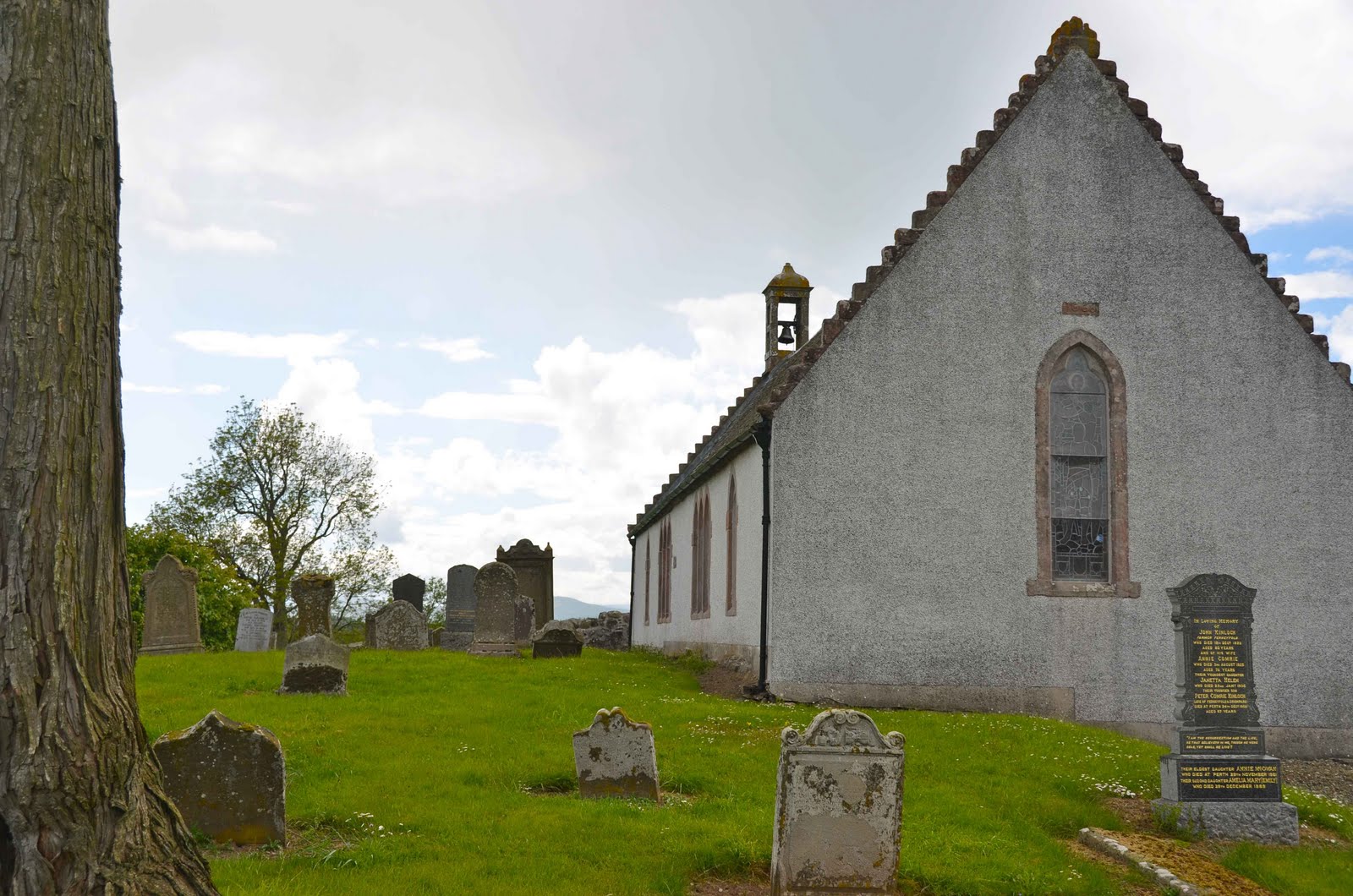
Before we left on our latest Scotland adventure, September and October, I wrote that one of my preoccupations on the trip would be to visit bone factories (aka graveyards) in Scotland looking for interesting stone carving on gravestones.  Over the six week trip I dragged Anne tombstone hunting in Edinburgh, Peebles, Pitlochry, Muthill, Comrie, Stirling, Perth, Dufftown, Elgin, Duffus, Dunfermline, Amulree, Meigle, Kirkwall (Orkney), St Andrews, several others in Scotland and England, and Dull.  Yes, there is an actual village in Scotland named Dull, and the church there and pictish standing stone were anything but dull.  In our visits to the cemeteries and church or kirk graveyards I discovered much more than I thought I would.  With the help of three credible resources (Understanding Scottish Graveyards by Willsher, A Scottish Graveyard Miscellany by Brown, and How to Read a Church by Taylor) I’ll share some of my findings.
First, graveyards are fascinating on several levels.  Artistically cemeteries and graveyards can be a photographer’s wonderland of designs and patterns.  Without getting into the details of the stones and carvings, the patterns of shapes and light can let the imagination loose.  I like the lines and arrangements of stones as well the way stones fit into backgrounds.  Here are several examples of patterns we’ve found in graveyards in Scotland:
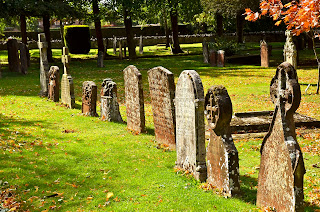

This interesting line of tombstones is in front of the Stratford-Upon-Avon Parish Church.

At Tullich Kirk near Ballater the stone crosses blend into the background stone building,

and at the parish church in Aboyne in Aberdeenshire the crosses dominate.
Several places we’ve found that toppled stones create striking images, such as these at Muthill,

and this toppled cross at Coull Kirk (Aberdeenshire),


and the leaning cross at Dull.

Another pattern that appears as you wander through the grave stones is the interplay of vegetation and the stones.  Over the years ivies and mosses, as well as larger plants, have grown over, around, and on top of the stone monuments.  At the Orphir Round Kirk on Mainland Orkney in the far north we saw these grave markers being swallowed by the bushes, 

while at Mortlach Church in Dufftown a tombstone seems to slice through a bush. 

At Dunphail Church on the way to Forres from Grantown-on-Spey the grave marker wears a quite bushy coiffure, 


and the coffin-shaped tomb at Wroxton, England, has a mop do which would make any Beatle proud. 
In the graves of the ruined St Peter’s Kirk near Duffus the moss is replacing the writing on one stone.
Another aspect of church graveyards I find interesting is the historical element beyond the graves themselves.  For instance, in the Peebles parish churchyard is an example of a Scottish Watchtower.  

A watchtower is a tall structure built so that curators could keep a watch over the fresh graves to thwart would-be grave robbers who liked to dig up freshly buried bodies to sell to doctors and universities for anatomical study.  Look into the history of Williams Burke and Hare, known as the West Port murderers, who found it lucrative to not only dig up recent graves, but to dispatch some of the living to provide fresh corpses.  To keep the newly departed safe in their graves some local cemeteries would use cast iron or iron and stone mortsafes to make it difficult to dig up a grave (Logierait near Pitlochry). 
Ancient history, as well, shows up in some kirkyards.  At Midmar Church in Aberdeenshire we saw a neolithic stone circle with the parish cemetery built around it.

On Fife at the Abernethy Church graveyard, next to one of the only two Irish-style round towers extant in Scotland, is a pictish carved stone monument dating back to about the 1100s.  

Now we come to the monuments and their carvings themselves.  I had seen the carvings on tombstones before and even photographed a few, but I really didn’t know what I was photographing.  For instance, I had read or been told (or just made it up and thought I’d read it or been told it) that a skull and crossbones (the pirate flag image) on a tombstone, like the one at Elgin Cathedral, indicated that the departed died of the plague.  

As horrible as the plague was, it sort of made sense.  Too bad it was completely wrong.  I’ll bring up the real meaning of the skull and crossbones later.  One of the first things I learned was about the style of crosses we were seeing.  The empty cross, one with no figure or decoration, symbolizes that an instrument of torture was defeated or that the victim’s soul has been released (Ripon Cathedral, England). 

The crucified Christ cross, of course, is a symbol of resurrection and hope.  Another sign of hope is the Easter cross, one garlanded with flowers (Logierait near Pitlochry).  

One of the most common crosses in Scottish graveyards is some form of Celtic cross or wheel-head cross (Dunphail Church and Fortingall).  


Here the circle is thought to represent the circle of eternity.  It also could simply be the result of the influence of the Celtic-revival period of mid to late-1800s.  Whatever the meaning, the Celtic-style crosses are some of the most beautiful in the churchyards.  
In the next entry, I’ll describe the decorations on the tombstones and their meanings. 

Monday, October 10, 2011

Scotland/England Autumn 2011 Trip Summary

Our autumn trip to Scotland and England is coming to an end.  It’s time for me to review what we’ve done and where we’ve been.  The numbers (and photos) will tell the story:
42 days...
6 in England in four different B&Bs,
4 days in Scotland’s Orkney Islands in two B&Bs,
7 days in Aviemore in the Scottish Highlands (timeshare self-catering),
24 days in Crieff in central Scotland all at Merlindale B&B, and
1 day in Edinburgh at the Airport Hilton.
Our auto was a Vauxhall Astra 1.8 automatic (with really uncomfortable seats).
We put on 3500 miles @ an average of $10.25 per gallon.
Golf:
22 rounds (total of 316 holes)

8 nine-hole rounds
13 eighteen-hole rounds

1 ten-hole round (it’s a long story)
14 different courses all in Scotland
6 parkland courses

3 heath or moorland courses
5 links courses
5 courses new to us and a total of 87-1/2 miles walked on golf courses.
Attractions visited:
15 historic (castles, etc.),
24 religious (cathedrals, abbeys, kirks),

10 shopping or commercial sites,
2 distilleries,

7 nature or gardens, and
  14 ancient (stone circles, cairns, etc.).
Eating out:
15 restaurants,

7 pubs, 
33 tearooms or coffee shops (including Starbucks in St Andrews, Elgin, Edinburgh, Blackford, Stratford upon Avon, Oxford, and 2 on the motorways), and
2 take-aways (fish and chip shops)
Out of all of our touring we have a few “bests” for the trip:
The best golf was at Moray Old GC and at Buckpool GC both on the Moray Firth in the north of Scotland (although golf is always best with our Scottish family John and Jacky).
The best meals were at Anderson’s Restaurant in Boat of Garten, Hess Bank Inn (near Lancaster), Breihz in Perth, and Mario’s Restaurant 27 in Ripon, England.

The best tearooms or coffee shops were Birsay Bay Cafe on Orkney, Betty’s Tearoom in York, the Watermill Bakery in Blair Atholl, and Badger’s Hall  Chipping Campden, England.

Our vote for best attractions go to all the ancient sites on Orkney (specifically Maeshowe Cairn, Skara Brae Village, the Broch of Gurness, and the Stennes Standing Stones), Castle Mey owned by the Queen Mum, Bilbury Village in the Cotswolds, and Branklyn Gardens in Perth.
As you can tell from our list and photos the trip was full with plenty of sunshine, miles an hour of wind, a few buckets full of rain, and tons of good times.  Our golf, whether brilliant or dreadful, was aways interesting and enjoyable.  The food was, with the exception of a weak panini here and there, mostly delicious and plentiful enough that even though our walking shoes got well worn we didn’t lose much weight (Damn!). As we do on each of our trips, we look forward to getting back home to George the Cat with a twinge of regret that we have to leave our second home, Scotland.

Over the next few months I will keep “Have Pen and Camera, Will Travel” updated with accounts from our autumn six weeks in Scotland as well as any new travels.  For now, Slainte!  (“Good Health” in Gaelic)

Photos from Top: Our Vauxhall in the rain, Kenmore GC in Highlands, Harburn GC near Edinburgh, Anne the caddy at Orkney GC, Anne on the links at Moray New GC, club captain at Buckpool GC, Ripon (England) Cathedral, Bell's Distillery tour, Broch of Gurness (Orkney), Badger's Hall at Chipping Campden, Anderson's Restaurant in Boat of Garten, Ring of Brodgar (Orkney), Bilbury Village in the Cotswolds,  lily at Branklyn Garden in Perth,  Castle Mey on the Pentland Firth.

Wednesday, September 28, 2011

The Orkney Trip


In 2009 we took the passenger ferry from John O’Groats to the southern tip of South Ronaldsay in the Orkney Islands.  We then got on a crowded bus for a day trip around four of the Orkney’s 70 plus islands.  We did see several of the main attractions of Orkney, but the bus passed many more with the driver’s comment, “And over there is...”
That one-day excursion was enough to convince us that we wanted to go back and “see” Orkney on our own schedule.  This trip we did just that.

We caught a different ferry, a car ferry, from Scrabster near Thurso on the Scottish mainland for our three day, three night tour of Orkney.  The one and a half hour transit of the Pentland Firth (part of the North Sea) was not an easy trip.  Large westerly swells kept the boat, big enough for 75 cars and several large lorries, rocking the whole way.  Anne, who fancies herself seaworthy, was bothered enough that we spent most of the trip on deck so she could get fresh air.  We docked at Stromness with almost the full day ahead of us.  Over the next two and a half days we managed to see most of the main attractions of Mainland Orkney (the largest and capital island) as well as some sites on other islands.  
The highlights of the tour were the ancient sites on Mainland.  Most fascinating was the 5000 year old village of Skara Brae on the west coast.  The village had been buried for about four thousand years until a strong storm washed away some of the cover in 1850.  Excavations revealed an entire village, including nine dwellings and stone furnishings, set into the ground.  Research revealed Skara Brae village had been continuously inhabited from about 3100 BC to 2500 BC. Tourists now walk above the in-ground dwellings and imagine how early agrarians lived.   


From Skara Brae on the west coast we drove in land to the Neolithic and Bronze Age ceremonial landscape of the Ring of Brodgar, a henge (mound and ditch) and stone circle made up of 36 (out of an original 60) stones as high as twelve feet.  The almost perfect circle 104 meters in diameter is between 4000 and 4500 years old and probably fulfilled a social and ceremonial function possibly associated with the commemoration of the dead. 


Not far from the Ring are the Stones of Stenness, a set of obviously shaped larger stones about 500 years older than the Ring.  At one point these were probably a part of a grand henge or ceremonial enclosure.  

Only a couple of miles by road led us to Maeshowe, the finest chambered tomb in northwest Europe and rivaling the better known Newgrange tomb in the Boyne Valley of Ireland.  The ten-meter long entrance passage (about three and a half foot tall) leads to a five-meter by five-meter chamber about 4.5 meters tall.  This is not a burial chamber for bodies, but rather with its three smaller side rooms a depository for the bones of the deceased.  The main chamber most likely was used also for ceremonial purposes when it was built about 5000 years ago.  

There were many other ancient sites that we visited as we toured around Orkney’s islands (Mainland, Lambs Holm, Burray, and South Ronaldsay), but one modern, if 200 years old can be called modern, site was a special treat. 


Highland Park Distillery, the most northerly of all the 105 whisky distilleries in Scotland, provided an exceptional tour for just the two of us.  Chris, our tour guide, took us through the malting process including drying the malted barley with both peat and coal fires, then to the brewing of the low wines in mash tuns made of Oregon pine, the double distilling into spirit, and finally the storing of the spirit for 12 years in oak casks before bottling it as Highland Park single-malt Scotch whisky.  We’ve been on many distillery tours, but this was one of the best both for its information and for the special dram we got at the end of the tour.
For our stay in Kirkwall, the capital of Orkney, we booked a pleasant B&B, Hildeval House, which had a grand view out to the Bay of Kirkwall and the Wide Firth.  Dinner one night at the Kirkwall Hotel was good pub grub, but we more enjoyed our two dinners  at a local Italian restaurant, Lucano.  We did find an interesting stop for lunch our first day on the islands.  Before walking along the edge of the North Sea at Birsay we followed some little red signs to the Birsay Bay Tearoom literally at the end of the road.


Delicious soup and sandwiches using local produce (some of it grown in the greenhouses next to the tearoom) and a fantastic location overlooking Birsay Bay made the little hut a destination.  
The trip to Orkney, the one we’d been planning for two years, was in most ways as good as we hoped and in some ways better than we had a right to expect.  We got really rained on hard only twice, once on the ten minute walk out to Maeshowe and the other on the first hole of the round we played at the Orkney GC.  The rest of the time the weather, which can be wild even by Scottish standards, was rather pleasant.  The one story we won’t tell in this entry is about the Tomb of the Eagle--you have to ask us about that story.      

Photos from the top: Scrabster Lighthouse, Mainland Orkney, Skara Brae (2), Ring of Brodgar (2), Stones of Stenness, Maeshowe Chambered Cairn, Highland Park Pot Stills, Tour Guide Chris, Birsay Bay Tearoom.

Thursday, September 15, 2011

The Trip to Harburn Golf Club
We had a tee time at 11:30 for Harburn Golf Club in West Lothian southwest of Edinburgh.  The trip from Crieff we figured rightly at an hour and fifteen, so we planned to leave for golf at 9:45 to give us time to check-in and get our kit together.  We were going to Harburn to take them a copy of Hidden Gems II and to play the course a second time.  From Crieff to get to Harburn GC we caught the M9 (motorway) at Greenloaning and headed down through Stirling to where the M9 turns off onto the M9 (it’s a Scottish road thing, see the “Missed Turn” story in our book Ten Years of Travel in Scotland, Ireland, England and Wales).  Then at Exit 4, the Linlithgow exit, the adventure began.  As we came off the M9 we reached the first roundabout (traffic circle) on our way to the hinterlands of West Lothian and the village of West Calder.  From that circle we faced twelve more roundabouts in about nine miles--at Loan, two more between there and Westfield, three more to Windeknowe, a double circle to get under the M8, one at East Whitburn, one at Blackburn, another at Addiewell, and a final one at the village of West Calder.  At the run up to each roundabout Lizzie, our GPS, would say, “In point four miles enter the roundabout and take the third exit to A801...In point four miles enter the roundabout and take the fourth exit to A801...Continue 2.2 miles, then enter roundabout and take the first exit to A801...” and so on.  


After a nice round in the dry (already unusual for this trip) at Harburn we retraced our twelve roundabout trip from Harburn GC to the M9.  Immediately, Lizzie began, “In point four miles enter the roundabout...”  Oh, well, you get the idea.  On the homebound trip we did add a side trip into the Stirling Sainsbury store (large grocery).  That only added eight more mini-roundabouts.  This kind of travel gives new meaning to the phrase, “We played ‘round about Harburn.”  
The Feeling of Autumn in the UK
Sitting in the Red Squirrel Coffee Shop in Crieff doing a little writing (our substitute for a Starbucks fix).  Someone coming in opens the door and a cool chill enters the room with them.  The door closes and the breeze is shut out.  In that instant of coolness, though, the feeling of fall (autumn to the Scots) hits me.  From that point on the sighs of autumn assail the senses.  The B&B is cold at night; it’s jumper (sweater) weather.  On an early morning round at the Crieff Ferntower course we can read the slopes on the greens more easily because of the tracks left by the putts of golfers in front of us.  


The trees, or at least some of them, are turning color so rapidly we can track the change daily.  Woolly Bear caterpillars, brown ones and black ones, march across greens heading to wherever it is Woolly Bears go.  This year with Scotland’s cold and wet summer and the world’s wild weather autumn seems to be in a hurry.  We hope it will slow down enough for us to enjoy it.

Overheard one Scot to another speaking about Hurricane Irene: “I understand they downgraded the storm over New York to a Scottish summer.”
The Moffat Woollen Mill
We’ve stopped a couple of times in the Scottish Borders village of Moffat--once to play golf at their interesting 18-hole course and twice to visit the Moffat Woollen Mill on our way down to England.  We have been totally amazed both times we’ve been to the Mill, a large retail outlet for lambs’ wool, cashmere, outdoor clothing, specialty food, tartans, whisky, and Scottish souvenirs.  They have a coffee shop and, most importantly for travelers, convenient toilets.  What is most amazing though is the amount of business they do on a regular basis.  When we pulled in on our most recent trip down to England the Moffat Woollen Mill parking lot had a couple of dozen passenger cars in the lot and fourteen behemoth 60 to 80 passenger tour buses. 


Inside hundreds of people, many with walkers, were queueing up for the toilets, shouting at each other in the noisy shop, picking through sale bins of jumpers and t-shirts.  Herds of employees were picking up after the throngs of geriatric tourists.  We felt young in comparison to the average age of  the bus occupants.  Bus drivers huddled together smoking in the autumn mist or stationed themselves just inside the door of their bus.  Tour guides were bouncing from one department in the shop to another trying to gather in their charges.  One bus pulled out and two more queued up to get into the lot.  We took our small treasures, a calendar and a couple of postcards, and headed back to the M74 trying not to get squashed by a leaving motorcoach.  What recession?

Sunday, September 4, 2011

Fall Trip to Scotland and England, First Report


We are in Scotland for the 18th time since we retired in 2000 after an uneventful series of flights from Portland (a great airport, by the way) through Minneapolis (quite dirty) to Stiphole in Amsterdam (busy) and on to Edinburgh (small, but homey).  People ask us why we keep going back to Scotland and why we don’t explore other places?  We answer that we fell in love with Scotland in the first few days of the very first trip and it now feels like coming home--in fact, Jacky at our B&B in Crieff always greets us, “Welcome home.”  Some people buy a beach house (at one time we did) or a mountain cabin.  Instead, we adopted a second country.  

 Leaving an Old Pet, Chapter 2
As part of the first entry from our spring trip to Scotland I talked about leaving our cat, George, when we go on trips.  I begin this entry with a revisit to that same commentary. Each time we leave George is harder than the last time because George isn’t getting any younger and at 14 years old we don’t know how many more times we will have George to leave.  This trip we had to make a special point of having a conversation with our cat and house sitter about “what if...”  When we used to have a kennel of Siberian Husky sled dogs and we had to put a dog down we’d always had the rest of the kennel to come back to.  The situation was never easy, but the rest of the dogs made it a little more bearable.  In another situation the night before we flew out to an Ireland trip our cat of the hour, Derek, took suddenly seriously ill.  I rushed him to an after hours Vet clinic and we had to put him down.  Our trip was made sadder by the loss, but we had time to get over it before coming home.  Having to leave a pet (an honored family member) at home is part of the travel experience that is not fun, but it is a part all of us with pets have to cope with.  

This trip in Scotland has an interesting side note relevant to this topic.  It seems that Queenie, the cat of our adopted Scottish family, began sitting outside our room’s door the day before we arrived--she does enjoy coming into our room and sleeping in our suitcase when we’re in residence--I say again, it was the day before we arrived.  The family says she’s done this with no one else.  Is there a “cat hotline” and George told Queenie to take care of his family?  Anne’s napping on her bed as I’m writing this and Queenie is curled up next to her, just like George would be if we were at home.

KFC
Jacky, our B&B host at Merlindale, begged us and begged us to bring her some American KFC.  The Scottish version is only slightly better than rubbish.  For years we joked about flying KFC over to Scotland with us and poisoning the whole family.  Jacky, a le Cordon Bleu trained chef, insisted that it would be perfectly safe, especially if we vacuum packed it.  Two trips ago we finally relented, bought some KFC in Canby, vacuum packed it the night before, and brought it to Scotland in Anne’s carry on.  Jacky was over-the-moon with delight.  She grabbed it, heated it in a very hot oven, and everyone relished the treat of American KFC.  Everyone except Anne and I.  We knew someone had to be well to rush the others to hospital when the food poisoning struck.  Thankfully nobody got even the slightest ill.  The next trip we packaged the KFC, but forgot and left it in the fridge.  We arrived at our Scottish home in the doghouse.  This trip we again brought KFC--six wings and four thighs.  Again no one has gotten sick.  This means we’re now expected to bring KFC on every trip.  We keep wondering how we’ll explain the rather pathetic looking package of vacuum packed wings and thighs to an Immigration and Customs agent.  Honest, sir, it’s just KFC, but no, we won’t eat it.
How do you pack for a long trip?
Anne and I divide the labor (or labour, since I’m writing in Scotland): I do most of the planning for our trip and Anne does most of the packing.  I have trouble imagining doing it any other way, but I know that our system would not work for others.  When I concentrate a few possibilities come to mind.  Are you one of these trip packers:
Last Minute Lou who throws everything in the suitcase on the way out the door and hopes she has everything she needs.
Meticulous Martha who makes lists and checks them twice, then checks each item off as it’s packed.  Anne fits here, but adds that each item is in its own plastic baggy--she is single-handedly keeping the Zip Lock company in business.
Triple Packing Teresa who packs, unpacks, packs, unpacks, and packs again.
Frustrated Fiona who stews and frets about each item to be packed--is it the right one, do I really need it, should it be in this bag or that or the carry on, etc.
Notice that none of my classifications are of men packers.  That’s because I think most of us males are spatially challenged--I have enough trouble getting my briefcase and camera case packed that I’m glad to leave the packing decisions to my Meticulous Martha.

Think on This: The less you know, the more you believe.
Next for Us: Four days of golf in the rain and then down to England and the Cotswolds. 
Photos: Anne at PDX, Queenie, Scottish Cemetery Cat, Anne Vegging Out, St Fillans GC 3rd hole.

Wednesday, August 17, 2011

Travel Planning 102


The first one that we really took note of was probably the one near the sixth tee at Maybole Golf Club in Ayrshire.  After that one we started noticing War Memorials on several golf courses (Turnberry, Strathlene Buckie, Anstruther, Abernethy) and in most villages (Crieff, Muthill, Kenmore, Dornoch, Dunkeld).  

These memorials to parish or village soldiers lost in World War I, II, and other conflicts would make an interesting subject of study for the visitor interested in the historical and sociological aspects of those wars.  They, though, have not yet become a compelling subject for us.  As we return again to Scotland for our 18th time in eleven years I find that I do seek out special topics to plan our trip around, sometimes with Anne’s active encouragement and other times with her reluctant consent.  Other travelers may have no need of special subjects as they explore one new place after another, as we did when we traveled to Alaska on our first cruise or took a road trip to Banff National Park in Canada.  Yet as we try to explore Scotland in depth, special topics to research or study help focus our travel days.
We’ve had a variety of topics which have directed our trips over the past few years including castles, religious structures, standing stones or stone circles, waterfalls, gardens, and, of course, distilleries.  

 It would be quite easy to build several trips around exploring Scotland’s castles--lived in, ruins, great houses.  In fact, in the northeast of Scotland there is a designated “Castle Trail,” which includes Drum, Crathes, Kildrummy, Fyvie, Huntly, and others.  In the Ayrshire area on the west coast are the great castles of Dean and Culzean (cul-een) with its apartments on the upper floors dedicated the President Dwight D. Eisenhower for his services in World War II.  
The Borders area in the southeast may not be rich in castles, although Floors Castle is nice to tour, but it has a wealth of abbeys to tour.  Melrose, Jedburgh, Dryburgh, and Kelso abbeys are individually fascinating, but as a group only a few miles apart these David I structures are phenomenal.  The ruins of St Andrews Cathedral and St Rule’s Tower just blocks away from the ruined St Andrews Castle in the golfing mecca of St Andrews are not to be missed.  Glasgow has its impressive Cathedral and Edinburgh has St Giles on the Royal Mile.  As impressive as these are, we enjoy visiting the smaller (a relative term) cathedrals at Dunblane, Dunkeld, Dunfermline, Dornoch, and
St Magnus in Kirkwall on the Orkney Islands. 

Books such as The Explorer’s Guide to Abbeys, Monasteries and Churches of Great Britain by Frank Bottomly (Avenel Books, 1981) and The Ancient Stones of Scotland by W. Douglas Simpson (Robert Hale, 1968) have helped direct our explorations.  
In the last couple of years we’ve used local booklets or guides, such as Stone Circles and Standing Stones of Perthshire by David Watson (Simple Guides, 2006) and The Stones of Strathearn by Andrew Finlayson (One Tree Island, 2010), to direct our searches for these very ancient monuments.  I pick up the guide on one trip and then use it to plan the next trip or a portion of it.  Last fall I picked up A Cycle of Saints: The Medieval Chapels of Strathearn by Perth and Kinross Heritage Trust (2004) and used it to plan our last day of touring on our spring trip--kept us actively touring and close to our home base of Crieff which is in central Strathearn (the valley of the River Earn).  
This brings me to this fall’s quest: Scottish graveyards.  Some might say such a search is a dead end, but then we’d have to punish them for saying that.  From two recently acquired books from Amazon, A Scottish Graveyard Miscellany by Hamish Brown ( Birlinn, 2008) and Understanding Scottish Graveyards by Betty Willsher (Canongate Press, 2006), I have convinced a reluctant Anne to join me in searching through interesting Scottish graveyards for folk art carved on the gravestones. 

We’ve seen and I’ve photographed some picturesque carvings on gravestones in the past, but now I will seek them out with some ideas about what they mean.  I have in our travel itinerary visits to cemeteries in Muthill, Methven, Perth, and Kinfauns, St Madoes, Logierait, and Tulliallan to look for and photograph stones with carvings of Biblical stories and occupations.  We will still visit or revisit castles, stones circles, gardens, and, of course, distilleries, but will add the new graveyard search to aid our in depth understanding of Scotland. 

Photos in Order: Muthill War Memorial; Ring of Brogar; Culzean Castle; Dunkeld Cathedral; Scottish Medieval Church; Adam & Eve carving.
Look for our blog entries from Scotland soon after we arrive on September 1.