Welcome to the new readers from the OEA conference workshop. Hope you enjoy the journey.
 |
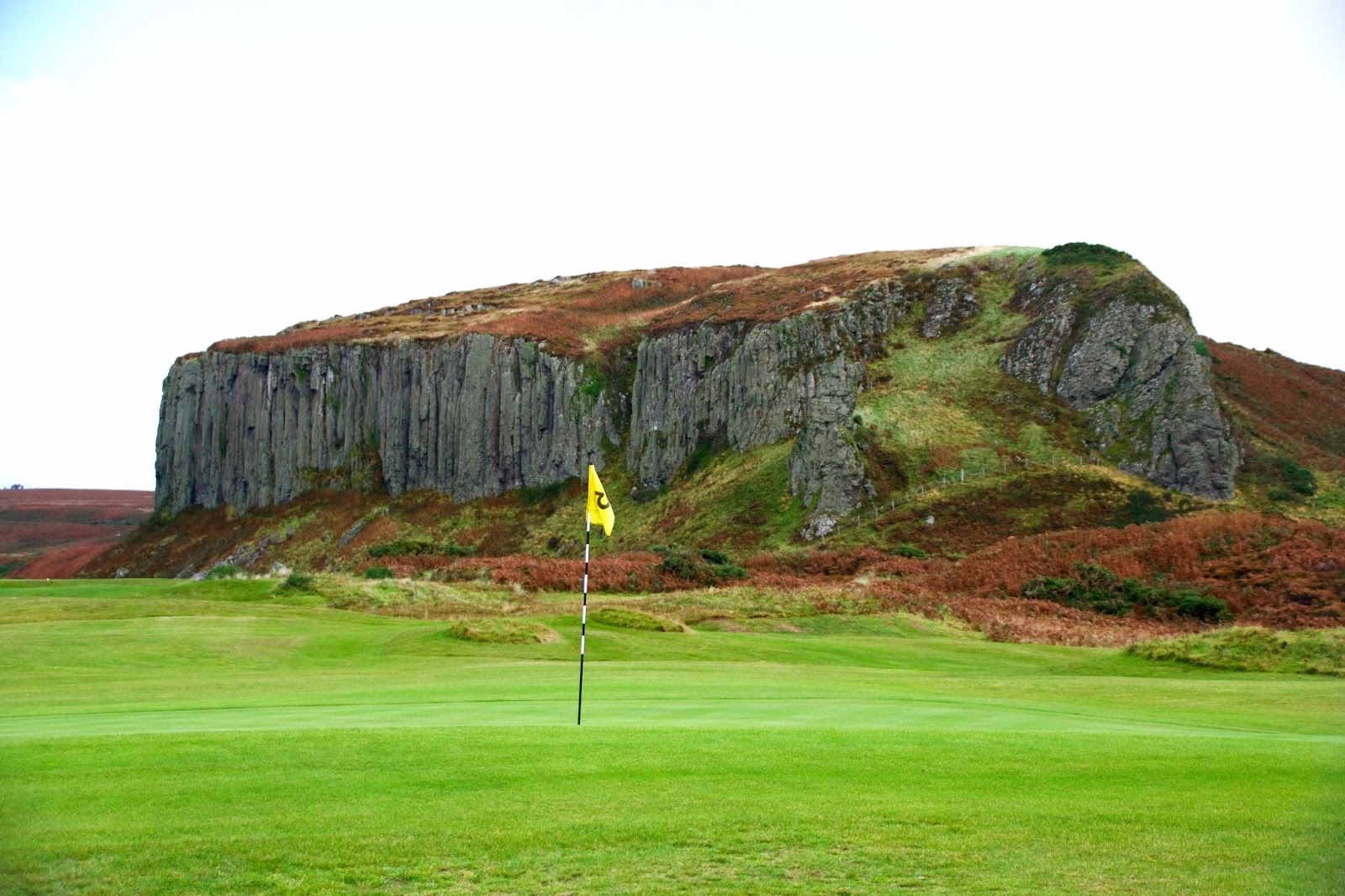
| Picturesque Shiskine Golf Club |
 |
| This is the road that circumnavigates the Isle of Arran. |
An Afternoon in Glasgow
 |
| Glasgow Building Reflections |
Jacky, our Scottish adopted sister, drove, so I got to look at the scenery as Anne, Jacky, and I went into Glasgow (an hour drive) to spend the afternoon with our adopted niece Ailsa, a second year Uni student majoring in Business. We parked at Ailsa’s dorm/apartment and walked the 20 minutes to Glasgow’s vibrant main shopping street Sauchiehall. Starbucks was our first stop—the first Pumpkin Spice latte of the season.
 |
| Ailsa and Jacky on the down escalator. |
Then it was across the Sauchiehall (a pedestrian mall) to the Apple store crowded with hundreds of Glaswegians struggling to get their hands on a new iPhone 7. Is there enough difference to justify the expensive upgrade? It seems there certainly is to many.
 |
| Street People |
 |
| Street Art |
Leaving the throngs to ogle the sparkling 7s, we walked down Sauchiehall to Buchanan Street (still a ped mall) where the ladies shopped at Primark, a clothing discounter. For forty minutes I wandered outside the shop watching a steady stream of customers file empty-handed in and come out with bags of treasure.
At one point, huddled against a display window under a small overhang, I pressed against the glass to avoid being drenched by a quick moving downpour. Anne, Jacky, and Ailsa eventually found their way out after the rain had ended; they were tightly clutching their Primark bargains.
I wasn’t as interested in shopping as I was in eating—it was 5:00 and we hadn’t had but a bite of cheese for lunch. Ailsa promised us good food and great prices at a restaurant in the Italian section of Glasgow only a few blocks away.
She made good on her promise; Amore offered a two-course dinner for £9.95 and my bruschetta and spaghetti with meatballs were quite tasty.
 |
| A Glasgow Selfie. |
 |
| Even the parking garages are well decorated in Glasgow. |
It was a mile walk back to see Ailsa’s apartment and an hour back to Crieff. Glasgow will be on our agenda in future trips—for the shopping, the food, and the people watching.
 |
| Pladda Island off the southern coast of Isle Arran. |
 |
| The mountains of Isle arran from the cross-island String Road. |
Be Careful What You Say…
We were having a cuppa at the Corrie GC tearoom on the Isle of Arran and doing some writing. The tearoom manager was friendly and chatty with those of us in the room. She commented about a group of young people who had just left saying, “They startled me. I hadn’t heard them come in and when I came from the kitchen they were there quietly fiddling with their mobile devices not saying a word. Just think, they’re the ones who will be in charge of us when we’re all in those special homes.”
She notice me writing and asked what I was doing. When I told her that I was working on my notes for the golf guides we write she said, “Oh, I’ve got to watch what I say when I don’t know who’s in the room.” She laughed and went into the kitchen.
 |
| The village of Corrie. |
A couple of minutes later she came out and told us a story of another time she should have held her tongue. She and one of her regulars were talking about fireworks for Hogmanay, the Scottish New Year’s celebration. The customer was bemoaning the fact that you couldn’t bring fireworks over to the island on the Caledonian MacBryne ferries from the mainland. The tearoom manager said loudly enough for the whole room to hear, “I just go over to Ardrossan, buy about £400 of fireworks, cover them with a blanket in the back of my car, and drive right on the ferry—to hell with CalMac rules.” One visitor said sort of quietly to her, “Young lady, you ought to be careful what you say in front of strangers.”
She gasped and said, “Oh my god, you work for Calmac ferries don’t you!”
“Yes, I’m a ship’s Captain.”
She said he wrote down her car registration (license plate number) and that her car now gets regularly checked.
 |
| Island post box or island art? Or both? |
 |
| I found a tiny graveyard off the main road around Arran. When I hiked to the graveyard I found stones commemorating members of Clan MacAlister, which is my clan. Notice the dates -- 1961 and 1783. |
The Stones of Isle Arran
It wasn’t a long drive from our B&B in Lamlash on the Isle of Arran to Brodick and then over the String Road to the small parking lot on the west coast of Arran about three miles north-northeast of Blackwaterfoot. At one end of the ten car lot was a gate with a sign pointing inland to Machrie Moor. Through the gate, Anne and I started the one and a half mile hike that would take us back four or five thousand years.
 |
| The view back down the path to Machrie Moor. |
We started our hike along a well-worn cart track through fields of sheep who weren’t very interested in us, unless we got too close. We passed several small groups of people hiking back to their cars and by the time we reached the first ancient site along the trail, we were alone with the stones.
 |
| The first ancient monument on the way to Machrie Moor is probably a cairn with kerb stones around it. |
Most impressive of all the archeological sites on Arran are Moss Farm Road circle and Machrie Moor which has been called “the best group of architecturally varied circles in western Europe.” The path is a dirt and gravel cart track which climbs gently through pastures to the Moss Farm Road stone circle (labeled “Circle X”). The “circle” is a type of burial cairn which is surrounded by a series of upright stones. Ancient people passing the cairn would have been impressed by the family’s importance shown by building such a fine monument to their dead.
 |
| Moss Farm Circle |
 |
| Old Moss Farm |
Continuing past a couple of significant standing stones we came to the ruins of Moss Farm. Here was the first of six stone circles in the care of Historic Scotland which make up the Machrie Moor stones.
Machrie Moor is an area of approximately five square miles of flat fertile soil called low blanket bog. The name machair means an area of flat sandy land. This had been an important area of human habitation far before the 1800 to 1600 BC date of the stone circles we see today.
 |
| The main stone of Circle No. 2. |
The wide moor hosts numerous prehistoric monuments, tombs, and hut circles besides the six main megalithic stone circles. The moor was abandoned at the end of the Bronze Age (about 2600 years ago) because of climate change and poor farming practices.
 |
| Three stones of another circle on Machrie Moor. |
Of the six circles Circle II contains the largest stones reaching almost 18 feet in height. Circle V, a concentric ring about 60 feet in diameter, is known as Suidhe Choir Fhionn or Fingal’s cauldron seat. Legend says that Fingal, the mythological Scottish giant, tied his dog Bran to a stone in the outer circle while he ate a meal in the inner circle. Circle XI is the most recently excavated being uncovered in 1985-86.
Diggings at the various circles have unearthed a smattering of human remains, arrowheads, a bronze awl, a food container, a beaker, and several flint flakes. The stones may have served a variety of ceremonial and/or astronomical purposes. Archeologist John Barnatt suggested in 1978 that the circles aligned with a notch of the Machrie glen skyline and that the notch is split by the rising sun on Midsummer’s Morn.
 |
| The view back at the parking lot for Machrie Moor. |
Anne and I noticed an interesting juxtaposition on the moor—the contrast of viewing the crumbling ruin of Moss Farm, probably only 200 to 300 years old, and the permanence of the stones placed there by primitive people more than 4000 years ago. As we walked back to our car we again passed small groups, this time heading up to view the stones. It was nice to have had the moor to ourselves at least for a little while.
 |
| The Birks (birches) of Aberfeldy |
 |
| A fitting good-bye to Scotland from our home course at St Fillans. |