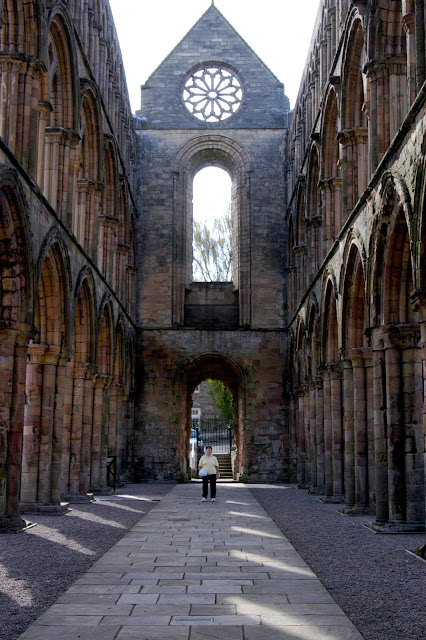
On our first trip to Scotland in the fall of 2000, we joined the Historic Scotland National Trust. Within two years I had written and sold two articles to Historic Scotland magazine—“Old Tom Morris: A National Treasure” about a major Scottish golf figure whose grave is featured in St Andrews Cathedral under the care of Historic Scotland, and “Mark of the Mason” about the identity marks masons left in castles, churches, abbeys and other buildings protected by Historic Scotland. While waiting to see these articles in print, the editor of Historic Scotland emailed an offer to me. In the fall of 2003, I met with Joanne Morrison in the Edinburgh offices of Historic Scotland to finalize my position as guest columnist in the magazine and to give me specific assignments. Not wanting to drive in a large confusing city (remember in Scotland they drive on the other side) we rode the train from Dunblane to Waverly station in Edinburgh and then got a cab to Historic Scotland offices near Leith. At our meeting we agreed on a series of assignments for me to be accomplished over the next few trips to Scotland.
The assignments included Historic Scotland properties reached by small ferries, properties with tearooms of note, properties with award winning gardens, industrial sites under care of Historic Scotland, and properties with the best views. These are the assignments to be worked on, but the one that needed to be completed on our spring 2004 trip was “The Stones of Isle Arran,” a guide to ancient Historic Scotland properties on the Isle of Arran in the Kilbrannan Sound off the Ayrshire coast. This was to be the lead article in fall 2004 issue.
This sets the scene for our fifth trip to Scotland in April and May (five weeks) in 2004. On this trip we played plenty of golf and did necessary sightseeing as we neared our finish to our first golf guide, Scotland’s Hidden Gems: Golf Courses and Pubs, published in February, 2005. But spring 2004 was the first trip we planned with writing for Historic Scotland in mind. This blog post tells and shows a little of the story of that writing trip.
The trip begins as almost all of our subsequent trips did in our home base of Crieff in Central Scotland.
 |
| Crieff in Early Morning Light |
After a few days we headed southeast to the Borders region, then west to Isle Arran, north to the highlands, and back to Crieff for the last two and a half weeks. But our writing story really begins on Arran.
The Stones of Arran
 |
| View of Holy Isle and Lamlash Bay from our B&B on Arran--Lilybank in Lamlash. |
The article on the stones found on Isle Arran in the Kilbrannon Sound between Ayrshire and Kintyre Peninsula was to include most of the ancient sites on the island under the care of Historic Scotland. These sites included standing stones, burial cairns, stone circles, and even one ancient castle. The main site is called Machrie Moor, an area in the southern uplands of the island containing numerous ancient sites in the region of 3000 years old.
 |
| Moss Farm Road stone circle on the path to Machrie Moor. |
 |
| One of several sets of standing stones on Machrie Moor. |
We had a good day for the mile and half hike to the moor and spent an hour or two exploring the area. While on Arran we also visited Auchagallon stone circle on the west coast (noted for its astronomical alignment)
and Torrylin burial cairn in the south, along with a couple of lesser sites.
The site that didn’t quite fit with the others was Lochranza Castle
—a 13th century tower associated with Stewarts and Hamiltons among others—but it is ancient, made out of stones, and a Historic Scotland site. Morrisaon agreed it fit the article.
 |
| The Main Road around Isle Arran |
Gardens of Historic Scotland
During our spring trip we visited several gardens at Historic Scotland properties. Castles were the predominant locations with our travel itinerary including stops at three iconic Scottish castles. Aberdour Castle on Firth of Forth was our first stop to visit the walled garden.
This castle built in the 12th century is one oldest in Scotland.
 |
| Darlington Castle |
Next we visited the longest herbaceous garden in the world at the medieval fortress of Dirlington Castle in North Berwick. The last castle garden we stopped at was at one of Scotland’s most important sites, Stirling Castle located above the town of Stirling on the volcanic plug called Castle Hill.
Fought over for centuries, it was said that who held Stirling Castle held Scotland. The garden we saw was created by William Watt in 1629. On this trip we also visited the herb garden at Jedburgh Abbey.
The 12th century Augustinian abbey has been in the care of Historic Scotland since 1917. Future trips added more gardens to finish the article.
Industrial Sites of Historic Scotland
This article was not one I proposed, but it turned out to be one of the most interesting. Joanne Morrison suggested several sites (I added more) of industrial interest under the care of Historic Scotland. Many of the places I would never have thought to visit—for instance, I had no idea what a beam engine was or that they even existed—but I found them very interesting when a visited. Without much difficulty we fit three sites into our planned itinerary: the Wanlochead beam engine,
 |
| The Beam Engine is a water powered pump used to pump water out of the lead mines. |
 |
| The village of Wanlockhead is the highest village in Scotland at around 1500 feet in elevation. Notice the sheep in the front yard. |
Bonawe Iron Furnace,
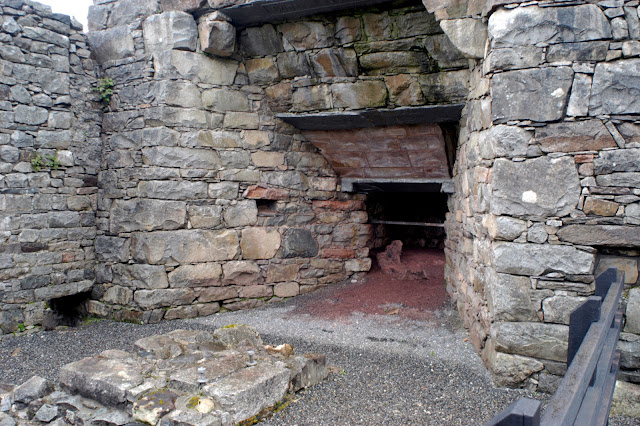 |
| The Bonawe Iron Furnace complex operated in the 18th century and at its height employed 600 people. |
and the New Abbey Corn Mill.
 |
| The corn mill in New Abbey in southern Scotland operates during the summer months. The 18th century mill is located a quarter of a mile from Sweetheart Abbey, another HS site. |
The beam engine visit took us into a little visited area of Scotland we had never thought to visit.
Best Views from Historic Scotland
Editor Joanne Morrison left the selection of best views to my choice as the tourist. There might be some tremendous views that I missed, but Anne and I had a great deal of fun discussing which views to include in this article. On the spring 2004 trip we selected three castle views for the article—Craigmillar Castle,
 |
| Located three miles from the centre of Edinburgh, this 16th century castle has a great view over the capitol city. |
Stirling Castle,
 |
| The view from Stirling Castle includes the Wallace Monument a couple of miles away and the Ochill Hills behind. |
and Tantallon Castle.
 |
| This is the view of Bass Rock you get from the ruins the 14th century Douglas Clan stronghold of Tantallon Castle. |
We also selected two views from ancient sites to be included in the article—Dunadd
 |
| The view from the top of the ruins of Dunadd, at one time capital of the Kingdom of Dal Raise which would one day become Scotland. The hill fort was first occupied in the 600s. |
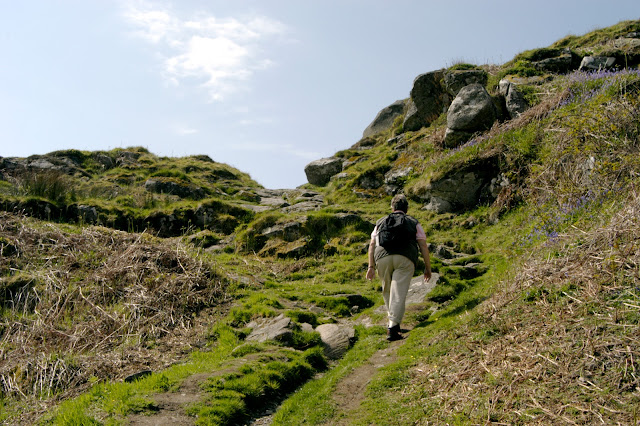 |
| It's a challenging little hike to the top of Dunadd for a couple of older tourists. |
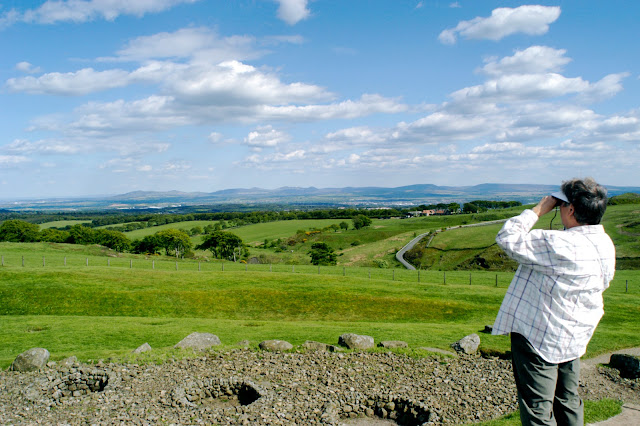
and Cairnpapple Hill.
 |
| The Neolithic Cairnpapple Hill is a burial tomb commanding a spectacular view. From the 1000 foot elevation of the cairn, on a clear day one can see the entire width of Scotland--from North Berick on east coast to Ayrshire on the west, a view of at least 70 miles in all directions. |
Which view would you pick as the best? I’ll let you know our choice at the end of the post.
 |
| Not an Historic Scotland site, but a worthwhile edition to this post is the view of Brig O'Doon in Alloway. The bridge was made famous by the Robert Burns poem "Tam O'Shanter." Oh, and I think it plays some part in a popular musical. |
What is our choice as the best view from Historic Scotland sites? We picked the view from coast to coast we got at Cairpapple Hill Cairn. Note: the second time we visited the hill, it was so foggy we could nae see the cairn from a hundred feet away.